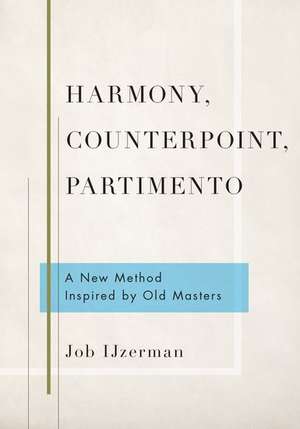
Harmony, Counterpoint, Partimento: A New Method Inspired by Old Masters
Autor Job IJzermanen Limba Engleză Paperback – 24 ian 2019
Preț: 401.49 lei
Preț vechi: 503.23 lei
-20%
Puncte Express: 602
Carte tipărită la comandă
Livrare economică 20 noiembrie-01 decembrie
Livrare express 16-22 octombrie pentru 110.24 lei
Livrare prin curier în România Termenul estimat este afișat lângă disponibilitate.
Transport gratuit pentru acest produs Plată online sau ramburs, în funcție de opțiunile comenzii.
Retur gratuit în 14 zile Comandă securizată și suport în română.
Specificații
ISBN-13: 9780190695019
ISBN-10: 0190695013
Pagini: 416
Ilustrații: 511 line
Dimensiuni: 175 x 251 x 28 mm
Greutate: 0.84 kg
Editura: Oxford University Press
Colecția OUP USA
Locul publicării:New York, United States
ISBN-10: 0190695013
Pagini: 416
Ilustrații: 511 line
Dimensiuni: 175 x 251 x 28 mm
Greutate: 0.84 kg
Editura: Oxford University Press
Colecția OUP USA
Locul publicării:New York, United States
V-ar putea interesa
-
 Stir It Up: Musical Mixes from Roots to JazzGene Santoro-16%Preț: 202.10 lei241.79 lei
 -
 The Beatles as Musicians: Revolver through the AnthologyWalter Everett-12%Preț: 255.67 lei290.25 lei
 -
 -31%Preț: 976.60 lei1423.05 lei
 -
 Inside Bluebeard's Castle: Music and Drama in Béla Bartók's OperaCarl S. Leafstedt-21%Preț: 520.06 lei661.16 lei
 -
 MENC Handbook of Research MethodologiesRichard Colwell-19%Preț: 370.95 lei456.73 lei
 -
 Music in the Galant StyleRobert Gjerdingen-30%Preț: 658.85 lei939.74 lei
 -
 The Musician's Guide to AcousticsMurray Campbell-32%Preț: 877.67 lei1296.39 lei
 -
 Binchois StudiesAndrew Kirkman-32%Preț: 746.39 lei1103.96 lei
 -
 Musical Composition in the Twentieth CenturyArnold Whittall-28%Preț: 520.60 lei725.85 lei
 -
 Beethoven's Anvil: Music in Mind and CultureWilliam L. Benzon-16%Preț: 102.81 lei122.37 lei
 -
 ListeningJean-Luc NancyPreț: 209.78 lei
 -
 How to Understand MusicOscar ThompsonPreț: 314.60 lei
 -
 Preț: 55.17 lei
 -
 Lebendiger KinderchorChristiane WieblitzPreț: 268.08 lei
Recenzii
IJzerman has developed a historically informed approach to eighteenth- and nineteenth-century harmony and counterpoint, one which takes advantage of the old keyboard exercises known as partimenti. The benefits of those lessons are well known, but until now no one had put together a text that adapted them for the modern classroom. IJzerman covers the era from Bach through Brahms, provides a teacher's manual, and an extensive workbook. If you have bright students, this is the text they would want if they had the choice.
Drawing on recent research on partimento and eighteenth-century schemata, IJzerman's Harmony, Counterpoint, Partimento is unlike any other textbook on the market. Its emphasis on the bass line as the driver of harmonic motion is especially praiseworthy.
Drawing on recent research on partimento and eighteenth-century schemata, IJzerman's Harmony, Counterpoint, Partimento is unlike any other textbook on the market. Its emphasis on the bass line as the driver of harmonic motion is especially praiseworthy.
Notă biografică
Job IJzerman has graduated in piano and music theory. He teaches music theory at the Conservatory of Amsterdam. A scholarship granted by the Dutch Department of Education, Culture and Science allowed him to perform research into the field of partimento and schema theory. The textbook Harmony, Counterpoint, Partimento is its final outcome.