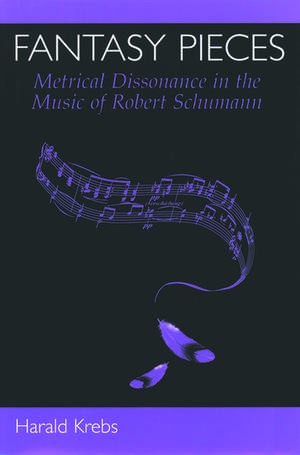
Fantasy Pieces: Metrical Dissonance in the Music of Robert Schumann
Autor Harald Krebsen Limba Engleză Paperback – 11 dec 2003
Preț: 976.60 lei
Preț vechi: 1423.05 lei
-31%
Puncte Express: 1465
Carte tipărită la comandă
Livrare economică 20-25 noiembrie
Livrare prin curier în România Termenul estimat este afișat lângă disponibilitate.
Transport gratuit pentru acest produs Plată online sau ramburs, în funcție de opțiunile comenzii.
Retur gratuit în 14 zile Comandă securizată și suport în română.
Specificații
ISBN-13: 9780195169461
ISBN-10: 0195169468
Pagini: 304
Ilustrații: numerous music examples
Dimensiuni: 152 x 229 x 18 mm
Greutate: 0.45 kg
Editura: Oxford University Press
Colecția OUP USA
Locul publicării:New York, United States
ISBN-10: 0195169468
Pagini: 304
Ilustrații: numerous music examples
Dimensiuni: 152 x 229 x 18 mm
Greutate: 0.45 kg
Editura: Oxford University Press
Colecția OUP USA
Locul publicării:New York, United States
V-ar putea interesa
-
 The Music of BrahmsMichael Musgrave-28%Preț: 408.49 lei567.84 lei
 -
 LisztDerek Watson-29%Preț: 399.53 lei559.23 lei
 -
 Conducting BerliozNorman Del Mar-19%Preț: 470.74 lei581.16 lei
 -
 Tchaikovsky's Last Days: A Documentary StudyAlexander Poznansky-30%Preț: 540.29 lei776.00 lei
 -
 Wagner's Das RheingoldWarren Darcy-28%Preț: 387.10 lei539.02 lei
 -
 Samuel Sebastian Wesley: A LifePeter Horton-28%Preț: 475.34 lei661.33 lei
 -
 DebussyEric Frederick Jensen-20%Preț: 300.42 lei375.55 lei
 -
 -28%Preț: 507.47 lei707.30 lei
 -
 -28%Preț: 394.47 lei548.74 lei
 -
 Rethinking DebussyElliott Antokoletz-25%Preț: 405.25 lei540.69 lei
 -
 -31%Preț: 695.29 lei1008.04 lei
 -
 The Schubert Song CompanionJohn Reed-25%Preț: 268.96 lei358.62 lei
Recenzii
"...[an] excellent book....Krebs unravels the musical subtleties that performers sense but do not always fully understand; performers have much to gain by applying Krebs's analytical approach to their interpretations of Schumann's music....This is analysis at its best: it is sensitively placed in a valid historical context, and solidly based on the real and heard elements in the score. The author supplies ample examples. Highly recommended for upper-level undergraduates through performers."--Choice
"This volume is a welcome contribution to the study of Schumann, especially for those interested in his music, but also for psychologists and others desiring to examine inferentially matters of personality through analysis of original documents."--Perceptual and Motor Skills
"...his accomplishment is no less than an imaginative reconstruction of the creative ferment of composing and theorizing in the early nineteenth century....In the course of such a wide-ranging interpretative journey, one could not ask for a more experienced and sensitive musical guide." --Music Theory Spectrum
"[This] is a very impressive piece of work. Though primarily a theoretical study, it casts its net considerably wider. Krebs is also sensitive to historical issues (precedents for Schumann's metrical style), philological matters (metrical revisions in the primary sources for Schumann's work), questions of performance practice, and even biography (possible relationships between Schumann's metrical techniques and his mental states). In addition, the book is written in an engaging and highly imaginative style."--John Daverio, School for the Arts, Boston University
"This book is a unique contribution to Schumann studies; it should be read by anyone who is seriously interested in Schumann's music."--William Rothstein, Queens College and the Graduate Center, CUNY
"[H]is accomplishment is no less than an imaginative reconstruction of the creative ferment of composing and theorizing in the early nineteenth century...Krebs's literary virtuosity in playing both sides of the fence does not smack of an ideologically loaded postmodernist approach to scholarship...[I]n daring to move creatively beyond the assurances of staid historical scholarship, Krebs also brings to bear a commanding knowledge of the repertoire, illustrated in copious analytical detail...In the course of such a wide-ranging interpretive journey, one could not ask for a more experienced and sensitive musical guide."--Music Theory Spectrum
"This volume is a welcome contribution to the study of Schumann, especially for those interested in his music, but also for psychologists and others desiring to examine inferentially matters of personality through analysis of original documents."--Perceptual and Motor Skills
"...his accomplishment is no less than an imaginative reconstruction of the creative ferment of composing and theorizing in the early nineteenth century....In the course of such a wide-ranging interpretative journey, one could not ask for a more experienced and sensitive musical guide." --Music Theory Spectrum
"[This] is a very impressive piece of work. Though primarily a theoretical study, it casts its net considerably wider. Krebs is also sensitive to historical issues (precedents for Schumann's metrical style), philological matters (metrical revisions in the primary sources for Schumann's work), questions of performance practice, and even biography (possible relationships between Schumann's metrical techniques and his mental states). In addition, the book is written in an engaging and highly imaginative style."--John Daverio, School for the Arts, Boston University
"This book is a unique contribution to Schumann studies; it should be read by anyone who is seriously interested in Schumann's music."--William Rothstein, Queens College and the Graduate Center, CUNY
"[H]is accomplishment is no less than an imaginative reconstruction of the creative ferment of composing and theorizing in the early nineteenth century...Krebs's literary virtuosity in playing both sides of the fence does not smack of an ideologically loaded postmodernist approach to scholarship...[I]n daring to move creatively beyond the assurances of staid historical scholarship, Krebs also brings to bear a commanding knowledge of the repertoire, illustrated in copious analytical detail...In the course of such a wide-ranging interpretive journey, one could not ask for a more experienced and sensitive musical guide."--Music Theory Spectrum
Notă biografică
Harald Krebs holds a Ph.D. in music theory from Yale University. He has taught at the University of British Columbia and the University of Wisconsin-Madison, and is currently professor of music theory at the School of Music of the University of Victoria.