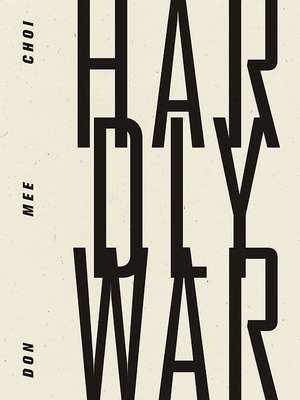
Hardly War
Autor Don Mee Choien Limba Engleză Paperback – 5 apr 2016
În volumul Hardly War, descoperim o explorare viscerală a modului în care istoria oficială și trauma personală se împletesc sub presiunea geopoliticii. Punctul central al acestei colecții îl reprezintă arhiva fotografică a tatălui autoarei, Don Mee Choi, care a documentat războaiele din Coreea și Vietnam. Remarcăm cum aceste artefacte vizuale nu sunt simple ilustrații, ci devin piloni ai unei narațiuni hibride care sfidează genurile literare convenționale, îmbinând poezia cu memoriile și chiar cu elemente de libret de operă. Această abordare fragmentată și experimentală permite autoarei să disece concepte complexe precum identitatea națională și militarismul, transformând „istoria” într-o entitate poetică aproape tangibilă. Hardly War acoperă o arie tematică similară cu Warring Genealogies de Joo Ok Kim, însă acolo unde lucrarea lui Kim analizează critic formarea rudeniilor rasializate prin documente și studii culturale, Don Mee Choi propune o metodă mult mai personală și artistică, filtrată prin memoria familială și metaforă. Poziționată cronologic între debutul său și succesul major DMZ Colony (volum distins cu National Book Award), această lucrare consolidează vocea distinctă a autoarei în literatura contemporană. Dacă în DMZ Colony accentul cade pe vocile și poveștile Coreei de Sud, în Hardly War vedem germenii acestei preocupări pentru istoria violentă, dar sub o formă mai strâns legată de figura paternă și de actul de a privi prin obiectivul camerei foto. Comparativ cu Remembering the Forgotten War de Philip West, care oferă o perspectivă culturală largă asupra dimensiunii umane a conflictului coreean, volumul de față este mai abstract și mai provocator din punct de vedere stilistic, cerând cititorului o implicare activă în descifrarea straturilor de propagandă și discurs militarist.
Preț: 96.21 lei
Carte disponibilă
Livrare economică 02-16 noiembrie
Specificații
ISBN-10: 1940696216
Pagini: 112
Dimensiuni: 169 x 228 x 12 mm
Greutate: 0.22 kg
Editura: Wave Books
V-ar putea interesa
-
 Fire to FireMark DotyPreț: 121.29 lei
 -
 Seven NotebooksCampbell McgrathPreț: 95.56 lei
 -
 Sea ChangeJorie GrahamPreț: 102.80 lei
 -
 The Penguin Book of Japanese VerseAnthony Thwaite-19%Preț: 75.79 lei93.55 lei
 -
 LightheadTerrance HayesPreț: 98.85 lei
 -
 The Major WorksAlexander PopePreț: 75.79 lei
 -
 IdyllsTheocritus-20%Preț: 51.19 lei63.87 lei
 -
 The PoemsPropertius-19%Preț: 52.59 lei64.70 lei
 -
 Love PoemsCarol Ann Duffy DBE-36%Preț: 48.42 lei76.09 lei
 -
 The Less DeceivedPhilip LarkinPreț: 89.48 lei
 -
 The Canterbury TalesGeoffrey ChaucerPreț: 147.84 lei
 -
 On Speaking TermsConnie WanekPreț: 98.35 lei
 -
 BerberMichael Peyron-20%Preț: 38.79 lei48.75 lei
 -
 China: City and ExileAlexander Monro-23%Preț: 36.13 lei46.72 lei
 -
 The Best British Poetry 2011Roddy LumsdenPreț: 96.53 lei
De ce să citești această carte
Recomandăm Hardly War cititorilor interesați de poezia experimentală care nu se teme să abordeze subiecte politice grele. Este o ocazie rară de a vedea cum materialele documentare — fotografiile de război — sunt transformate în artă literară. Cititorul câștigă o perspectivă unică asupra conflictelor asiatice din secolul XX, mediată de o autoare care stăpânește perfect atât arta traducerii, cât și pe cea a compoziției originale.
Descriere scurtă
Like fried potato chips – I believe so,
utterly so – The hush-hush proving
ground was utterly proven as history –
Hardly=History – I believe so, eerily so
– hush hush – Now watch this
performance – Bull's-eye – An uncanny
human understanding on target –
Absolute=History – loaded with
terrifying meaning – The Air Force
doesn't say, hence Ugly=Narration –
Don Mee Choi is the author of The Morning News Is Exciting (Action Books, 2010), and translator of contemporary Korean women poets. She has received a Whiting Writers Award and the 2012 Lucien Stryk Translation Prize. Her translation of Kim Hyesoon's Sorrowtoothpaste Mirrorcream (Action Books, 2014) was a finalist for the 2015 PEN Poetry in Translation Award. She was born in Seoul and came to the United States via Hong Kong. She now lives in Seattle, Washington.
Cuprins
Race=Nation
Photo: Taedong River Bridge & Flight of
Refugees /A Little Glossary
Woe Are You?
6.25
Photo: With her brother on her back/
I refuse to translate
1950 June 28: The Fall of Seoul
Photo: With my brother on my back/
I Was Narrowly Narrator
The Hydrangean Candidate
Photo: August 15, 1948/ A Little Menu
Hydrangea Agenda
Suicide Parade
Photo: There is no sky only visual aid
A Little Confession
Double Hence
Ugly=Nation
Please!
Purely Illustrative
New Tarzon Guided Bomb/Bomb with a Brain
The Tarzon’s Guide to History/Victory=Narration
Photo: Refugee Girl Daisy Girl
I, Lack-a-daisy
Daisy Serenade
Kitty Hawk Postcard
Daddy’s Flower Bed: A Little Chorus
Shitty Kitty
Neocolony’s Colony
Operation Punctum
Hardly Opera
Photos: My Father in Saigon, May 1968/
A Little Paper Closet
Act 1. I was surprised!
Act 2. What’s going on? OK OK
Act 3. Everybody was there
Act 4. U.S. Ambassador’s garden party
First Stage Scene
Second Stage Scene
Act 5. Madam Kim!
Act 6. Pyongyang Excursion 1950
Act 8. Flower of All Flowers
Notes
Acknowledgements
Recenzii
Kathleen Rooney, The New York Times Sunday Book Review
Playful and complex...Choi's poetry operates within a tradition of Korean-American experimental poets that includes Theresa Hak Kyung Cha and Myung Mi Kim. Choi's zany take on militarism and the Korean diaspora may seem absurdist, but it is an inventive and daring waltz that upends what is commonly understood as the 'Forgotten War.'
Publishers Weekly
While imperial history relishes mythmaking and triumphalism at the expense of the human and psychological costs of war, Choi revels in history’s untold spaces.
Lizzie Tribone, BOMB
This book's sort of rogue clarity hinges on the poet's relationship with her father. Essentially, we experience the destabilizing effects of US-ROK entanglement as coherent because this relationship sutures time and space. His award-winning photographs of the war suffuse the pages.
Caitie Moore, The Poetry Project Newsletter