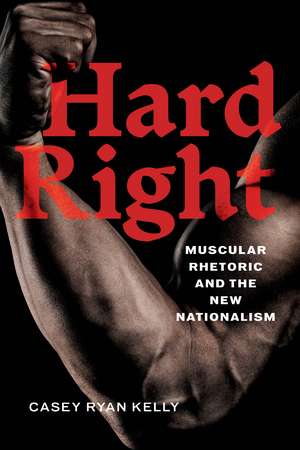
Hard Right: Muscular Rhetoric and the New Nationalism
Autor Casey Ryan Kellyen Limba Engleză Paperback – 19 aug 2026
A groundbreaking examination of far-right rhetoric around fitness and the human body and how such rhetoric serves white nationalist, masculinist aims.
In recent years, far-right, white-nationalist groups in the US have churned out streams of discourse glorifying “muscularity” as the ideal masculine form. This preoccupation with physical fitness—along with expressed fears of declining testosterone levels in men, race-mixing, and transgender women—reveals the masculine bodily fantasies and anxieties that underwrite the political unconscious of the far right. In Hard Right, Casey Ryan Kelly examines the link between extreme fitness culture and fascist organizations, arguing that the human body operates as a privileged signifier of national belonging in the rhetoric of the far right.
Drawing from psychoanalytic theory, Kelly shows that far-right rhetoric constructs fantasies of recovering the “natural” or primal masculine body. These fantasies are frequently accompanied by anxieties about “soft,” disabled, and ambiguously gendered bodies, all of which are seen as signs of degeneracy that must be transformed, exiled, or eradicated for the sake of national and racial health. Through its examination of “Red Pill” fitness influencers, “bro science” conspiracy theories, far-right podcasts, and more, Hard Right ultimately shows how the cultural logics of men’s health and physical fitness converge with the political logics of white nationalism and late fascism.
In recent years, far-right, white-nationalist groups in the US have churned out streams of discourse glorifying “muscularity” as the ideal masculine form. This preoccupation with physical fitness—along with expressed fears of declining testosterone levels in men, race-mixing, and transgender women—reveals the masculine bodily fantasies and anxieties that underwrite the political unconscious of the far right. In Hard Right, Casey Ryan Kelly examines the link between extreme fitness culture and fascist organizations, arguing that the human body operates as a privileged signifier of national belonging in the rhetoric of the far right.
Drawing from psychoanalytic theory, Kelly shows that far-right rhetoric constructs fantasies of recovering the “natural” or primal masculine body. These fantasies are frequently accompanied by anxieties about “soft,” disabled, and ambiguously gendered bodies, all of which are seen as signs of degeneracy that must be transformed, exiled, or eradicated for the sake of national and racial health. Through its examination of “Red Pill” fitness influencers, “bro science” conspiracy theories, far-right podcasts, and more, Hard Right ultimately shows how the cultural logics of men’s health and physical fitness converge with the political logics of white nationalism and late fascism.
Preț: 320.58 lei
Nou
Puncte Express: 481
Comandă specială
Livrare economică 10-16 noiembrie
Livrare prin curier în România Termenul estimat este afișat lângă disponibilitate.
Transport gratuit de la 400.00 lei Plată online sau ramburs, în funcție de opțiunile comenzii.
Retur gratuit în 14 zile Comandă securizată și suport în română.
Specificații
ISBN-13: 9780814259931
ISBN-10: 0814259936
Pagini: 206
Ilustrații: 3 b&w images
Dimensiuni: 152 x 229 x 15 mm
Greutate: 0.29 kg
Editura: Ohio State University Press
Colecția Ohio State University Press
ISBN-10: 0814259936
Pagini: 206
Ilustrații: 3 b&w images
Dimensiuni: 152 x 229 x 15 mm
Greutate: 0.29 kg
Editura: Ohio State University Press
Colecția Ohio State University Press
Recenzii
“Hard Right reveals fresh insights on how masculinity discourses shape who and what is considered valuable. As scholars continue to interrogate the new ways that autocratic and fascist goals gather support, this book makes plain the motivations for those pursuits and how rhetoric facilitates such purposes.” —Leslie A. Hahner, coauthor of Make America Meme Again: The Rhetoric of the Alt-Right
“Kelly writes with coherence and insight on a topic that is both timely and likely to be of enduring interest for many years. Hard Right makes a significant and novel contribution that will be important across multiple audiences.” —Calum L. Matheson, author of Desiring the Bomb: Communication, Psychoanalysis, and the Atomic Age
Notă biografică
Casey Ryan Kelly is Professor of Rhetoric and Public Culture in the Department of Communication Studies at the University of Nebraska–Lincoln. He is the author of five books, including Caught on Tape: White Masculinity and Obscene Enjoyment and Apocalypse Man: The Death Drive and the Rhetoric of White Masculine Victimhood.
Extras
Of course, physical fitness and weight lifting are also increasingly popular activities in the US, which includes everything from CrossFit programs and fitness boot camps to home gyms and personalized workout apps. There are a vast number of different gym subcultures, catering to the lifestyle and aesthetic norms of everyone from gay men and women to the world of amateur and professional bodybuilders. There are even leftist bodybuilding influencers who identify as the “swoletariat” on TikTok, Instagram, YouTube, and Reddit. But the broader patterns of politicized fitness discourse that circulate within the digital ecology of men’s health tend to privilege a right-leaning masculine lifestyle politic. For instance, the Fresh and Fit media empire produces extensive content (podcasts, videos, social media posts, and websites) that links physical fitness with masculine power in sex, dating, and finance. Their daily podcast has also hosted far-right figures such as Candace Owens and white nationalist Nick Fuentes. The growing popularity of MMA and UFC has vaulted to prominence influencers like Andrew Tate—the self-proclaimed “king of toxic masculinity”—who preach a gospel of physical dominance and violent misogyny. Some influencers, such as the infamous “Liver King” (Brian Johnson), advocate a return to strenuous ancestral caveman lifestyles and raw organ meat diets (with Johnson speaking from his 8,300-square-foot mansion, no less). Even simply following these less politically active male fitness influencers—who promote workout routines, supplements, and equipment designed to achieve a muscular aesthetic—inserts users into algorithms that funnel audiences to more extreme far-right content. Presumably, the male fitness algorithm interprets user interest in the lifestyle of fighting, fitness, and weight lifting as potential interest in political content that emphasizes male dominance. In this way, the culture of male fitness can operate as a gateway to something more nefarious than dubious supplements and overpriced workout retreats.
These muscle-bound fantasies are also coupled with profound bodily anxieties. Though sanguine in their beliefs about the biological superiority of white masculinity, many far-right audiences are addled by apocalyptic fears of declining sperm counts and testosterone levels in men, high obesity rates, transgender and gender-nonbinary individuals, drag queens reading books to schoolchildren, and interracial sexuality. In their pursuit of masculine bodily perfection, far-right groups have resurrected eugenics, racist population science, and survival doctrines to support their claims that white civilization is jeopardized by “degeneracy,” or the pollution of white racial stock and bodily capacities by a combination of genetically inferior immigrants, “woke” gender theories, progressive diet trends (such as soy-based vegetarian lifestyles), and “soft” sedentary lifestyles. Although fitness is a much broader lifestyle trend in the United States that transcends the political spectrum, the far right’s muscular rhetoric engenders their core values, which include an intolerance for weakness, a glorification of struggle and domination, an affinity for violence, and an investment in rigidly defined gender roles and racial hierarchies.
Hard Right explores how the far right links muscularity to resurgent nationalism in order to convey a “tough” political posture toward various threats to white masculinity, including the movement of goods and people across national borders (globalization), an impending demographic shift toward a non-white majority, and dwindling economic mobility, as well as progressive movements organized around anti-racism, feminism, transgender rights, and other adjacent political causes that are anathema to white conservative visions of the polity. Ultimately, this book is concerned with how fitness has become sutured to far-right political ideologies and how the muscular male physique has been converted into a sign of white men’s inherent right to rule over the body politic.
These muscle-bound fantasies are also coupled with profound bodily anxieties. Though sanguine in their beliefs about the biological superiority of white masculinity, many far-right audiences are addled by apocalyptic fears of declining sperm counts and testosterone levels in men, high obesity rates, transgender and gender-nonbinary individuals, drag queens reading books to schoolchildren, and interracial sexuality. In their pursuit of masculine bodily perfection, far-right groups have resurrected eugenics, racist population science, and survival doctrines to support their claims that white civilization is jeopardized by “degeneracy,” or the pollution of white racial stock and bodily capacities by a combination of genetically inferior immigrants, “woke” gender theories, progressive diet trends (such as soy-based vegetarian lifestyles), and “soft” sedentary lifestyles. Although fitness is a much broader lifestyle trend in the United States that transcends the political spectrum, the far right’s muscular rhetoric engenders their core values, which include an intolerance for weakness, a glorification of struggle and domination, an affinity for violence, and an investment in rigidly defined gender roles and racial hierarchies.
Hard Right explores how the far right links muscularity to resurgent nationalism in order to convey a “tough” political posture toward various threats to white masculinity, including the movement of goods and people across national borders (globalization), an impending demographic shift toward a non-white majority, and dwindling economic mobility, as well as progressive movements organized around anti-racism, feminism, transgender rights, and other adjacent political causes that are anathema to white conservative visions of the polity. Ultimately, this book is concerned with how fitness has become sutured to far-right political ideologies and how the muscular male physique has been converted into a sign of white men’s inherent right to rule over the body politic.
Cuprins
List of Illustrations
INTRODUCTION Body Dysmorphia
CHAPTER 1 “Do You Even Lift, Bro?”: The Red Pill Meets Fitness
CHAPTER 2 The Fitness Dark Web
CHAPTER 3 Bro Science and Body Vernaculars
CHAPTER 4 Active Club Propaganda
CHAPTER 5 UFC Nationalism
CONCLUSION Muscles über Alles?
Acknowledgments
Bibliography
Index
INTRODUCTION Body Dysmorphia
CHAPTER 1 “Do You Even Lift, Bro?”: The Red Pill Meets Fitness
CHAPTER 2 The Fitness Dark Web
CHAPTER 3 Bro Science and Body Vernaculars
CHAPTER 4 Active Club Propaganda
CHAPTER 5 UFC Nationalism
CONCLUSION Muscles über Alles?
Acknowledgments
Bibliography
Index
Descriere
Examines the link between extreme fitness culture and the far right, showing how preoccupations with muscularity converge with political logics of white nationalism and late fascism.