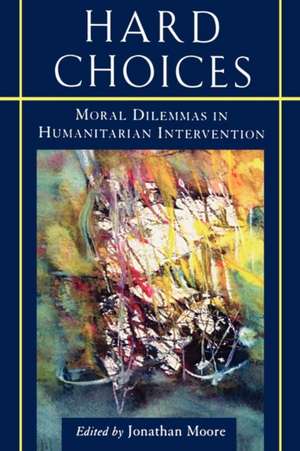
Hard Choices: Moral Dilemmas in Humanitarian Intervention
Editat de Jonathan Moore Contribuţii de Mary B. Anderson, Kofi A. Annan, Rony Brauman, Romeo A. Dallaire, Richard J. Goldstone, Colin T. Granderson, Pierre Hassner, J Bryan Hehir, Michael Ignatieff, Ian Martin, Larry Minear, Elizabeth Reid, Mohamed Sahnoun, Mu Sochua, Cornelio Sommaruga, Roger Williamson, José Zalaquetten Limba Engleză Paperback – 19 noi 1998
This volume of original essays by international policy leaders, practitioners, and scholars brings together insights into the conflicting moral pressures present in different kinds of interventions ranging from Rwanda and Somalia to Haiti, Cambodia, and Bosnia. From their various cultural and professional perspectives the authors cover issues of human rights, sanctions, arms trade, refugees, HIV, and the media. Together they make the case that, although there are no easy answers, moral reflection and content can improve the quality of decisionmaking and intervention in internal conflicts.
Published under the auspices of The International Committee of the Red Cross.
Preț: 360.20 lei
Preț vechi: 462.13 lei
-22%
Puncte Express: 540
Carte tipărită la comandă
Livrare economică 24 noiembrie-08 decembrie
Livrare prin curier în România Termenul estimat este afișat lângă disponibilitate.
Transport gratuit de la 400.00 lei Plată online sau ramburs, în funcție de opțiunile comenzii.
Retur gratuit în 14 zile Comandă securizată și suport în română.
Specificații
ISBN-13: 9780847690312
ISBN-10: 0847690318
Pagini: 336
Dimensiuni: 146 x 230 x 18 mm
Greutate: 0.42 kg
Ediția:0336
Editura: Bloomsbury Publishing
Colecția Rowman & Littlefield
Locul publicării:New York, United States
ISBN-10: 0847690318
Pagini: 336
Dimensiuni: 146 x 230 x 18 mm
Greutate: 0.42 kg
Ediția:0336
Editura: Bloomsbury Publishing
Colecția Rowman & Littlefield
Locul publicării:New York, United States
V-ar putea interesa
-
 -30%Preț: 571.29 lei821.56 lei
 -
 Beyond Disagreement: Open Remedies in Human Rights AdjudicationAruna Sathanapally-31%Preț: 978.34 lei1424.12 lei
 -
 -10%Preț: 345.25 lei384.58 lei
 -
 Social Policy and Citizenship: The Changing LandscapeAdalbert Evers-34%Preț: 729.68 lei1102.41 lei
 -
 Creating CapabilitiesMartha C. NussbaumPreț: 141.08 lei
 -
 DispossessionJudith ButlerPreț: 147.32 lei
 -
 Preț: 240.32 lei
 -
 -27%Preț: 1000.00 lei1362.72 lei
 -
 Iran & Iraq: Human Rights ReportsKyle T Hunt-27%Preț: 999.12 lei1362.16 lei
 -
 Afghanistan & Pakistan: Human Rights ReportsClarence J Peters-27%Preț: 998.68 lei1361.87 lei
 -
 Venezuela: Profiles, Foreign Relations & Human RightsTyler M Rutledge-27%Preț: 888.52 lei1210.34 lei
 -
 Dispatches from the Dark SideGareth PeircePreț: 120.14 lei
 -
 Preț: 149.64 lei
Cuprins
Chapter 1 Foreword
Chapter 2 Introduction
Chapter 3 From War and Peace to Violence and Intervention: Permanent Moral Dilemmas under Changing Political and Technological Conditions
Chapter 4 Military Intervention and National Sovereignty: Recasting the Relationship
Chapter 5 Peacekeeping, Military Intervention, and National Sovereignty in Internal Armed Conflict
Chapter 6 The End of Innocence: Rwanda 1994
Chapter 7 Mixed Intervention in Somalia and the Great Lakes: Culture, Neutrality, and the Military
Chapter 8 Military-Humanitarian Ambiguities in Haiti
Chapter 9 Weaving a New Society in Cambodia: The Story of Monath
Chapter 10 "You Save My Life Today, But for What Tomorrow?" Some Moral Dilemmas of Humanitarian Aid
Chapter 11 Hard Choices after Genocide: Human Rights and Political Failures in Rwanda
Chapter 12 Refugee Camps, Population Transfers, and NGOs
Chapter 13 Bringing War Criminals to Justice during an Ongoing War
Chapter 14 Moral Reconstruction in the Wake of Human Rights Violations and War Crimes
Chapter 15 The Morality of Sanctions
Chapter 16 Moving in Vicious Circles: The Moral Dilemmas of Arms Transfers and Weapons Manufacture
Chapter 17 A Future, If One Is Still Alive: The Challenge of the HIV Epidemic
Chapter 18 The Stories We Tell: Television and Humanitarian Aid
Chapter 19 Index
Chapter 2 Introduction
Chapter 3 From War and Peace to Violence and Intervention: Permanent Moral Dilemmas under Changing Political and Technological Conditions
Chapter 4 Military Intervention and National Sovereignty: Recasting the Relationship
Chapter 5 Peacekeeping, Military Intervention, and National Sovereignty in Internal Armed Conflict
Chapter 6 The End of Innocence: Rwanda 1994
Chapter 7 Mixed Intervention in Somalia and the Great Lakes: Culture, Neutrality, and the Military
Chapter 8 Military-Humanitarian Ambiguities in Haiti
Chapter 9 Weaving a New Society in Cambodia: The Story of Monath
Chapter 10 "You Save My Life Today, But for What Tomorrow?" Some Moral Dilemmas of Humanitarian Aid
Chapter 11 Hard Choices after Genocide: Human Rights and Political Failures in Rwanda
Chapter 12 Refugee Camps, Population Transfers, and NGOs
Chapter 13 Bringing War Criminals to Justice during an Ongoing War
Chapter 14 Moral Reconstruction in the Wake of Human Rights Violations and War Crimes
Chapter 15 The Morality of Sanctions
Chapter 16 Moving in Vicious Circles: The Moral Dilemmas of Arms Transfers and Weapons Manufacture
Chapter 17 A Future, If One Is Still Alive: The Challenge of the HIV Epidemic
Chapter 18 The Stories We Tell: Television and Humanitarian Aid
Chapter 19 Index
Recenzii
Sharply worded statements of uncomfortable truths.
A short chapter by the Canadian General Romeo Dallaire in Hard Choices must qualify as the most gripping account of peacekeeping ever written.
The book is not about Kosovo per se, but its themes and illustrations are pertinent to our current turmoil in the Balkans. One obvious point is that the consequences of inaction can be horrible.
Every chapter in this timely book is worth reading.
The volume is the most comprehensive available about the view of the international community on morally sound and policy-prudent intervention. . . . Recommended for upper-division undergraduate, graduate, and faculty collections.
Each of these essays shows a different aspect of the dilemmas confronting humanitarian workers as well as the multiple and often incompatible tasks that fall within the range of humanitarian intervention.
This volume illuminates what may be the challenge for the next decade, century, and millennium: closing the gap between lofty rethoric and the reality in the field.
The book is a solid contribution to the ever-growing debate on humanitarian intervention.
Hard Choices is a remarkably franc attempt to consider the consequences and shortcomings of humanitarian intervention.
A short chapter by the Canadian General Romeo Dallaire in Hard Choices must qualify as the most gripping account of peacekeeping ever written.
The book is not about Kosovo per se, but its themes and illustrations are pertinent to our current turmoil in the Balkans. One obvious point is that the consequences of inaction can be horrible.
Every chapter in this timely book is worth reading.
The volume is the most comprehensive available about the view of the international community on morally sound and policy-prudent intervention. . . . Recommended for upper-division undergraduate, graduate, and faculty collections.
Each of these essays shows a different aspect of the dilemmas confronting humanitarian workers as well as the multiple and often incompatible tasks that fall within the range of humanitarian intervention.
This volume illuminates what may be the challenge for the next decade, century, and millennium: closing the gap between lofty rethoric and the reality in the field.
The book is a solid contribution to the ever-growing debate on humanitarian intervention.
Hard Choices is a remarkably franc attempt to consider the consequences and shortcomings of humanitarian intervention.