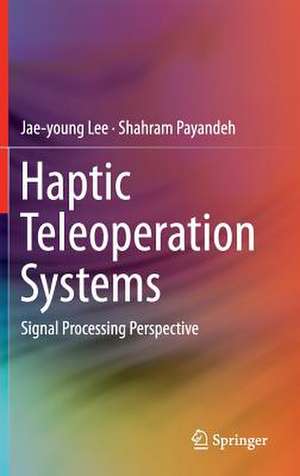
Haptic Teleoperation Systems
Autor Jae-Young Lee, Shahram Payandehen Limba Engleză Hardback – 10 iul 2015
Preț: 661.27 lei
Preț vechi: 777.97 lei
-15%
Puncte Express: 992
Carte tipărită la comandă
Livrare economică 27 noiembrie-11 decembrie
Livrare prin curier în România Termenul estimat este afișat lângă disponibilitate.
Transport gratuit pentru acest produs Plată online sau ramburs, în funcție de opțiunile comenzii.
Retur gratuit în 14 zile Comandă securizată și suport în română.
Specificații
ISBN-13: 9783319195568
ISBN-10: 3319195565
Pagini: 144
Ilustrații: XII, 130 p. 69 illus., 26 illus. in color.
Dimensiuni: 160 x 241 x 13 mm
Greutate: 0.34 kg
Ediția:2015
Editura: Springer
Locul publicării:Cham, Switzerland
ISBN-10: 3319195565
Pagini: 144
Ilustrații: XII, 130 p. 69 illus., 26 illus. in color.
Dimensiuni: 160 x 241 x 13 mm
Greutate: 0.34 kg
Ediția:2015
Editura: Springer
Locul publicării:Cham, Switzerland
V-ar putea interesa
-
 -18%Preț: 907.57 lei1106.79 lei
 -
 Writing Virtual Environments for Software VisualizationClinton Jeffery-15%Preț: 663.03 lei780.03 lei
 -
 -15%Preț: 666.33 lei783.92 lei
 -
 Where Humans Meet MachinesAmy Neustein-15%Preț: 671.56 lei790.08 lei
 -
 Color Image and Video EnhancementEmre Celebi-15%Preț: 675.76 lei795.00 lei
 -
 SensorsDario Compagnone-18%Preț: 995.23 lei1213.70 lei
 -
 Locating, Classifying and Countering Agile Land VehiclesDavid D. SworderPreț: 411.92 lei
 -
 Art and IllusionistsNicholas WadePreț: 331.41 lei
 -
 Preț: 401.71 lei
 -
 Machine Learning Techniques for Gait Biometric RecognitionJames Eric MasonPreț: 406.64 lei
 -
 Handbook of Camera Monitor SystemsAnestis Terzis-18%Preț: 1167.85 lei1424.21 lei
 -
 SiGe-based Re-engineering of Electronic Warfare SubsystemsWynand Lambrechts-15%Preț: 672.68 lei791.40 lei
 -
 Sprachbedienung im AutomobilStefan Hamerich-15%Preț: 545.33 lei641.57 lei
 -
 Mensch-Maschine-KommunikationJoachim SchenkPreț: 482.34 lei
 -
 Statistische InformationstechnikKroschel KristianPreț: 483.39 lei
 -
 -15%Preț: 661.73 lei778.50 lei
 -
 Delta-Sigma A/D-ConvertersRichard Gaggl-31%Preț: 575.22 lei836.67 lei
 -
 Brain-Computer Interface ResearchChristoph GugerPreț: 366.49 lei
 -
 Environmental Signal Processing and AdaptationGerhard Heldmaier-15%Preț: 623.40 lei733.41 lei
 -
 Data Fitting and UncertaintyTilo Strutz-18%Preț: 734.15 lei895.30 lei
 -
 Group-target TrackingWen-Dong Geng-15%Preț: 599.11 lei704.84 lei
 -
 GPU Computing and ApplicationsYiyu Cai-15%Preț: 669.81 lei788.01 lei
 -
 Ear Biometrics in 2D and 3DSurya Prakash-44%Preț: 571.42 lei1019.60 lei
 -
 Preț: 333.71 lei
Public țintă
ResearchCuprins
Introduction.- A Bayesian Approach to Haptic Teleoperation Systems.- Stability of Haptic Teleoperation System Based on the Bayesian Approach.- A Layered Protocol Architecture for Haptic Teleoperation.- Haptic Data Compression.- Haptic Data Digitization and Forward Error Correction.- Conclusion and Future Work.- References.- Appendices.
Notă biografică
Jae-young Lee is a Senior Research Associate Electronics and Telecommunication Research Institute (ETRI)
Shahram Payandeh is a Professor at Simon Fraser University.
Shahram Payandeh is a Professor at Simon Fraser University.
Textul de pe ultima copertă
This book examines the signal processing perspective in haptic teleoperation systems. This text covers the topics of prediction, estimation, architecture, data compression, and error correction that can be applied to haptic teleoperation systems. The authors begin with an overview of haptic teleoperation systems, then look at a Bayesian approach to haptic teleoperation systems. They move onto a discussion of haptic data compression, haptic data digitization and forward error correction.
· Presents haptic data prediction/estimation methods that compensate for unreliable networks
· Discusses haptic data compression that reduces haptic data size over limited network bandwidth and haptic data error correction that compensate for packet loss problem
· Provides signal processing techniques used with existing control architectures
· Presents haptic data prediction/estimation methods that compensate for unreliable networks
· Discusses haptic data compression that reduces haptic data size over limited network bandwidth and haptic data error correction that compensate for packet loss problem
· Provides signal processing techniques used with existing control architectures