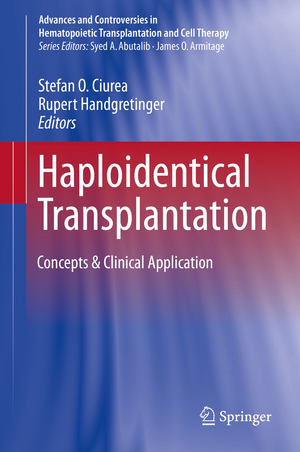
Haploidentical Transplantation: Advances and Controversies in Hematopoietic Transplantation and Cell Therapy
Editat de Stefan O. Ciurea, Rupert Handgretingeren Limba Engleză Hardback – 18 mai 2018
În domeniul hematologiei și al transplantului medular, volumul Haploidentical Transplantation se constituie ca o resursă clinică de nivel avansat, dedicată medicilor specialiști care gestionează cazuri complexe unde donatorii compatibili HLA lipsesc. Remarcăm o structură riguroasă, organizată pe piloni esențiali: de la perspectiva istorică la metodele tehnice de manipulare a grefei, precum selecția pozitivă CD34+ sau depleția celulelor T alfa-beta și CD19+. Descoperim aici o analiză critică a controverselor actuale, editorii Stefan O. Ciurea și Rupert Handgretinger punând accent pe deciziile fundamentale în practica de zi cu zi. Un aspect distinctiv este secțiunea dedicată selecției donatorului „ideal”, unde sunt evaluate strategiile de atenuare a anticorpilor anti-HLA și diferențele dintre regimurile de condiționare mieloablative și cele non-mieloablative. Acolo unde Cord Blood Transplantations explorează utilizarea sângelui placentar ca sursă alternativă, acest volum aprofundează specificul transplantului haploidentic, oferind soluții pentru controlul bolii grefă-contra-gazdă prin utilizarea ciclofosfamidei post-transplant. Progresia conținutului facilitează trecerea de la protocoalele tehnice la aplicații clinice specifice, inclusiv pentru boli non-maligne la copii. Față de abordarea generalistă din Hematopoietic Cell Transplants, lucrarea de față se concentrează pe nișa transplantului de la donatori parțial compatibili, integrând algoritmi vizuali care transformă datele din studiile clinice în instrumente de lucru pentru hematologi. Tonul este precis și clinic, evitând speculațiile în favoarea dovezilor bazate pe experiența centrelor de excelență.
Preț: 885.37 lei
Preț vechi: 931.97 lei
-5%
Carte disponibilă
Livrare economică 11-25 noiembrie
Specificații
ISBN-10: 3319543091
Pagini: 352
Ilustrații: XI, 337 p. 25 illus., 18 illus. in color.
Dimensiuni: 160 x 241 x 24 mm
Greutate: 0.71 kg
Ediția:1st edition 2018
Editura: Springer
Colecția Advances and Controversies in Hematopoietic Transplantation and Cell Therapy
Seria Advances and Controversies in Hematopoietic Transplantation and Cell Therapy
Locul publicării:Cham, Switzerland
V-ar putea interesa
-
 Hematology in Clinical Practice, Fifth EditionRobert Hillman-34%Preț: 574.92 lei868.84 lei
 -
 Hematomas: Types, Treatments & Health RisksMisael F Garza Salazar-23%Preț: 929.58 lei1211.61 lei
 -
 Color Atlas of Hematology – Practical Microscopic and Clinical DiagnosisHarald Klaus Theml-5%Preț: 324.06 lei341.13 lei
 -
 Antiphospholipid Antibody SyndromePier Luigi Meroni-5%Preț: 740.93 lei779.92 lei
 -
 HämatologieRolf Mahlberg-5%Preț: 271.42 lei285.70 lei
De ce să citești această carte
Recomandăm această lucrare hematologilor și medicilor de transplant care caută protocoale clare pentru extinderea bazei de donatori. Cititorul câștigă acces la tehnici de ultimă oră în manipularea grefei și gestionarea complicațiilor post-transplant. Este un instrument esențial pentru optimizarea îngrijirii pacienților adulți și pediatrici care necesită soluții rapide în absența unui donator complet compatibil.
Despre autor
Editorii acestui volum sunt figuri proeminente în hematologia mondială. Stefan O. Ciurea este recunoscut pentru cercetările sale inovatoare în transplantul haploidentic și imunoterapia cancerului, având o contribuție majoră în dezvoltarea protocoalelor care au făcut acest tip de transplant mai sigur pentru pacienții cu risc înalt. Rupert Handgretinger este un expert de talie internațională în oncologie pediatrică și transplant de celule stem, fiind pionier în tehnici de selecție a celulelor stem și în utilizarea imunoterapiei pentru tratarea leucemiilor la copii.
Descriere scurtă
Cuprins
en.-="" part="" 4:="" disease-specific="" adult="" population.-="" non-malignant="" adults.-="" acute="" myelogenous="" leukemia="" lymphomas-="" parameswaran="" hari.-="" chronic="" leukemias="" and="" myeloproliferative="" neoplasms.-="" immunologic="" reconstitution="" after="" haploidentical="" transplantation.-="" prevention="" treatment="" of="" relapse="" transplant.-="" unique="" complications="" limitations="" future="" prospects="" transplantation
Notă biografică
oidentical transplantation, and is principal investigator on multiple clinical trials.
Rupert Handgretinger is Professor of Pediatrics, Chairman of the Department of General Pediatrics and Hematology/Oncology and Medical Director of the Children’s University Hospital Tübingen. He received his medical degree from the Eberhard-Karls-University in Tübingen in 1986 and was trained at the Children's University Hospital Tübingen in General Pediatrics and Hematology/Oncology. In 2000, he was appointed as director of the Division of Stem Cell Transplantation at St. Jude Children’s Research Hospital in Memphis, USA, where he served as a full faculty member and Professor of Pediatrics at the University of Tennessee, Memphis, until 2005. He returned to Tübingen in 2005 when he was appointed as Chairman of the Department of General Pediatrics and Hematology/Oncology at the Children's University Hospital Tübingen. His main research interests are cellular im
munotherapeutic approaches to the treatment of children with various forms of cancer in the context of allogeneic stem cell transplantation. He is especially interested in the establishment of graft engineering techniques to introduce new concepts in haploidentical transplantation and in the elucidation of mechanisms of graft-mediated anti-tumor effects induced by Natural Killer and other effector cells.