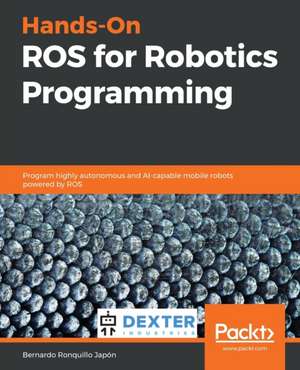
Hands-On ROS for Robotics Programming
Autor Bernardo Ronquillo Japónen Limba Engleză Paperback – 26 feb 2020
Prin parcurgerea acestui ghid tehnic, cititorul va reuși să proiecteze și să implementeze un robot mobil autonom capabil să navigheze și să învețe din mediul său înconjurător prin tehnici avansate de inteligență artificială. Observăm că Bernardo Ronquillo Japón pune un accent deosebit pe rezolvarea uneia dintre cele mai mari provocări din domeniu: corelarea perfectă între simularea virtuală și comportamentul robotului în lumea reală. Suntem de părere că utilizarea kit-ului GoPiGo3 ca punct de referință oferă o bază solidă pentru experimente, permițând trecerea de la modelarea 3D în Gazebo la execuția de sarcini complexe pe un hardware accesibil bazat pe Raspberry Pi. Ca și Carol Fairchild în ROS Robotics By Example - Second Edition, autorul distilează experiență reală în principii acționabile, însă acest volum merge mai departe, integrând capitole dedicate învățării prin recompensă (reinforcement learning). Merită menționat că fluxul de lucru propus nu se limitează la simple comenzi de mișcare; cititorul va învăța să descompună un comportament dorit într-o succesiune de acțiuni robotice și să utilizeze datele de la senzori pentru a genera răspunsuri adaptive. De asemenea, spre deosebire de alte manuale teoretice, aici regăsim o abordare practică a testării unitare, esențială pentru stabilitatea sistemelor de operare robotice. Structura volumului facilitează înțelegerea conceptelor de SLAM și navigație, oferind instrumentele necesare pentru ca un robot să își recunoască împrejurimile prin Deep Learning. Această tranziție de la robotica tradițională la sistemele AI-powered transformă cartea într-o resursă tehnică valoroasă pentru inginerii care doresc să stăpânească ecosistemul Robot Operating System.
Preț: 325.34 lei
Preț vechi: 406.67 lei
-20%
Carte tipărită la comandă
Livrare economică 26 noiembrie-10 decembrie
Specificații
ISBN-10: 1838551301
Pagini: 432
Dimensiuni: 191 x 235 x 24 mm
Greutate: 0.8 kg
Editura: Packt Publishing
V-ar putea interesa
-
 So That's How It Works! Robots and AITom Jackson-40%Preț: 57.36 lei95.06 lei
 -
 The Big Book of RobotsCampbell BooksPreț: 84.16 lei
 -
 Introduction to Robotics, Global EditionJohn Craig-9%Preț: 596.70 lei655.72 lei
 -
 The Essential Book of AIAnne Rooney-20%Preț: 76.61 lei95.77 lei
 -
 -8%Preț: 591.74 lei643.20 lei
 -
 The LEGO MINDSTORMS EV3 Discovery BookLaurens Valk-18%Preț: 216.13 lei264.86 lei
 -
 The LEGO MINDSTORMS EV3 LaboratoryDaniele Benedettelli-19%Preț: 215.56 lei264.52 lei
 -
 Learn Robotics with Raspberry PiMatt Timmons-Brown-34%Preț: 116.45 lei177.71 lei
 -
 -36%Preț: 284.14 lei440.90 lei
 -
 Robot's First SnowBilly SharffPreț: 102.10 lei
 -
 Racing RobotsElizabeth DalePreț: 48.72 lei
 -
 First Sticker Book RobotsAlice BeechamPreț: 46.53 lei
 -
 RobotsHenny Admoni-29%Preț: 69.75 lei98.14 lei
 -
 The Official Raspberry Pi Handbook 2025The Makers of the Magpi Magazine-20%Preț: 115.05 lei143.81 lei
 -
 The Official Raspberry Pi Handbook 2026The Makers of Raspberry Pi Official MagazinePreț: 127.56 lei
 -
 Walking Robots into Real WorldKarsten Berns-18%Preț: 1177.33 lei1435.77 lei
 -
 Robot Operating System (ROS)Anis Koubâa-18%Preț: 1171.25 lei1428.35 lei
 -
 Foundations of RoboticsDamith HerathPreț: 368.73 lei
De ce să citești această carte
Recomandăm această carte inginerilor și pasionaților de robotică care doresc să treacă de la simple simulări la roboți autonomi inteligenți. Cititorul câștigă competențe practice în utilizarea ROS pentru navigație, SLAM și machine learning, având la dispoziție un flux de lucru complet pentru dezvoltarea de roboți capabili să învețe singuri prin trial and error în medii fizice reale.