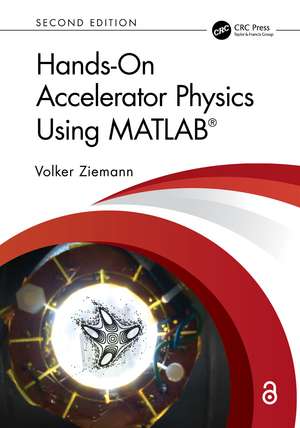
Hands-On Accelerator Physics Using MATLAB®
Autor Volker Ziemannen Limba Engleză Hardback – 31 mar 2025
The second edition features a new chapter on future accelerators and several new sections on polarization, neutrino beams, testing of superconducting cavities, and matching in longitudinal phase space, among others.
The MATLAB code was updated to be consistent with the recent release of R2024a. All code is available from the book’s GitHub site at https://github.com/volkziem/HandsOnAccelerators2nd.
Key features:
- Provides a broad introduction into physics of particle accelerators from synchrotron light sources to high-energy colliders.
- Discusses technical subsystems, including magnets, radio-frequency engineering, instrumentation and diagnostics, correction of imperfections, control, vacuum, and cryogenics.
- Illustrates key concepts with sample code in MATLAB.
Preț: 1019.90 lei
Preț vechi: 1243.79 lei
-18%
Puncte Express: 1530
Carte tipărită la comandă
Livrare economică 27 noiembrie-11 decembrie
Livrare prin curier în România Termenul estimat este afișat lângă disponibilitate.
Transport gratuit pentru acest produs Plată online sau ramburs, în funcție de opțiunile comenzii.
Retur gratuit în 14 zile Comandă securizată și suport în română.
Specificații
ISBN-13: 9781032726960
ISBN-10: 1032726962
Pagini: 416
Ilustrații: 360
Dimensiuni: 178 x 254 x 31 mm
Greutate: 0.93 kg
Ediția:2
Editura: CRC Press
Colecția CRC Press
ISBN-10: 1032726962
Pagini: 416
Ilustrații: 360
Dimensiuni: 178 x 254 x 31 mm
Greutate: 0.93 kg
Ediția:2
Editura: CRC Press
Colecția CRC Press
V-ar putea interesa
-
 Foundations of Modern CosmologyJohn F. Hawley-30%Preț: 711.48 lei1011.83 lei
 -
 -14%Preț: 285.33 lei330.01 lei
 -
 EUREKA!: Physics of Particles, Matter and the UniverseR.J Blin-StoylePreț: 458.47 lei
 -
 Compound Semiconductor Radiation DetectorsAlan Owens-15%Preț: 620.70 lei730.24 lei
 -
 Standard Model PhenomenologyShaaban Khalil-18%Preț: 1412.81 lei1722.93 lei
 -
 Brilliant Light in Life and Material SciencesVasili Tsakanov-18%Preț: 1236.28 lei1507.67 lei
 -
 Topics in Hadron Spectroscopy: Volume IIID C Peaslee-27%Preț: 946.84 lei1288.22 lei
 -
 -27%Preț: 6211.87 lei8509.42 lei
 -
 -15%Preț: 617.08 lei725.97 lei
 -
 Particle PhysicsA. G. Lee-9%Preț: 1299.06 lei1427.54 lei
Public țintă
Postgraduate, Professional Practice & Development, Professional Reference, and Professional TrainingCuprins
Chapter 1: Introduction and History. Chapter 2: Reference System. Chapter 3: Transverse Beam Optics. Chapter 4: Magnets. Chapter 5: Longitudinal Dynamics and Acceleration. Chapter 6: Radio-Frequency Systems. Chapter 7: Instrumentation and Diagnostics. Chapter 8: Imperfections and Their Correction. Chapter 9: Targets and Luminosity. Chapter 10: Synchrotron Radiation and Free-Electron Lasers. Chapter 11: Non-linear Dynamics. Chapter 12: Collective Effects. Chapter 13: Accelerator Subsystems. Chapter 14: Examples of Accelerators. Chapter 15: Future Accelerators. Appendix A: The Student Labs. Appendix B: Appendices Available Online. Bibliography. Index.
Notă biografică
Volker Ziemann earned his PhD in accelerator physics from Dortmund University in 1990. After post-doctoral positions in Stanford at SLAC and in Geneva at CERN, where he worked on the design of the LHC, he moved to Uppsala in 1995 where he worked at the electron-cooler storage ring CELSIUS. In 2005 he moved to the physics department where he taught physics. Since 2024 he has been Director for Accelerator Education at Jefferson National Laboratory. He was responsible for several accelerator physics projects at CERN, DESY, and XFEL. In 2014 he received the Thuréus Prize from the Royal Society of Sciences in Uppsala. He was a member of Uppsala University’s senate, served on evaluation committees for the German ministry of research and the Canadian NSERC, is a member of the Scientific Council of the Helmholtz Institute in Mainz, and teaches at CERN accelerator schools. He authored four books and over 200 articles and reports.
Recenzii
What I love about this book is the ease with which it introduces the reader to the complex art of accelerator design. In a friendly, conversational tone that invites you to read on, the book not only teaches the basics of accelerator physics, but also introduces us to more advanced topics such as nonlinear beam dynamics, various instabilities, and sophisticated methods such as Lie algebra and Hamiliton formalism. The well-designed and well-placed MATLAB exercises help with understanding and internalisation, and provide a virtual 'control room' experience. It is also noteworthy that no aspect of a real accelerator is neglected, be it dosimetry, the vacuum system or the building. Its comprehensive approach makes the book a highly recommended resource for aspiring accelerator physicists.
- Atoosa Meseck, Professor of Accelerator Physics, University of Mainz, March 2025
Volker Ziemann’s Hands-On Accelerator Physics Using MATLAB® stands out for the book’s ability to connect foundational physics with hands-on computational tools in a seamless and pedagogically powerful manner. Ziemann succeeds not only in demystifying abstract concepts but also in empowering the reader to experiment, tweak, and internalize the physics through immediate feedback. This is more than a textbook—it is a dynamic laboratory in silico.
As the authors of Unifying Physics of Accelerators, Lasers, and Plasma, I am especially appreciative of Ziemann’s inventive approach that resonates with the unifying mindset I advocate—bridging theory,sapplication, and intuition. This book doesn’t merely teach accelerator physics; it invites the reader to play with it, to explore its underlying principles through code and computation. In doing so, it fosters the kind of creative problem-solving that is essential not only in accelerator physics but across the broader landscape of modern physics and engineering.
Highly recommended for students, educators, and professionals who value clarity, creativity, and computational insight.
- Andrei Seryi and Elena Seraia, Jefferson Laboratory, April 2025
- Atoosa Meseck, Professor of Accelerator Physics, University of Mainz, March 2025
Volker Ziemann’s Hands-On Accelerator Physics Using MATLAB® stands out for the book’s ability to connect foundational physics with hands-on computational tools in a seamless and pedagogically powerful manner. Ziemann succeeds not only in demystifying abstract concepts but also in empowering the reader to experiment, tweak, and internalize the physics through immediate feedback. This is more than a textbook—it is a dynamic laboratory in silico.
As the authors of Unifying Physics of Accelerators, Lasers, and Plasma, I am especially appreciative of Ziemann’s inventive approach that resonates with the unifying mindset I advocate—bridging theory,sapplication, and intuition. This book doesn’t merely teach accelerator physics; it invites the reader to play with it, to explore its underlying principles through code and computation. In doing so, it fosters the kind of creative problem-solving that is essential not only in accelerator physics but across the broader landscape of modern physics and engineering.
Highly recommended for students, educators, and professionals who value clarity, creativity, and computational insight.
- Andrei Seryi and Elena Seraia, Jefferson Laboratory, April 2025
Descriere
Hands-On Accelerator Physics Using MATLAB(R), second edition provides a broad introduction into the physics and the technology of particle accelerators from synchrotron light sources to high-energy colliders.