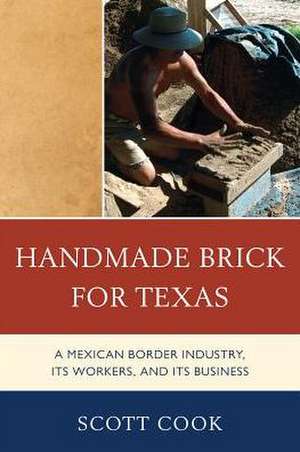
Handmade Brick for Texas: A Mexican Border Industry, Its Workers, and Its Business
Autor Scott Cooken Limba Engleză Paperback – 13 dec 2010
Preț: 739.53 lei
Preț vechi: 1147.17 lei
-36%
Puncte Express: 1109
Carte tipărită la comandă
Livrare economică 12-26 noiembrie
Livrare prin curier în România Termenul estimat este afișat lângă disponibilitate.
Transport gratuit pentru acest produs Plată online sau ramburs, în funcție de opțiunile comenzii.
Retur gratuit în 14 zile Comandă securizată și suport în română.
Specificații
ISBN-13: 9780739147986
ISBN-10: 0739147986
Pagini: 290
Dimensiuni: 155 x 232 x 21 mm
Greutate: 0.44 kg
Ediția:New.
Editura: Bloomsbury Publishing
Colecția Lexington Books
Locul publicării:New York, United States
ISBN-10: 0739147986
Pagini: 290
Dimensiuni: 155 x 232 x 21 mm
Greutate: 0.44 kg
Ediția:New.
Editura: Bloomsbury Publishing
Colecția Lexington Books
Locul publicării:New York, United States
Recenzii
Handmade Brick for Texas is a must-read for historical archaeologists in Texas. It brings an important historical perspective to material culture studies. Handmade bricks are often viewed as a class of material culture that has limited interpretative value, but Cook has demonstrated that these objects embody a tremendous amount of socioeconomic information. I will never pick up a handmade brick at a historic archaeological site without wondering about its complex history . . . Who made it? When and where was it made? How much did it cost? How did it get delivered and end up where it was found? The book presents a very human perspective on the brick industry. The stories are up close and personal. Cook's use of the brickmakers' own words makes it easy for the reader to feel some of their emotions and share in their successes and frustrations. I really like the use of Spanish translations throughout the text. The pictures are wonderful and a great addition.
This is a deep and rich ethnography. Like the other works of Scott Cook, Handmade Brick for Texas illustrates research of the highest caliber. Here he focuses on the century and a quarter of the long history and development of the handmade brick industry in the reverine belt on both sides of the Lower Rio Grande/Rio Bravo Border. This is classic ethnography that illustrates the strength of extended fieldwork and face-to-face encounters with the people who live the border. Importantly, this book adds a dimension to the notion of 'maquilas' on the U.S.-Mexico Border. . . . The intricate ties of labor in agriculture and brick-making illustrate the high degree of variability and adaptation of these border folk and labor to the region. Handmade Brick for Texas illustrates a nuanced and important dimension of the Mexican agrarian reform of the 40's and the rise of ejidos on the U.S.-Mexico Border. There is very little research on the ejidos of the border, but this book delves not only into their origins but their relevance in the building of this industry. . . . This is a rigorous analysis of the industry from its beginnings to the present, providing the reader with a meticulous ethnographic and economic analysis of this important commerce. Handmade Brick for Texas opens and relates a profound border life that adds new insights about borderlanders, border life, and Mexican entrepreneurs.
Altogether, Cook offers a fine book. Readers wishing to learn the details of making and selling Mexican handmade brick will happily revel in Cook's descriptions, while readers interested in the labor and social history of the border will benefit from the wealth of information Cook presents.
This is a deep and rich ethnography. Like the other works of Scott Cook, Handmade Brick for Texas illustrates research of the highest caliber. Here he focuses on the century and a quarter of the long history and development of the handmade brick industry in the reverine belt on both sides of the Lower Rio Grande/Rio Bravo Border. This is classic ethnography that illustrates the strength of extended fieldwork and face-to-face encounters with the people who live the border. Importantly, this book adds a dimension to the notion of 'maquilas' on the U.S.-Mexico Border. . . . The intricate ties of labor in agriculture and brick-making illustrate the high degree of variability and adaptation of these border folk and labor to the region. Handmade Brick for Texas illustrates a nuanced and important dimension of the Mexican agrarian reform of the 40's and the rise of ejidos on the U.S.-Mexico Border. There is very little research on the ejidos of the border, but this book delves not only into their origins but their relevance in the building of this industry. . . . This is a rigorous analysis of the industry from its beginnings to the present, providing the reader with a meticulous ethnographic and economic analysis of this important commerce. Handmade Brick for Texas opens and relates a profound border life that adds new insights about borderlanders, border life, and Mexican entrepreneurs.
Altogether, Cook offers a fine book. Readers wishing to learn the details of making and selling Mexican handmade brick will happily revel in Cook's descriptions, while readers interested in the labor and social history of the border will benefit from the wealth of information Cook presents.