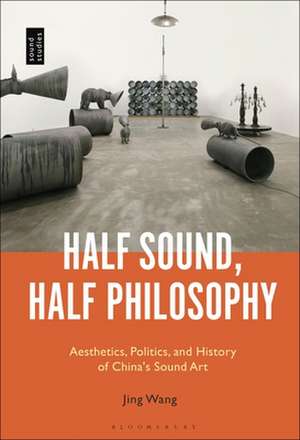
Half Sound, Half Philosophy: Aesthetics, Politics, and History of China's Sound Art
Autor Professor Jing Wangen Limba Engleză Hardback – 11 feb 2021
Preț: 614.02 lei
Preț vechi: 910.90 lei
-33%
Puncte Express: 921
Carte tipărită la comandă
Livrare economică 03-17 decembrie
Livrare prin curier în România Termenul estimat este afișat lângă disponibilitate.
Transport gratuit pentru acest produs Plată online sau ramburs, în funcție de opțiunile comenzii.
Retur gratuit în 14 zile Comandă securizată și suport în română.
Specificații
ISBN-13: 9781501333484
ISBN-10: 1501333488
Pagini: 232
Dimensiuni: 160 x 232 x 20 mm
Greutate: 0.48 kg
Editura: Bloomsbury Publishing
Colecția Bloomsbury Academic
Locul publicării:New York, United States
ISBN-10: 1501333488
Pagini: 232
Dimensiuni: 160 x 232 x 20 mm
Greutate: 0.48 kg
Editura: Bloomsbury Publishing
Colecția Bloomsbury Academic
Locul publicării:New York, United States
V-ar putea interesa
-
 Digital TraditionEliot Bates-31%Preț: 920.88 lei1332.50 lei
 -
 Saxophone Globetrotters, E flat edition + CDRos StephenPreț: 114.49 lei
 -
 Analytical and Cross-Cultural Studies in World MusicMichael Tenzer-31%Preț: 715.54 lei1033.91 lei
 -
 -19%Preț: 312.59 lei385.75 lei
 -
 Music Endangerment: How Language Maintenance Can HelpCatherine Grant-21%Preț: 292.54 lei369.85 lei
 -
 -24%Preț: 206.30 lei272.21 lei
 -
 -14%Preț: 268.28 lei313.00 lei
 -
 Music in Portugal and SpainSalwa El-Shawan Castelo-Branco-23%Preț: 501.95 lei651.89 lei
 -
 Radical Traditions: Reimagining Culture in Balinese Contemporary MusicAndrew Clay McGraw-11%Preț: 245.25 lei274.68 lei
 -
 -31%Preț: 987.38 lei1429.59 lei
 -
 -19%Preț: 245.67 lei301.83 lei
 -
 Masters Series de CubaJon Griffin JrPreț: 148.68 lei
 -
 The Early Tudor Court and International Musical RelationsTheodor Dumitrescu-15%Preț: 443.05 lei521.23 lei
 -
 Identity and Locality in Early European Music, 1028-1740Jason Stoessel-15%Preț: 475.57 lei559.50 lei
 -
 -15%Preț: 473.86 lei557.49 lei
 -
 -17%Preț: 353.87 lei426.71 lei
 -
 Music and Identity in Ireland and BeyondMark Fitzgerald-18%Preț: 1303.98 lei1590.23 lei
 -
 World Music Class 2015Charmony GivnologyPreț: 64.64 lei
 -
 World Music Class (2015)Arttsi InstitutePreț: 70.36 lei
 -
 Soul + Salsa = Soulsa (2015)Arttsi InstitutePreț: 52.06 lei
 -
 Fela Anikulapo-Kuti: Afrobeat, Rebellion, and PhilosophyDr. Adeshina Afolayan-25%Preț: 212.37 lei284.32 lei
 -
 EurovisionGarry HollandPreț: 70.36 lei
 -
 Music Scenes and MigrationsDavid Treece-23%Preț: 718.78 lei933.48 lei
 -
 The ShakuhachiHenry Johnson-23%Preț: 756.48 lei982.44 lei
Cuprins
Acknowledgements
List of Illustrations
Introduction
1. Sound, Resonance, the Philosophy of Qi
Ancient Chinese Acoustics
The Philosophy of Qi
Sound Explained Through Qi-Philosophy
Conclusion
2. A Brief History of Sound in China's Contemporary Art
Conditions and Precursors
New Media Art After 2000
Sound Art after 2000
3. A Brief History of Electronic and Experimental Music in China
The Electronic Instrument Builders
Academic Electronic Music: Inauguration
Non-Academic Electronic and Experimental Music
Conclusion
4. Shanshui-Thought in Experimental Music Practice
Shanshui-Thought: An Overview
Shanshui: The Existential and the Epistemological
Making Shanshui-Thought Audible: Two Aesthetic Qualities
Conclusion
5. In Praise of Strange Sounds of the Shamanistic
The Minor Tradition in Ancient Chinese Culture: Shamanism and Chimei Wangliang
Acoustic Cultural Heritage and Nationalism
Huanghu and Its Two Aesthetic Operations of Resonance and Withdrawal
Conclusion
6. Ubiquitous Control: From Cosmic Bell, Loudspeakers to Immanent Humming
Zhang Peili and Anti-monumentality of Sound
Zhang Ding and the Military-entertainment-art Complex
Liu Chuang and the (Im)Possibility of Not Being Governed
Conclusion: Qi-Thinking, or Cybernetics: A way of Going On
Glossary of Terms
Bibliography
Index
List of Illustrations
Introduction
1. Sound, Resonance, the Philosophy of Qi
Ancient Chinese Acoustics
The Philosophy of Qi
Sound Explained Through Qi-Philosophy
Conclusion
2. A Brief History of Sound in China's Contemporary Art
Conditions and Precursors
New Media Art After 2000
Sound Art after 2000
3. A Brief History of Electronic and Experimental Music in China
The Electronic Instrument Builders
Academic Electronic Music: Inauguration
Non-Academic Electronic and Experimental Music
Conclusion
4. Shanshui-Thought in Experimental Music Practice
Shanshui-Thought: An Overview
Shanshui: The Existential and the Epistemological
Making Shanshui-Thought Audible: Two Aesthetic Qualities
Conclusion
5. In Praise of Strange Sounds of the Shamanistic
The Minor Tradition in Ancient Chinese Culture: Shamanism and Chimei Wangliang
Acoustic Cultural Heritage and Nationalism
Huanghu and Its Two Aesthetic Operations of Resonance and Withdrawal
Conclusion
6. Ubiquitous Control: From Cosmic Bell, Loudspeakers to Immanent Humming
Zhang Peili and Anti-monumentality of Sound
Zhang Ding and the Military-entertainment-art Complex
Liu Chuang and the (Im)Possibility of Not Being Governed
Conclusion: Qi-Thinking, or Cybernetics: A way of Going On
Glossary of Terms
Bibliography
Index
Recenzii
In this book, WANG Jing offers the reader the unique opportunity to investigate sonic creativity within but mainly outside of academe in China ranging from sound art to experimental and electroacoustic music to DIY culture and electronic instrument building. The historical discussion covers much ground but is not restricted to a multi-strand survey. Key to her approach is the investigation of Chinese cultural and philosophical elements that permeate this substantial body of creative work demonstrating beyond any doubt that experimentalism with sound in China is hardly a simple reflection of developments from other, mainly western countries but is instead largely deeply rooted in Chinese traditions, some ancient, related to sound, to qi and much more.
If sound is qi, resonating, Chinese sound art animated by qi lives in the resonances that arise in the mutating, overlapping atmospheres of state power plays and works of artistic resistance. In this stunning book, Jing Wang audits pieces that mobilize clock hearts, crowd shouts, cybernetic dissonance, and strategic silence to jolt us into an active attention to how violence and defiance are made and born in the ambient sounds of everyday life.
Half Sound, Half Philosophy is the first major study of Chinese sound art and its affinity to ancient Qi-philosophy, an organic, holistic and enchanted worldview that stands in marked contrast to the commercialism and individualization of post-Mao China. Erudite and being attuned to the subtle play of resonances and the subliminal in the acoustics of Qi, Wang's book is destined to become a classic of sound art scholarship and sound studies more broadly.
Wang's timely publication is a must read for anyone interested in a transnational perspective on sound.
Half Sound, Half Philosophy contributes a uniquely ambitious and essential entry into the emerging literature on sound in East Asia. Wang's rich scholarly analysis extends the core tenets of qi as acoustical thought into a contemporary history of electronic music and sound artists, revealing the deep roots of sonic philosophy in Chinese conceptual and creative practices.
If sound is qi, resonating, Chinese sound art animated by qi lives in the resonances that arise in the mutating, overlapping atmospheres of state power plays and works of artistic resistance. In this stunning book, Jing Wang audits pieces that mobilize clock hearts, crowd shouts, cybernetic dissonance, and strategic silence to jolt us into an active attention to how violence and defiance are made and born in the ambient sounds of everyday life.
Half Sound, Half Philosophy is the first major study of Chinese sound art and its affinity to ancient Qi-philosophy, an organic, holistic and enchanted worldview that stands in marked contrast to the commercialism and individualization of post-Mao China. Erudite and being attuned to the subtle play of resonances and the subliminal in the acoustics of Qi, Wang's book is destined to become a classic of sound art scholarship and sound studies more broadly.
Wang's timely publication is a must read for anyone interested in a transnational perspective on sound.
Half Sound, Half Philosophy contributes a uniquely ambitious and essential entry into the emerging literature on sound in East Asia. Wang's rich scholarly analysis extends the core tenets of qi as acoustical thought into a contemporary history of electronic music and sound artists, revealing the deep roots of sonic philosophy in Chinese conceptual and creative practices.