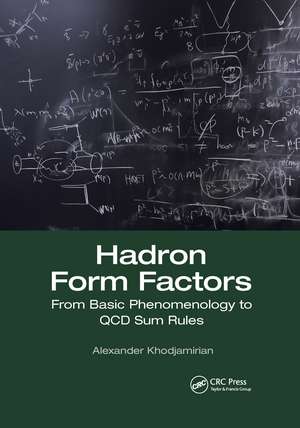
Hadron Form Factors: From Basic Phenomenology to QCD Sum Rules
Autor Alexander Khodjamirianen Limba Engleză Paperback – 13 dec 2021
This book will be a useful guide for graduate students and early-career researchers working in the field of particle phenomenology and experiments.
Features:
• The first book to address the phenomenology of hadron form factors at a pedagogical level in one coherent volume
• Contains up-to-date descriptions of the most important form factors of the electroweak transitions investigated in particle physics experiments
Preț: 488.53 lei
Puncte Express: 733
Carte tipărită la comandă
Livrare economică 07-21 decembrie
Livrare prin curier în România Termenul estimat este afișat lângă disponibilitate.
Transport gratuit pentru acest produs Plată online sau ramburs, în funcție de opțiunile comenzii.
Retur gratuit în 14 zile Comandă securizată și suport în română.
Specificații
ISBN-13: 9781032173030
ISBN-10: 1032173033
Pagini: 312
Ilustrații: 40 Illustrations, black and white
Dimensiuni: 178 x 254 x 17 mm
Greutate: 0.58 kg
Ediția:1
Editura: CRC Press
Colecția CRC Press
ISBN-10: 1032173033
Pagini: 312
Ilustrații: 40 Illustrations, black and white
Dimensiuni: 178 x 254 x 17 mm
Greutate: 0.58 kg
Ediția:1
Editura: CRC Press
Colecția CRC Press
V-ar putea interesa
-
 -9%Preț: 910.97 lei1001.06 lei
 -
 Military Laser TechnologyMcAulay-8%Preț: 617.12 lei670.77 lei
 -
 Dark Matter from Light: extending quantum mechanics to Newton's First LawMichael J. WallacePreț: 126.91 lei
 -
 -19%Preț: 679.20 lei838.52 lei
 -
 Chemie über den Wolken ... und DarunterR ZellnerPreț: 244.37 lei
 -
 Zurück vor den UrknallMartin BojowaldPreț: 147.32 lei
 -
 -8%Preț: 526.24 lei572.01 lei
 -
 Simulación de plasmas mediante las ecuaciones cinéticas de derivaJosé Miguel Reynolds Barredo-8%Preț: 465.23 lei505.69 lei
 -
 -19%Preț: 414.83 lei512.13 lei
 -
 Preț: 407.21 lei
 -
 Étude polarimétrique d''étoiles jeunesMarc-André Jolin-19%Preț: 503.24 lei621.28 lei
 -
 Etude expérimentale des instabilités fluides dans un plasma magnétiséFrédéric Brochard-19%Preț: 464.63 lei573.63 lei
Cuprins
1. QCD, Quark Currents and Hadrons. 2.. Meson Form Factors. 3. Baryon Form Factors. 4. Hadronic Padiative Transitions. 5. Form Factors in timelike Region. 6. Nonlocal Hadronic Matrix Elements. 7. Form Factor Asymptotics. 8. QCD Sum Rules. 9. Light-cone Expansion and Distribution Amplitudes. 10. QCD Light-cone Sum Rules
Notă biografică
Alexander Khodjamirian is a professor at the Department of Physics, University of Siegen, Germany. Dr. Khodjamirian received his PhD degree in theoretical physics from the Yerevan Physics Institute in 1980, where he later worked as a staff member in the Theory Division. In 1992 he moved to Germany, first as a Humboldt Fellow at Ludwig-Maximilian University in Munich, then as a research associate and visitor at various universities and research centers in Germany and Europe (LMU in Munich, University of Würzburg, NBI in Copenhagen, CERN, University of Lund, University of Karlsruhe). From 2004 he worked as a senior staff scientist, before becoming a professor at the University of Siegen in 2009. Prof. Dr. Khodjamirian is a foreign member of the Armenian National Academy of Sciences. He is highly respected in his field of scientific research, which is theoretical particle physics, quantum chromodynamics and the phenomenology of hadrons.
Recenzii
Form factors are certain functions that characterise distribution and flow of matter inside extended objects and are very common in particle and hadron physics. The book by A. Khodjamirian provides a general review of this broad topic at the level accessible for graduate students. The standard course in the theory of strong interactions, Quantum Chromodynamics, should be a prerequisite.
The book is addressed to students specialising in QCD phenomenology who want to familiarize themselves with the general concepts and learn how the calculations of hadron form factors are done in practice using several standard methods, without digging too much in the theory background. It will also be useful for experimenalists who are interested in an overall picture and want to understand where the theory predictions come from.
The last three chapters contain a somewhat more advanced material as compared to the rest of the book.
They will be very useful for practitioners as an introduction to the techniques of QCD sum rule calculations.
Prof. Dr. Vladimir Braun, Universität Regensburg
The book is addressed to students specialising in QCD phenomenology who want to familiarize themselves with the general concepts and learn how the calculations of hadron form factors are done in practice using several standard methods, without digging too much in the theory background. It will also be useful for experimenalists who are interested in an overall picture and want to understand where the theory predictions come from.
The last three chapters contain a somewhat more advanced material as compared to the rest of the book.
They will be very useful for practitioners as an introduction to the techniques of QCD sum rule calculations.
Prof. Dr. Vladimir Braun, Universität Regensburg
Descriere
This book introduces the theory of hadron form factors in a consistent manner, deriving step-by-step the key equations, defining the form factors, explaining their symmetry relations and applying mathematical tools to describe their behaviour. It is an ideal guide for graduate students studying particle physics and researchers.