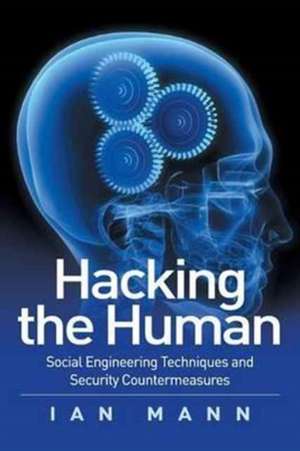
Hacking the Human
Autor Ian Mannen Limba Engleză Paperback – 22 aug 2016
Preț: 166.19 lei
Puncte Express: 249
Carte disponibilă
Livrare economică 29 octombrie-12 noiembrie
Livrare prin curier în România Termenul estimat este afișat lângă disponibilitate.
Transport gratuit de la 400.00 lei Plată online sau ramburs, în funcție de opțiunile comenzii.
Retur gratuit în 14 zile Comandă securizată și suport în română.
Specificații
ISBN-13: 9781910223741
ISBN-10: 1910223743
Pagini: 266
Dimensiuni: 152 x 229 x 14 mm
Greutate: 0.39 kg
Editura: Consilience Media
ISBN-10: 1910223743
Pagini: 266
Dimensiuni: 152 x 229 x 14 mm
Greutate: 0.39 kg
Editura: Consilience Media
V-ar putea interesa
-
 The Life ProjectHelen Pearson-18%Preț: 76.72 lei94.06 lei
 -
 The Happy Reader - Issue 9Penguin-17%Preț: 17.88 lei21.50 lei
 -
 Contemporary British SocietyNicholas AbercrombiePreț: 401.88 lei
 -
 American Culture in the 1970sWill Kaufman-16%Preț: 202.31 lei241.46 lei
 -
 Aboriginal Cultures in AlbertaSusan Berry-17%Preț: 116.61 lei139.78 lei
 -
 -27%Preț: 998.80 lei1361.95 lei
 -
 Native Americans: Developments, Policies & Research -- Volume 5Albert O Hughes-27%Preț: 1215.19 lei1658.01 lei
 -
 Conflicts in the City: Reflections on Urban UnrestLuis del Romero Renau-27%Preț: 1273.97 lei1736.20 lei
 -
 Chinese Civilization in the 21st CenturyAndrew Targowski-26%Preț: 643.91 lei873.74 lei
 -
 My Street Cats: Their Personality & Social BehaviorDr Raphaella BilskiPreț: 107.79 lei
 -
 Nikephoros: Zeitschrift für Sport und Kultur im AltertumPaul Christesen-19%Preț: 493.87 lei611.49 lei
Cuprins
Contents: Introduction; Part One The Risks: What is social engineering?; Understanding your risks; People, your weakest link; Limitations to current security thinking. Part Two Understanding Human Vulnerabilities: Trust me; Reading a person; Subconscious mind; Parent, Adult, Child. Part Three Countermeasures: Vulnerability mapping; Protection systems; Awareness and Training; Testing. Index.
Notă biografică
Ian Mann is Senior System Consultant with ECSC Ltd (www.ecsc.co.uk) a specialist information security consultancy. Ian has worked with a wide range of companies, including a number of leading financial institutions, to help them understand the risk from attacks by social engineers, and to develop effective countermeasures. He is also known for his presentations on the subject.
Descriere
Descriere de la o altă ediție sau format:
Ian Mann turns the black art of social engineering into an information security risk that can be understood, measured and managed effectively. The text highlights the main sources of risk from social engineering and draws on psychological models to explain the basis for human vulnerabilities.
Ian Mann turns the black art of social engineering into an information security risk that can be understood, measured and managed effectively. The text highlights the main sources of risk from social engineering and draws on psychological models to explain the basis for human vulnerabilities.