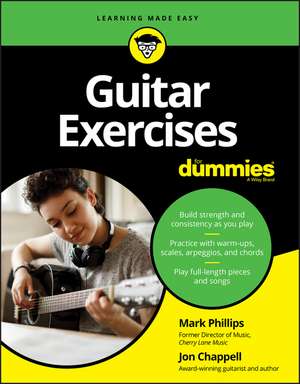
Guitar Exercises for Dummies
Autor Mark Phillips, Jon Chappellen Limba Engleză Paperback – 21 iul 2020
Notăm cu interes modul în care colecția de metodologii practice de la John Wiley & Sons, Inc. reușește să transforme rigoarea tehnică într-o experiență tactilă și logică. Guitar Exercises For Dummies nu este doar un manual, ci un atelier de lucru care pune accent pe senzația fizică a progresului. Remarcăm structura riguroasă care ghidează degetele de la simple exerciții de încălzire, executate chiar și în absența instrumentului, până la structuri complexe de arpegii și acorduri. Experiența de lectură este una activă: nu parcurgeți pagini de teorie aridă, ci sunteți invitați să simțiți tensiunea și relaxarea corectă a mușchilor prin indicații precise despre postura corpului. Fiecare capitol este construit pentru a clădi forță și consistență, integrând natural elemente de expresivitate precum dinamica și frazarea. Pe raftul de artă, alături de Technique Master de Christian J Triola, acest album se distinge prin abordarea sa enciclopedică și pragmatică, oferind peste 400 de exerciții ce funcționează ca un antrenament complet. În timp ce alte lucrări se concentrează pe stiluri specifice, aici regăsim o bază tehnică universală. Credem că această lucrare completează perfect titlurile anterioare ale autorilor, precum Guitar For Dummies sau Guitar All-in-One For Dummies. Dacă lucrările precedente puneau bazele teoretice și de întreținere a instrumentului, volumul de față acționează ca un motor de performanță, rafinând mecanica fină a execuției prin repetiție inteligentă și piese muzicale aplicate la finalul fiecărei secțiuni.
Preț: 158.56 lei
Carte disponibilă
Livrare economică 02-16 decembrie
Livrare express 18-24 noiembrie pentru 31.49 lei
Specificații
ISBN-10: 1119694566
Pagini: 240
Dimensiuni: 215 x 276 x 22 mm
Greutate: 0.46 kg
Editura: Wiley
Locul publicării:Hoboken, United States
V-ar putea interesa
-
 Guitar Fretboard WorkbookBarrett TagliarinoPreț: 136.56 lei
-
 Preț: 140.87 lei
-
 The Complete Book of Scales, Chords, ArpeggiosWillard PalmerPreț: 104.51 lei
-
 Preț: 138.07 lei
-
 Preț: 59.54 lei
-
 Ukulele Exercises For DummiesAlistair WoodPreț: 126.43 lei
-
 Mandolin Exercises for DummiesDon JulinPreț: 149.33 lei
-
 Guitar For Dummies, 4eHal Leonard CorporationPreț: 159.83 lei
-
 Bass Guitar Exercises For DummiesPatrick PfeifferPreț: 145.87 lei
-
 Singing Exercises For DummiesPamelia S. PhillipsPreț: 144.62 lei
-
 Guitar All-In-One for DummiesHal Leonard CorporationPreț: 211.42 lei
-
 Classical Guitar For Dummies, 2nd EditionJon ChappellPreț: 131.12 lei
-
 Guitar Chords for DummiesAntoine PolinPreț: 126.93 lei
-
 Guitar WorkoutJohn HeussenstammPreț: 238.36 lei
-
 Preț: 129.14 lei
-
 -14%Preț: 71.34 lei82.72 lei
-
 Preț: 163.48 lei
-
 Justinguitar.com Beginner's SongbookMusic SalesPreț: 212.88 lei
De ce să citești această carte
Recomandăm această carte oricărui chitarist care simte că a stagnat din punct de vedere tehnic. Câștigul principal este transformarea practicii zilnice într-un sistem logic de peste 400 de exerciții care dezvoltă forța degetelor și precizia. Este un ghid esențial pentru a trece de la simpla memorare a unor piese la stăpânirea fizică a instrumentului, indiferent de genul muzical abordat.
Despre autor
Mark Phillips este un chitarist, aranjor și editor cu o experiență de peste 30 de ani în industria editorială muzicală. Pregătirea sa academică este impresionantă, deținând o diplomă în teoria muzicii de la Case Western Reserve University și un masterat de la Northwestern University, unde a fost distins pentru excelență academică și ales membru în Pi Kappa Lambda. Această expertiză teoretică profundă se reflectă în precizia și claritatea exercițiilor pe care le propune, transformându-l într-una dintre cele mai autoritare voci în pedagogia chitarei moderne.
Notă biografică
Descriere scurtă
Cuprins
About This Book 1
Conventions We Use in This Book 2
What You're Not to Read 3
Foolish Assumptions 3
How This Book Is Organized 4
Part 1: Preparing to Practice 4
Part 2: Scales and Scale Sequences 4
Part 3: Arpeggios and Arpeggio Sequences 4
Part 4: Chords and Additional Exercises 4
Part 5: The Part of Tens 4
Icons Used in This Book 5
Where to Go from Here 5
Part 1: Preparing to Practice 7
Chapter 1: Reviewing Guitar Fundamentals 9
Perfecting Your Practice Posture 9
Brushing Up On Guitar Notation 10
Decoding tablature 10
Comprehending chord diagrams 11
Interpreting neck diagrams 11
Recognizing rhythm slashes 12
Chapter 2: Warming Up for Your Practice Sessions 13
Preparing Your Body and Mind to Play 13
Limbering up your fingers 13
Reflecting on your breathing, relaxation, and focus 14
Waking Up Your Fingers with Some Practice Exercises 15
Single-note exercises 16
Chord exercises 17
Part 2: Scales and Scale Sequences 19
Chapter 3: Putting the Major Scales to Use in Your Playing 21
Practicing Five Major Scale Patterns 21
Major scale pattern #1 22
Major scale pattern #2 24
Major scale pattern #3 25
Major scale pattern #4 27
Major scale pattern #5 28
Applying Your Scale Work to Actual Pieces of Music 29
"The First Noël" 29
Bach's "Minuet in G" 31
Chapter 4: Adding Major Scale Sequences to Your Repertoire 33
Practicing Major Scale Sequences 34
Major scale sequences using pattern #1 34
Major scale sequences using pattern #2 36
Major scale sequences using pattern #3 38
Major scale sequences using pattern #4 39
Major scale sequences using pattern #5 40
Putting Your Sequence Skills to Work with a Few Songs 42
"Oh, Them Golden Slippers" 42
"We Wish You a Merry Christmas" 43
Chapter 5: Tackling the Three Minor Scales 45
Familiarizing Yourself with Natural Minor Scales 45
Natural minor scale pattern #1 46
Natural minor scale pattern #2 47
Natural minor scale pattern #3 49
Natural minor scale pattern #4 50
Natural minor scale pattern #5 51
Raising the Bar with Melodic Minor Scales 53
Melodic minor scale pattern #1 53
Melodic minor scale pattern #2 55
Melodic minor scale pattern #3 56
Melodic minor scale pattern #4 58
Melodic minor scale pattern #5 59
Harmonizing with Harmonic Minor Scales 60
Harmonic minor scale pattern #1 61
Harmonic minor scale pattern #2 62
Harmonic minor scale pattern #3 63
Harmonic minor scale pattern #4 65
Harmonic minor scale pattern #5 66
Playing Pieces Using the Three Minor Scales 67
"God Rest Ye Merry, Gentlemen" 67
Handel's "Allegro" 68
"The Three Ravens" 69
Chapter 6: Examining Minor Scale Sequences 71
It's Only Natural: Practicing Natural Minor Scale Sequences 71
Natural minor scale sequences using pattern #1 72
Natural minor scale sequences using pattern #2 73
Natural minor scale sequences using pattern #3 74
Natural minor scale sequences using pattern #4 74
Natural minor scale sequences using pattern #5 75
Up and Down the Scale: Practicing Melodic Minor Scale Sequences 76
Melodic minor scale sequences using pattern #1 76
Melodic minor scale sequences using pattern #2 77
Melodic minor scale sequences using pattern #3 78
Melodic minor scale sequences using pattern #4 79
Melodic minor scale sequences using pattern #5 79
Discovering a More Intense Sound with Harmonic Minor Scale Sequences 80
Harmonic minor scale sequences using pattern #1 81
Harmonic minor scale sequences using pattern #2 82
Harmonic minor scale sequences using pattern #3 83
Harmonic minor scale sequences using pattern #4 84
Harmonic minor scale sequences using pattern #5 85
Practicing Some Pieces Using Minor Scale Sequences 85
"To Work upon the Railroad" 86
Bach's "Bourrée in E Minor" 87
"The Full Little Jug" 88
Part 3: Arpeggios and Arpeggio Sequences 89
Chapter 7: Breaking Out with Major Arpeggios 91
Preparing Yourself for Major Chords by Practicing Major Arpeggios 91
Major arpeggio pattern #1 92
Major arpeggio pattern #2 93
Major arpeggio pattern #3 94
Major arpeggio pattern #4 95
Major arpeggio pattern #5 95
Applying Your Skills: Performing Pieces Using Major Arpeggios 96
"To the Colors" 97
"Retreat" 98
Chapter 8: Discovering How to Play Major Arpeggio Sequences 99
Picking Up On Major Arpeggio Sequences 99
Major arpeggio sequences using pattern #1 100
Major arpeggio sequences using pattern #2 101
Major arpeggio sequences using pattern #3 102
Major arpeggio sequences using pattern #4 104
Major arpeggio sequences using pattern #5 105
Playing Pieces That Feature Major Arpeggio Sequences 106
"Blues Riff in B" 106
"Doo-Wop Groove in A" 108
Chapter 9: Getting to Know Minor Arpeggios 109
Working On Minor Arpeggios 110
Minor arpeggio pattern #1 110
Minor arpeggio pattern #2 111
Minor arpeggio pattern #3 113
Minor arpeggio pattern #4 114
Minor arpeggio pattern #5 115
Playing Pieces with Minor Arpeggios 116
"Wolfgang's Whistle" 116
"Amadeus's Air" 117
Chapter 10: Looking at Minor Arpeggio Sequences 119
Adding Minor Arpeggio Sequences to Your Practice Sessions 119
Minor arpeggio sequences using pattern #1 120
Minor arpeggio sequences using pattern #2 121
Minor arpeggio sequences using pattern #3 122
Minor arpeggio sequences using pattern #4 124
Minor arpeggio sequences using pattern #5 125
Tackling a Few Pieces Composed of Minor Arpeggio Sequences 126
"Mozart's Motif" 126
Schumann's "The Wild Horseman" 128
Chapter 11: Enhancing Your Playing with Seventh Chord Arpeggios 131
Practicing Dominant Seventh Chord Arpeggios 132
Dominant seventh chord arpeggio pattern #1 132
Dominant seventh chord arpeggio pattern #2 133
Dominant seventh chord arpeggio pattern #3 134
Dominant seventh chord arpeggio pattern #4 135
Dominant seventh chord arpeggio pattern #5 135
Putting Your Fingers to Work with Minor Seventh Chord Arpeggios 136
Minor seventh chord arpeggio pattern #1 137
Minor seventh chord arpeggio pattern #2 138
Minor seventh chord arpeggio pattern #3 139
Minor seventh chord arpeggio pattern #4 140
Minor seventh chord arpeggio pattern #5 141
Running Through the Major Seventh Chord Arpeggios 142
Major seventh chord arpeggio pattern #1 142
Major seventh chord arpeggio pattern #2 143
Major seventh chord arpeggio pattern #3 144
Major seventh chord arpeggio pattern #4 145
Major seventh chord arpeggio pattern #5 146
Applying Seventh Chord Arpeggios to Some Famous Pieces 147
Schubert's "Ave Maria" 147
Fauré's "Pavane" 149
Chapter 12: Trying Your Hand at Seventh Chord Arpeggio Sequences 153
Taking On Dominant Seventh Chord Arpeggio Sequences 153
Dominant seventh chord arpeggio sequence using pattern #1 154
Dominant seventh chord arpeggio sequence using pattern #2 154
Dominant seventh chord arpeggio sequence using pattern #3 155
Dominant seventh chord arpeggio sequence using pattern #4 156
Dominant seventh chord arpeggio sequence using pattern #5 156
Adding Minor Seventh Chord Arpeggio Sequences to Your Collection 157
Minor seventh chord arpeggio sequence using pattern #1 157
Minor seventh chord arpeggio sequence using pattern #2 158
Minor seventh chord arpeggio sequence using pattern #3 159
Minor seventh chord arpeggio sequence using pattern #4 159
Minor seventh chord arpeggio sequence using pattern #5 160
Practicing Major Seventh Chord Arpeggio Sequences 161
Major seventh chord arpeggio sequence using pattern #1 161
Major seventh chord arpeggio sequence using pattern #2 162
Major seventh chord arpeggio sequence using pattern #3 162
Major seventh chord arpeggio sequence using pattern #4 163
Major seventh chord arpeggio sequence using pattern #5 164
Playing Pieces with Seventh Chord Arpeggio Sequences 164
Liszt's "Liebestraum" 165
Bach and Gounod's "Ave Maria" 165
Part 4: Chords and Additional Exercises 167
Chapter 13: Building Finger Independence with Chord Exercises 169
Practicing Inversion Patterns 170
Patterns using outside chords 170
Patterns using inside chords 178
Playing Chord Progressions 185
Progressions using outside chords 185
Progressions using inside chords 186
Practicing Pieces That Use Chord Progressions 187
Putting outside chords to use with "Danny Boy" 187
Playing inside chords in "Look for the Silver Lining" 189
Chapter 14: Developing Strength and Speed by Playing Single-Note Exercises 191
Moving Across the Neck 192
Stepping up and down on one string 192
Skipping around on one string 193
Jumping around on different strings 194
Moving Along the Neck 195
Climbing up and down the strings 196
Ascending and descending with diagonals 198
Part 5: The Part of Tens 201
Chapter 15: Ten Tips for Maximizing Your Practice Time 203
Establish Your Practice Place 203
Define Your Practice Time (and Stick to It) 203
Establish Objectives for Your Practice Sessions 204
Keep Your Accessories Handy 204
Get Your Head in the Game 204
Warm Up Your Hands and Fingers 204
Start Slow and Work Your Way Up 204
Isolate Difficult Passages 205
Play Different Guitars 205
Join the Club 205
Chapter 16: Ten Ways to Improve Your Musicianship 207
Get with the Rhythm 207
Familiarize Yourself with Pitch 207
Discover Harmony 208
Perform Live for a Crowd 208
Compose Your Own Melody and Improvise a Bit 208
Train Your Ear to Hear 208
Polish Your Playing with Expression 208
Listen to Lots of Music 209
Watch a Performer's Body Language 209
Test Yourself by Teaching Someone Else 209
Appendix A: How to Use The Website 211