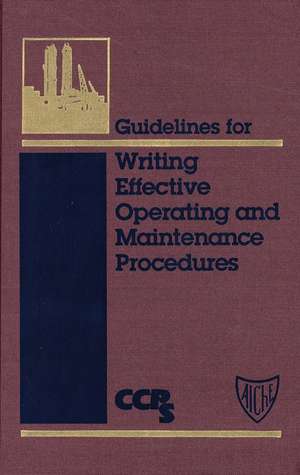
Guidelines for Writing Effective Operating and Maintenance Procedures
Autor Center for Chemical Process Safety (CCPS)en Limba Engleză Hardback – 15 mai 1996
Preț: 1029.24 lei
Preț vechi: 1131.03 lei
-9%
Puncte Express: 1544
Carte tipărită la comandă
Livrare economică 03-17 decembrie
Livrare prin curier în România Termenul estimat este afișat lângă disponibilitate.
Transport gratuit pentru acest produs Plată online sau ramburs, în funcție de opțiunile comenzii.
Retur gratuit în 14 zile Comandă securizată și suport în română.
Specificații
ISBN-13: 9780816906581
ISBN-10: 0816906580
Pagini: 160
Dimensiuni: 157 x 235 x 14 mm
Greutate: 0.4 kg
Editura: Wiley
Locul publicării:Hoboken, United States
ISBN-10: 0816906580
Pagini: 160
Dimensiuni: 157 x 235 x 14 mm
Greutate: 0.4 kg
Editura: Wiley
Locul publicării:Hoboken, United States
V-ar putea interesa
-
 Herbs, Botanicals and TeasB. Dave Oomah-15%Preț: 530.47 lei624.09 lei
-
 Internal Reflection and ATR SpectroscopyMilan Milosevic-8%Preț: 650.06 lei706.59 lei
-
 ADME TechnologiesZhang-9%Preț: 1280.43 lei1407.07 lei
-
 Bioinspiration and BiomimicrySwiegers-9%Preț: 973.25 lei1069.51 lei
-
 Endocrine DisruptersMatthiessen-9%Preț: 894.14 lei982.57 lei
-
 Preț: 457.99 lei
-
 International Tables for Crystallography, Volume HChristopher J Gilmore-23%Preț: 2626.98 lei3411.66 lei
-
 -23%Preț: 587.49 lei762.97 lei
-
 -23%Preț: 760.33 lei987.43 lei
-
 Guidelines for Asset Integrity ManagementCcps (Center for Chemical Process Saf-9%Preț: 954.80 lei1049.23 lei
-
 Essential Practices for Creating, Strengthening, and Sustaining Process Safety CultureCenter for Chemical Process Safety (CCPS)-23%Preț: 694.32 lei901.71 lei
-
 -27%Preț: 697.47 lei955.44 lei
-
 Guidelines for Siting and Layout of FacilitiesCcps (Center For Chemical Process Safety)-9%Preț: 1089.59 lei1197.35 lei
-
 The Science of Cooking: A Quick ImmersionClaudi MansPreț: 77.90 lei
-
 Preț: 377.20 lei
-
 -11%Preț: 382.54 lei429.81 lei
-
 Spatially resolved immobilization of metallopolymersRouven Müller-23%Preț: 787.43 lei1022.64 lei
-
 The Enzymes in Synthesis of Chiral Bioactive CompoundsNesrin Mahmoud Morsy MohamedPreț: 378.33 lei
-
 Analytical chemistry (Volume I) Qualitative AnalysisF. P TreadwellPreț: 222.29 lei
Public țintă
Professionals in industry and academia concerned with process safety, hazard prevention, risk assesment, and health and safety.Notă biografică
The CENTER FOR CHEMICAL PROCESS SAFETY (CCPS), an industry technology alliance of the American Institute of Chemical Engineers (AIChE), has been a world leader in developing and disseminatinginformation on process safety management and technology since 1985. CCPS has published over 80 books in its process safety guidelines and process safety concepts series. For more information, visit www.ccpsonline.org.
Cuprins
Preface.
Acknowledgments.
Glossary.
Chapter 1. Introduction to Effective Procedure Writing.
1.1. Why Was This Book Written?
1.2. Book Objectives.
1.3. The Current Worldwide Trend Toward Procedures.
1.4. Who Should Use This Book?
1.5. Where Do You Go From Here?
Chapter 2. Process Safety Environmental, and Quality Considerations.
2.1. Purpose.
2.2. Understanding the Guidelines and Regulations.
2.3. Voluntary Guidelines.
2.4. Governmental Regulations.
2.5. Quality Considerations.
2.6. Some Elements of Effective Procedures and Procedure.
Management Systems.
2.7. Additional Considerations.
2.8. Conclusion.
Endnotes.
Chapter 3. How to Design An Operating and Maintenance Procedure Management System.
3.1. Purpose.
3.2. The Importance of Written Procedures.
3.3. Elements of a Comprehensive Procedure Management System.
3.4. Determining Procedure Management System Requirements.
3.5. Evaluating Your Current Practices.
3.6. Identifying Your Resources.
3.7. Designing and Implementing Your Procedures Management System.
3.8. How to Determine Which Procedures to Write.
3.9. Implementing a Procedure Project.
3.10. Procedure Training.
3.11. Maintaining and Improving Your Procedure Management System.
3.12. Conclusion.
Chapter 4. Writing Operating and Maintenance Procedures.
4.1. Purpose.
4.2. What Resources Do You Need Before You Begin Writing?
4.3. What Do We Know About the Procedure.
4.4. Considerations for Effective Procedures.
4.5. Importance of Procedure Format.
4.6. Introductory Sections.
4.7. Procedure Steps Section.
4.8. Drafting the Procedure.
4.9. The Procedure Review and Approval Cycle.
4.10. Special Considerations for Maintenance Procedures.
4.11. Batch Process Considerations.
Chapter 5. Elements of Effective Procedures.
5.1. Purpose.
5.2. Importance of Procedure Evaluation Criteria.
5.3. Who Will Use the Procedure Evaluation Criteria?
5.4. Procedure Checklists Elements.
Endnotes.
Chapter 6. Writing Emergency Operating Procedures.
6.1. Purpose.
6.2. Defining Events Requiring Emergency Operating Procedures.
6.3. Identifying Emergency Situations.
6.4. Developing and Writing Emergency Operating Procedures.
6.5. Directing the User to the Correct Emergency Operating Procedure.
6.6. Incorporating Human Factors in Emergency Operating Procedures.
6.7. using Decision Aids.
6.8. How Emergency Operating Procedures Link to the Emergency Response Plan.
Endnotes.
Chapter 7. Procedure Control.
7.1. Purpose.
7.2. What Is Procedure Control?
7.3. Controlling Procedure Revisions and Development.
7.4. Who Should Review the Procedures?
7.5. Procedure Approval.
7.6. Evaluating Procedures In Use.
7.7. Electronic Document Control.
Chapter 8. Procedure Development Costs and Benefits.
8.1. Purpose.
8.2. reasons for Procedure Development.
8.3. Procedure Development Costs.
8.4. Return on Investment: Improvements You Can Expect from Effective Procedures.
Endnotes.
Appendix A. Selected Procedure Initiatives, Consensus Codes, and Regulations Affecting Procedures.
Appendix B. Common Points of API, OSHA, and EPA.
Appendix C. How to Determine the Tasks That Require Written Procedures.
Appendix D. Procedure Performance Evaluation.
Appendix E. Procedure Criteria Checklist.
Appendix F. Sample Procedure Formats.
Appendix G. Sample Formats of Operating Limits Tables.
General References.
Index.