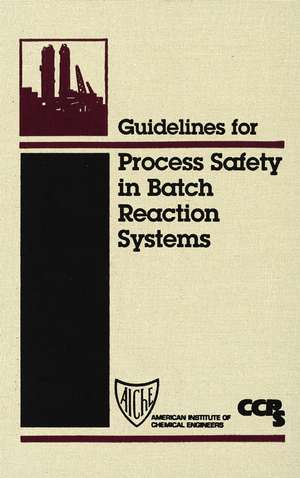
Guidelines for Process Safety in Batch Reaction Systems
Autor Center for Chemical Process Safety (Ccps, Center for Chemical Process Safety (CCPS)en Limba Engleză Hardback – 15 sep 1999
Preț: 1059.33 lei
Preț vechi: 1164.10 lei
-9%
Carte tipărită la comandă
Livrare economică 24 decembrie 26 - 07 ianuarie 27
Specificații
ISBN-10: 0816907803
Pagini: 196
Dimensiuni: 157 x 235 x 15 mm
Greutate: 0.45 kg
Ediția:Revised edition
Editura: Wiley
Locul publicării:Hoboken, United States
V-ar putea interesa
-
 Excel for ChemistsE Joseph Billo-20%Preț: 461.42 lei576.77 lei
-
 20% Chance of RainJonesPreț: 347.43 lei
-
 Guidelines for Hazard Evaluation ProceduresCenter for Chemical Process Safety (CCPS)-9%Preț: 1063.28 lei1168.44 lei
-
 Guidelines for Determining the Probability of Ignition of a Released Flammable MassCcps (Center for Chemical Process Saf-8%Preț: 652.74 lei709.49 lei
-
 Corrosion and Materials SelectionAlireza Bahadori-9%Preț: 1566.77 lei1721.72 lei
-
 Fundamental Concepts in Heterogeneous CatalysisJens K Nørskov-23%Preț: 601.73 lei781.46 lei
-
 -23%Preț: 760.33 lei987.43 lei
-
 Guidelines for Asset Integrity ManagementCcps (Center for Chemical Process Saf-9%Preț: 960.22 lei1055.19 lei
-
 Essential Practices for Creating, Strengthening, and Sustaining Process Safety CultureCenter for Chemical Process Safety (CCPS)-23%Preț: 698.27 lei906.85 lei
-
 Guidelines for Siting and Layout of FacilitiesCcps (Center for Chemical Process Saf-9%Preț: 1095.79 lei1204.17 lei
-
 The Story Book of ScienceJean Henri FabrePreț: 103.82 lei
-
 Food Processing Handbook 2e 2V SetJG Brennan-14%Preț: 1974.63 lei2296.09 lei
-
 Sambucus Nigra L.: Analyse Du Roman Et Du FilmNassim DjabouPreț: 438.53 lei
Public țintă
Process safety managers and professionals working with batch reaction systems.Notă biografică
Cuprins
Acknowledgments.
Acronyms and Abbreviations.
Chapter 1. Process Safety in Batch Reaction Systems.
1.1. Scope.
1.2. Special Concerns of Batch Reaction Systems.
1.3. Approach Used in Guidelines.
Chapter 2. Chemistry.
2.1. Introduction.
2.2. Case Study.
2.3. Key Issues.
2.4. Process Safety Practices.
Table 2: Chemistry.
Appendix 2A. Chemical Reactivity Hazards Screening.
A.1. Understand the Problem.
A.2. Conduct Theoretical Screening.
A.3. Conduct Experimental Screening.
A.4. Conduct Experimental Analysis.
Chapter 3. Equipment Configuration and Layout.
3.1. Introduction.
3.2. Case Studies.
Pump Leak Incidents.
Tank Farm Fire.
3.3. Key Issues.
3.4. Process Safety Practices.
Table 3: Equipment Configuration and Layout.
Chapter 4. Equipment.
4.1. Introduction.
Vessels Including Reactors and Storage Vessels.
Centrifuges.
Dryers.
Batch Distillation Columns and Evaporators.
Process Vents and Drains.
Charging and Transferring Equipment.
Drumming Equipment.
Milling Equipment.
Filters.
4.2. Case Studies.
Batch Pharmaceutical Reactor Accident.
Seveso Runaway Reaction.
Pharmaceutical Powder Dryer Fire and Explosion.
4.3. Key Issues.
4.4. Process Safety Practices.
Table 4.0: General.
Table 4.1: Reactors and Vessels.
Table 4.3: Dryers.
Table 4.5: Process Vents and Drains.
Table 4.6: Transferring and Charging Equipment.
Table 4.7: Drumming Equipment.
Table 4.8: Milling Equipment.
Table 4.9: Filters.
Appendix 4A. Storage and Warehousing.
Chapter 5. Instrumentation/Control Systems.
5.1. Introduction.
5.2. Case Study.
5.3. Key Issues.
5.4. Process Safety Practices.
Table 5: Instrumentation/Control Systems.
Chapter 6. Operations and Procedures.
6.1. Introduction.
6.2. Case Studies.
Initiator Overcharging Incident.
Reactant Stratification Incident.
6.3. Key Issues.
6.4. Process Safety Practices.
Table 6: Operations and Procedures.
References.
Glossary.