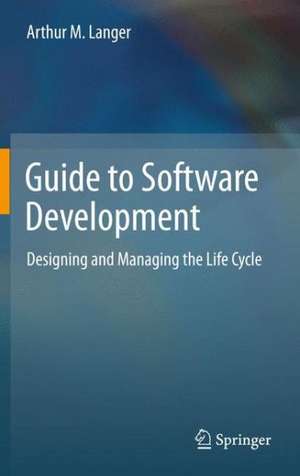
Guide to Software Development
Autor Arthur M Langeren Limba Engleză Paperback – 22 feb 2014
Preț: 389.07 lei
Preț vechi: 617.23 lei
-37%
Puncte Express: 584
Carte indisponibilă temporar
Livrare prin curier în România Termenul estimat este afișat lângă disponibilitate.
Transport gratuit de la 400.00 lei Plată online sau ramburs, în funcție de opțiunile comenzii.
Retur gratuit în 14 zile Comandă securizată și suport în română.
Specificații
ISBN-13: 9781447161691
ISBN-10: 1447161696
Pagini: 354
Ilustrații: XVIII, 354 p.
Dimensiuni: 155 x 235 x 21 mm
Greutate: 0.56 kg
Ediția:2012 edition
Editura: SPRINGER LONDON
Locul publicării:London, United Kingdom
ISBN-10: 1447161696
Pagini: 354
Ilustrații: XVIII, 354 p.
Dimensiuni: 155 x 235 x 21 mm
Greutate: 0.56 kg
Ediția:2012 edition
Editura: SPRINGER LONDON
Locul publicării:London, United Kingdom
V-ar putea interesa
-
 Understanding BeliefsNils J Nilsson-18%Preț: 77.30 lei94.68 lei
 -
 Human-Computer SystemsEldo C Koenig-8%Preț: 550.80 lei598.70 lei
 -
 Type-2 Fuzzy Logic ControlMendel-20%Preț: 768.63 lei960.78 lei
 -
 DATA BonanzaAtkinson-20%Preț: 714.60 lei893.25 lei
 -
 Dragon Professional Individual for DummiesStephanie Diamond-20%Preț: 180.15 lei225.19 lei
 -
 Practical OpenCVSamarth Brahmbhatt-20%Preț: 306.69 lei383.37 lei
 -
 Designing Voice User InterfacesCathy Pearl-20%Preț: 195.53 lei244.41 lei
 -
 Computational IntelligenceAlexandru Floares-35%Preț: 1012.79 lei1567.33 lei
 -
 Artificial Intelligence for Building Energy AnalysisFr'd'ric Magoul's-20%Preț: 923.76 lei1154.70 lei
 -
 -20%Preț: 955.67 lei1194.58 lei
Public țintă
Professional/practitionerCuprins
Introduction.- Part I: Determining Needs.- Assessing Business Requirements.- Build vs. Buy Issues.- Establishing Requirements (RFI, RFP).- Searching for Solutions.- Controlling Costs and Realistic Budgeting.- Analysis Methods and Tools.- Part II: Development Architecture.- Creating Requirement Documents using Analysis Tools.- The Data.- Legacy Systems and Data Conversion.- Business Process Reengineering.- Data Analytics and Data Warehouses.- Documentation and Acceptance Testing.- Part III: How to Implement.- Project Management.- Standards and ISO 9000.- Vendor Contract Considerations.- Going Live and Conclusions.
Textul de pe ultima copertă
The challenge of improving the quality and process of implementing enterprise software has only become more complex, and software products for enterprise resource planning (ERP) often fail to provide quicker and more cost-effective solutions. Furthermore, the decision whether to make or buy software is not a simple one.
This Guide to Software Development addresses the problem of how best to make such decisions, and what effect such decisions have on the software development life cycle (SDLC). Offering an integrated approach that includes important management and decision practices, this text/reference explains how to create successful automated solutions that fit user and customer needs, by mixing different SDLC methodologies. Guiding readers through the theory, and applying this to the realities of practice, the book offers essential advice on defining accurate business requirements, and managing change.
Topics and features:
This Guide to Software Development addresses the problem of how best to make such decisions, and what effect such decisions have on the software development life cycle (SDLC). Offering an integrated approach that includes important management and decision practices, this text/reference explains how to create successful automated solutions that fit user and customer needs, by mixing different SDLC methodologies. Guiding readers through the theory, and applying this to the realities of practice, the book offers essential advice on defining accurate business requirements, and managing change.
Topics and features:
- Provides concrete examples and effective case studies
- Focuses on the skills and insights that distinguish successful software implementations
- Covers management issues as well as technical considerations, including how to deal with political and cultural realities in organizations
- Identifies many new alternatives for how to manage and model a system using sophisticated analysis tools and advanced management practices
- Emphasizes how and when professionals can best apply these tools and practices, and what benefits can be derived from their application
- Discusses searching for vendor solutions, and vendor contract considerations
Caracteristici
Explains how to create successful automated solutions that fit user and customer needs, by mixing different SDLC methodologies Guides readers through the theory, and application in real practice, covering management issues as well as technical considerations Includes chapter-ending problems and exercises, and concrete examples and effective case studies, as well as useful Appendices, a Glossary, and suggestions for further reading