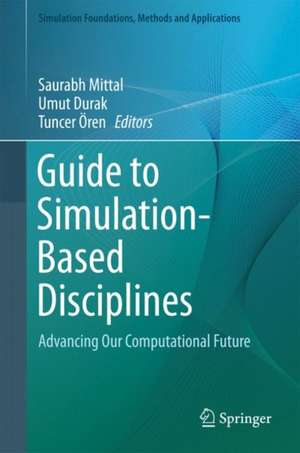
Guide to Simulation-Based Disciplines: Simulation Foundations, Methods and Applications
Editat de Saurabh Mittal, Umut Durak, Tuncer Örenen Limba Engleză Hardback – 9 aug 2017
ABORDAREA PRACTICĂ: În volumul Guide to Simulation-Based Disciplines, raportul dintre fundamentul teoretic și aplicabilitatea imediată este echilibrat prin studii de caz concrete și întrebări de verificare la finalul fiecărui capitol. Descoperim aici o resursă care nu se limitează la definirea conceptelor, ci demonstrează cum modelarea și simularea (M&S) devin motoare de progres în domenii diverse, de la arhitectură și medicină până la științe sociale și management organizațional. Dacă Body of Knowledge for Modeling and Simulation v-a oferit cadrul teoretic și organizarea terminologică a disciplinei, această carte oferă instrumentele practice necesare pentru a implementa aceste modele în scenarii reale. Notăm cu interes modul în care editorii au structurat progresia informației. Partea I stabilește evoluția istorică și peisajul tehnologic actual, în timp ce secțiunile următoare plonjează în aplicații specifice. Analizăm, de pildă, rolul simulării în designul ingineresc și integrarea acesteia în paradigma ingineriei sistemelor, cu un accent deosebit pe sistemele cibernetico-fizice și Internet of Things. Considerăm că abordarea este una exhaustivă, acoperind inclusiv utilizarea simulării în antrenamentele militare și în procesul de învățare. Această lucrare consolidează direcția de cercetare a editorilor, situându-se la intersecția dintre lucrările anterioare ale lui Saurabh Mittal. Dacă în Netcentric System of Systems Engineering with DEVS Unified Process accentul cădea pe interoperabilitatea sistemelor eterogene, volumul de față extinde viziunea asupra întregului ciclu de viață al designului software. Este o piesă centrală în seria Simulation Foundations, Methods and Applications, servind drept punte între cercetarea academică și rigoarea necesară în aplicațiile industriale complexe.
Din seria Simulation Foundations, Methods and Applications
- 20%
 Preț: 376.27 lei
 - 20%
 Preț: 853.83 lei
 - 20%
 Preț: 666.52 lei
 - 20%
 Preț: 405.31 lei
 -
 Preț: 425.63 lei
 - 20%
 Preț: 328.37 lei
 - 20%
 Preț: 1084.67 lei
 - 20%
 Preț: 598.58 lei
 - 20%
 Preț: 1213.79 lei
 - 20%
 Preț: 678.02 lei
 - 20%
 Preț: 852.69 lei
 - 20%
 Preț: 679.12 lei
 - 20%
 Preț: 673.39 lei
 - 20%
 Preț: 345.78 lei
 - 20%
 Preț: 337.80 lei
 - 20%
 Preț: 670.94 lei
 - 20%
 Preț: 617.03 lei
 - 20%
 Preț: 546.76 lei
 - 20%
 Preț: 700.07 lei
 - 20%
 Preț: 1545.23 lei
 - 20%
 Preț: 336.33 lei
 - 20%
 Preț: 742.75 lei
 - 20%
 Preț: 564.57 lei
 - 20%
 Preț: 1210.47 lei
Preț: 682.88 lei
Preț vechi: 853.60 lei
-20%
Carte disponibilă
Livrare economică 10-24 noiembrie
Specificații
ISBN-10: 3319612638
Pagini: 392
Ilustrații: XIX, 370 p. 86 illus., 57 illus. in color.
Dimensiuni: 160 x 241 x 26 mm
Greutate: 0.77 kg
Ediția:1st edition 2017
Editura: Springer
Colecția Simulation Foundations, Methods and Applications
Seria Simulation Foundations, Methods and Applications
Locul publicării:Cham, Switzerland
V-ar putea interesa
-
 What's Inside My Computer?Christine Zuchora-Walske-18%Preț: 44.14 lei53.60 lei
 -
 Simulation and Modeling Methodologies, Technologies and ApplicationsMohammad S. Obaidat-20%Preț: 995.93 lei1244.91 lei
 -
 The Innovation in Computing CompanionGerard O'Regan-20%Preț: 190.01 lei237.51 lei
 -
 Simulation and Modeling Methodologies, Technologies and ApplicationsMohammad S. Obaidat-20%Preț: 630.50 lei788.13 lei
 -
 Simulation and Modeling Methodologies, Technologies and ApplicationsMohammad S. Obaidat-20%Preț: 986.11 lei1232.64 lei
 -
 Simulation and Modeling Methodologies, Technologies and ApplicationsMohammad S. Obaidat-20%Preț: 631.12 lei788.90 lei
 -
 Simulation and Modeling Methodologies, Technologies and ApplicationsMohammad S. Obaidat-20%Preț: 961.13 lei1201.41 lei
 -
 -20%Preț: 943.76 lei1179.70 lei
 -
 History and Philosophy of ComputingFabio Gadducci-20%Preț: 371.55 lei464.44 lei
 -
 Advances in Conceptual ModelingSebastian Link-20%Preț: 333.74 lei417.18 lei
 -
 Simulation and Modeling Methodologies, Technologies and ApplicationsMohammad S. Obaidat-20%Preț: 961.47 lei1201.84 lei
 -
 Information Modelling for Archaeology and AnthropologyCesar Gonzalez-Perez-20%Preț: 448.51 lei560.63 lei
 -
 Computer Aided Systems Theory - EUROCAST 2017Roberto Moreno-Díaz-20%Preț: 346.74 lei433.42 lei
 -
 Modelling and Simulation in Science, Technology and Engineering MathematicsSurajit Chattopadhyay-20%Preț: 742.01 lei927.52 lei
 -
 Advances in Aeronautical InformaticsUmut Durak-20%Preț: 739.95 lei924.94 lei
 -
 -20%Preț: 344.18 lei430.22 lei
 -
 Monte Carlo and Quasi-Monte Carlo MethodsArt B. Owen-20%Preț: 685.76 lei857.20 lei
 -
 Algorithmic Game TheoryXiaotie Deng-20%Preț: 334.80 lei418.50 lei
 -
 Advances in Computing and Data SciencesMayank Singh-20%Preț: 343.63 lei429.54 lei
 -
 -20%Preț: 343.74 lei429.68 lei
De ce să citești această carte
Pentru cercetătorii și practicienii care doresc să treacă de la simpla modelare la o infrastructură robustă de simulare, acest ghid este esențial. Veți câștiga o înțelegere aplicată a modului în care simularea poate optimiza procesele în inginerie, medicină sau management. Este recomandată celor care au nevoie de dovezi concrete privind beneficiile simulării în avansarea propriului domeniu de activitate, oferind un fundament solid pentru viitorul computațional.
Despre autor
Saurabh Mittal, Umut Durak și Tuncer Ören sunt figuri proeminente în comunitatea internațională de modelare și simulare. Saurabh Mittal este recunoscut pentru expertiza sa în ingineria sistemelor de sisteme și procese unificate DEVS, având o contribuție majoră în adaptarea simulării pentru medii netcentrice și sisteme cibernetico-fizice. Tuncer Ören, un pionier al domeniului, a contribuit decisiv la stabilirea unui 'Body of Knowledge' pentru M&S. Împreună, acești editori aduc o perspectivă multidisciplinară, combinând experiența academică cu necesitățile practice din inginerie, apărare și managementul complexității.
Descriere scurtă
Cuprins
Recenzii