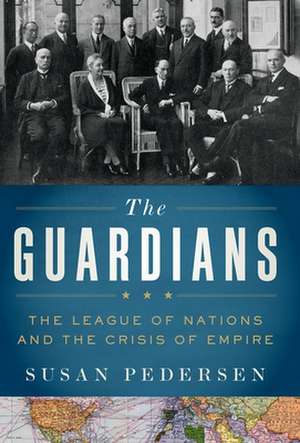
Guardians
Autor Susan Pedersenen Limba Engleză Paperback – dec 2017
| Toate formatele și edițiile | Preț | Express |
|---|---|---|
| Paperback (2) | 106.97 lei 44-50 zile | +59.93 lei 4-10 zile |
| OUP OXFORD – 13 iul 2017 | 106.97 lei 44-50 zile | +59.93 lei 4-10 zile |
| Oxford University Press – dec 2017 | 148.14 lei 3-5 săpt. | |
| Hardback (1) | 318.94 lei 3-5 săpt. | |
| Oxford University Press – | 318.94 lei 3-5 săpt. |
Preț: 148.14 lei
Puncte Express: 222
Preț estimativ în valută:
26.20€ • 30.04$ • 22.64£
26.20€ • 30.04$ • 22.64£
Carte disponibilă
Livrare economică 07-21 aprilie
Specificații
ISBN-13: 9780190619121
ISBN-10: 0190619120
Pagini: 590
Dimensiuni: 140 x 210 x 31 mm
Greutate: 0.68 kg
Editura: Oxford University Press
ISBN-10: 0190619120
Pagini: 590
Dimensiuni: 140 x 210 x 31 mm
Greutate: 0.68 kg
Editura: Oxford University Press
V-ar putea interesa
-
 The Return of the Native: American Indian Political ResurgenceStephen Cornell-8%Preț: 305.75 lei332.86 lei
 -
 -34%Preț: 1645.00 lei2508.70 lei
 -
 The Oxford Handbook of the History of International LawBardo Fassbender-28%Preț: 386.79 lei538.22 lei
 -
 Imperialism Past and PresentEmanuele SaccarelliPreț: 201.27 lei
 -
 Sir Robert and Sir William -- Two Europeans in IndiaElizabeth Hamilton-22%Preț: 367.90 lei469.95 lei
 -
 -27%Preț: 694.37 lei955.80 lei
 -
 Preț: 380.51 lei
 -
 Preț: 447.95 lei
 -
 Beyond the StateAnna Greenwood-23%Preț: 744.52 lei966.91 lei
 -
 Cultures of decolonisationRuth Craggs-23%Preț: 698.87 lei907.62 lei
 -
 Democratization and Human Security in Postwar Sierra LeoneJoseph J BanguraPreț: 374.76 lei
 -
 -15%Preț: 401.99 lei472.93 lei
 -
 -18%Preț: 1077.74 lei1314.32 lei
 -
 Preț: 327.02 lei
 -
 Innovative Departures: Anthropology and the Indian DiasporaRavindra K. Jain-18%Preț: 1191.57 lei1453.13 lei
 -
 -18%Preț: 877.67 lei1070.32 lei
 -
 Imperialism: A StudyJ. A. Hobson-18%Preț: 1062.01 lei1295.14 lei
 -
 Transnationalism, Education and Empowerment: The Latent Legacies of EmpireNiranjan Casinader-18%Preț: 1193.81 lei1455.86 lei
 -
 Preț: 453.10 lei
 -
 Preț: 308.87 lei
 -
 How Empire Shaped UsProfessor Antoinette BurtonPreț: 183.66 lei
 -
 Global MigrationsAngela McCarthy-18%Preț: 166.78 lei202.94 lei
 -
 Preț: 266.42 lei
 -
 'Ich bin eine Kanackin'Pinar Tuzcu-23%Preț: 220.14 lei286.95 lei
Notă biografică
Susan Pedersen is Professor and James P. Shenton Professor of the Core Curriculum at Columbia University. She specializes in British history, the British Empire, comparative European history, and international history. She is the author of several books, including Eleanor Rathbone and the Politics of Conscience.
Descriere
Descriere de la o altă ediție sau format:
The First World War threw the imperial order into crisis. New states emerged from the great European land empires, while Germany's African and Pacific colonies, and the Ottoman provinces in the Middle East fell into allied hands. Britain, France, Belgium, Japan, and the British dominions wanted to keep the new states, but Woodrow Wilson and the millions converted to the ideal of self-determination thought otherwise. At the Paris Peace conference of 1919, the allies agreed reluctantly to govern their new conquests according to international and humanitarian norms and under 'mandate' from the League of Nations. As The Guardians shows, this decision had enormous consequences. The allies sought to use the League to safeguard imperial authority, but that authority was undermined by the mechanisms for international oversight they had themselves created. Colonial nationalists and humanitarians exploited new rights of petition or opportunities for publicity to expose abuses or scandals; Germans resentful of the loss of their colonies and Italians eager to found a new empire arrived in Geneva to demand a repartition of the spoils. As imperial politicians wearied of continual scandals and crises - revolts in South West Africa, Syria, Samoa, and Palestine; famine in Rwanda; labour abuses in New Guinea; extortionate oil contracts in Iraq - they began to question whether independent states might be easier to deal with than territories subject to international scrutiny. Drawing on research in four continents and dozens of archives, and bringing to life a global network of nationalists, humanitarians, international bureaucrats, and imperial statesmen, The Guardians offers an entirely new interpretation of the importance of international organizations in the emergence of the modern world order.
The First World War threw the imperial order into crisis. New states emerged from the great European land empires, while Germany's African and Pacific colonies, and the Ottoman provinces in the Middle East fell into allied hands. Britain, France, Belgium, Japan, and the British dominions wanted to keep the new states, but Woodrow Wilson and the millions converted to the ideal of self-determination thought otherwise. At the Paris Peace conference of 1919, the allies agreed reluctantly to govern their new conquests according to international and humanitarian norms and under 'mandate' from the League of Nations. As The Guardians shows, this decision had enormous consequences. The allies sought to use the League to safeguard imperial authority, but that authority was undermined by the mechanisms for international oversight they had themselves created. Colonial nationalists and humanitarians exploited new rights of petition or opportunities for publicity to expose abuses or scandals; Germans resentful of the loss of their colonies and Italians eager to found a new empire arrived in Geneva to demand a repartition of the spoils. As imperial politicians wearied of continual scandals and crises - revolts in South West Africa, Syria, Samoa, and Palestine; famine in Rwanda; labour abuses in New Guinea; extortionate oil contracts in Iraq - they began to question whether independent states might be easier to deal with than territories subject to international scrutiny. Drawing on research in four continents and dozens of archives, and bringing to life a global network of nationalists, humanitarians, international bureaucrats, and imperial statesmen, The Guardians offers an entirely new interpretation of the importance of international organizations in the emergence of the modern world order.
Recenzii
[An] original, stimulating and thoroughly researched examination of how the new League managed to sustain a façade of trusteeship in a world of selfish imperial interests... This is a fascinating examination of empire in its final death throes.
A richly detailed study of the League's Permanent Mandates Commission... Pedersen's book is genuinely revelatory a long disquisition on the politics of unintended consequences, as a bureaucratic system designed to uphold and legitimise imperial reconstruction provided the tools for its undoing.
The first indispensable book written on a critical subject in 50 years... fair-minded, hard-hitting and readable... The Guardians is a magnificent book.
A strikingly original book.
The Guardians offers many important insights, not least in demonstrating how internationalism deepened when Germany became a commission member and how the UK's governance of Iraq inspired today's system of economic imperialism. The book's primary revelation, however, relates to what the league did not do. Pedersen argues that self-determination, the concept that supposedly underpinned its creation, "was not what the Commission would serve". Its failure to take seriously the demands of its mandated populations initiated a set of forces that would help to forge our unequal world of today. Pedersen's study is nothing less than a groundbreaking account of how one organisation shaped the 20th century.
A magnificent study.
provides an enlightening, insightful, richly textured exposé of the Mandates Commission from birth to transformation under the United Nations. Her multi-archival, international, superbly footnoted, and, at its core, personality driven narrative brings alive an institution ... the author's highly engaging narrative style makes the book fly by as if it were a summer beach read. Extremely readable, richly informative, and boldly argued.
A richly detailed study of the League's Permanent Mandates Commission... Pedersen's book is genuinely revelatory a long disquisition on the politics of unintended consequences, as a bureaucratic system designed to uphold and legitimise imperial reconstruction provided the tools for its undoing.
The first indispensable book written on a critical subject in 50 years... fair-minded, hard-hitting and readable... The Guardians is a magnificent book.
A strikingly original book.
The Guardians offers many important insights, not least in demonstrating how internationalism deepened when Germany became a commission member and how the UK's governance of Iraq inspired today's system of economic imperialism. The book's primary revelation, however, relates to what the league did not do. Pedersen argues that self-determination, the concept that supposedly underpinned its creation, "was not what the Commission would serve". Its failure to take seriously the demands of its mandated populations initiated a set of forces that would help to forge our unequal world of today. Pedersen's study is nothing less than a groundbreaking account of how one organisation shaped the 20th century.
A magnificent study.
provides an enlightening, insightful, richly textured exposé of the Mandates Commission from birth to transformation under the United Nations. Her multi-archival, international, superbly footnoted, and, at its core, personality driven narrative brings alive an institution ... the author's highly engaging narrative style makes the book fly by as if it were a summer beach read. Extremely readable, richly informative, and boldly argued.