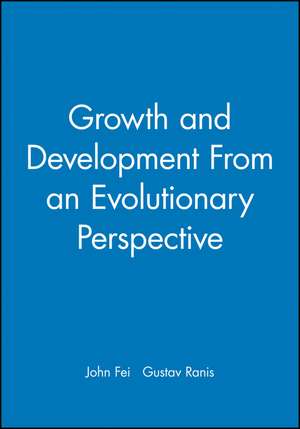
Growth and Dev Evolutionary Perspective
Autor Fei, Ranisen Limba Engleză Hardback – 28 iul 1997
Preț: 829.35 lei
Preț vechi: 1136.09 lei
-27%
Puncte Express: 1244
Carte tipărită la comandă
Livrare economică 18 noiembrie-02 decembrie
Livrare prin curier în România Termenul estimat este afișat lângă disponibilitate.
Transport gratuit pentru acest produs Plată online sau ramburs, în funcție de opțiunile comenzii.
Retur gratuit în 14 zile Comandă securizată și suport în română.
Specificații
ISBN-13: 9781557860798
ISBN-10: 1557860793
Pagini: 480
Dimensiuni: 157 x 235 x 30 mm
Greutate: 0.84 kg
Ediția:New.
Editura: Wiley
Locul publicării:Chichester, United Kingdom
ISBN-10: 1557860793
Pagini: 480
Dimensiuni: 157 x 235 x 30 mm
Greutate: 0.84 kg
Ediția:New.
Editura: Wiley
Locul publicării:Chichester, United Kingdom
V-ar putea interesa
-
 Classroom Management Support Complete Self-Assessment GuideGerardus Blokdyk-19%Preț: 557.36 lei688.10 lei
 -
 Channel Marketing Solutions A Clear and Concise ReferenceGerardus Blokdyk-19%Preț: 557.08 lei687.74 lei
 -
 Capability Quality control Third EditionGerardus Blokdyk-19%Preț: 557.08 lei687.74 lei
 -
 Compatibility Security Complete Self-Assessment GuideGerardus Blokdyk-19%Preț: 557.08 lei687.74 lei
 -
 Customer Engagement technology Complete Self-Assessment GuideGerardus Blokdyk-19%Preț: 557.36 lei688.10 lei
 -
 Processing Image Recognition Standard RequirementsGerardus Blokdyk-19%Preț: 557.08 lei687.74 lei
 -
 Analysis Efficiency The Ultimate Step-By-Step GuideGerardus Blokdyk-19%Preț: 557.08 lei687.74 lei
 -
 Solutions Financial Services The Ultimate Step-By-Step GuideGerardus Blokdyk-19%Preț: 557.08 lei687.74 lei
 -
 Instructional design Information Standard RequirementsGerardus Blokdyk-19%Preț: 557.08 lei687.74 lei
 -
 Conflict Management Change Third EditionGerardus Blokdyk-19%Preț: 557.08 lei687.74 lei
 -
 DECONSTRUCCIÓN. LA SEGUNDA REPÚBLICARuben CaceresPreț: 275.98 lei
 -
 Presupuesto público y calidad de gastoShesira Vidurrizaga PfennigPreț: 381.97 lei
 -
 INTRODUCTION TO AN ECONOMY OF RELIGIONDavid TshibanguPreț: 380.29 lei
 -
 INTRODUÇÃO A UMA ECONOMIA DA RELIGIÃODavid TshibanguPreț: 380.66 lei
 -
 Agrarkreditsystem im Bundesstaat Jammu und KaschmirMohmmad Younus WaniPreț: 253.34 lei
 -
 Sistema kreditowaniq sel'skogo hozqjstwa w shtate Dzhammu i KashmirMohmad Junus VaniPreț: 123.01 lei
 -
 Obst und Gemüse - König der MikronährstoffePadmavathi PadmavathiPreț: 253.14 lei
 -
 DIE EUROPÄISCHE GELDPOLITIKJuan Antonio Falcón Blasco-8%Preț: 493.11 lei535.99 lei
 -
 Preț: 224.90 lei
 -
 Preț: 123.47 lei
 -
 U worot sowremennogo VawilonaLongmatej TettehPreț: 160.66 lei
 -
 Smelost' zhenschin izmenila rajony GomyMari Teodozi Rashel' Mululu KisoniqPreț: 124.64 lei
 -
 A coragem das mulheres transformou os bairros de GomaMarie Théodosie Rachel Mululu KisoniaPreț: 226.35 lei
 -
 Bank liquidity and financing of the economy in the CEMAC zoneFrançois Martial Elysée TsangaPreț: 147.13 lei
 -
 Bankowskaq likwidnost' i finansirowanie äkonomiki w zone CEMACFransua Mars'ql' Jelize CangaPreț: 124.44 lei
Public țintă
graduate students, academics with interest in economic development, especially to wards advanced and third world countriesNotă biografică
John C. H. Fei was formerly Chairman of the Board at the Chung Hua Institute of Economic Research in Taipei, Taiwan. Co-author of five books and more than 75 articles, Fei also served as consultant to organizations such as AID, NPA, UNDP and the National Science Council of Taiwan. A Ph.D. from Massachusetts Institute of Technology, he taught at Cornell University and Yale University.
Gustav Ranis is the Director of The Yale Center for International and Area Studies and Professor of International Economics at Yale University. Having served as consultant to such entities as The World Bank, ADB, AID, OECD, UNIDO, FAO, UNDP, and the Ford and Rockefeller Foundations, Ranis is on the advisory boards, of several third-world research institutions. He has written extensively on theoretical and policy-related issues of development.
Gustav Ranis is the Director of The Yale Center for International and Area Studies and Professor of International Economics at Yale University. Having served as consultant to such entities as The World Bank, ADB, AID, OECD, UNIDO, FAO, UNDP, and the Ford and Rockefeller Foundations, Ranis is on the advisory boards, of several third-world research institutions. He has written extensively on theoretical and policy-related issues of development.
Cuprins
List of Figures. List of Tables.
Preface.
Part I: Introduction:.
1. Growth and Development: An Overview.
Part II: Agrarianism and Dualism:.
2. From Closed and Open Agrarianism to Modern Dualism.
3. Development of the Closed Dualistic Economy: A Bird's Eye View.
Part III: The Analytics of Growth and Development:.
4. The Neoclassical Production Function, Growth and Development.
5. A General Analysis of Growth Systems.
6. Applications to Modern Economic Growth.
Part IV: Applications to Growth and Development under Dualism:.
7. Transition Growth in the Closed Dualistic Economy.
8. Transition Growth under Open Dualism.
9. Growth, Equity, and Human Development.
Part V: Conclusions for Policy:.
10. Policy and Political Economy in the Transition to Modern Economic Growth.
Bibliography.
Index.
Preface.
Part I: Introduction:.
1. Growth and Development: An Overview.
Part II: Agrarianism and Dualism:.
2. From Closed and Open Agrarianism to Modern Dualism.
3. Development of the Closed Dualistic Economy: A Bird's Eye View.
Part III: The Analytics of Growth and Development:.
4. The Neoclassical Production Function, Growth and Development.
5. A General Analysis of Growth Systems.
6. Applications to Modern Economic Growth.
Part IV: Applications to Growth and Development under Dualism:.
7. Transition Growth in the Closed Dualistic Economy.
8. Transition Growth under Open Dualism.
9. Growth, Equity, and Human Development.
Part V: Conclusions for Policy:.
10. Policy and Political Economy in the Transition to Modern Economic Growth.
Bibliography.
Index.
Descriere
Traces the evolution of development theory from the Physiocrats and the classical School to Solow, Lewis, and Lucas and Roemer. This book identifies the policy implications of the development process, comparing East Asian with Latin American cases. It demonstrates how political economy factors suggest and enhanced endogenization of policy choices.