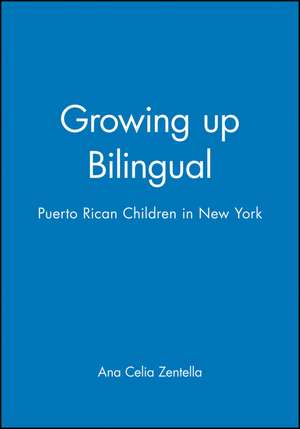
Growing Up Bilingual
Autor Ana Cella Zentella, Zentellaen Limba Engleză Paperback – 3 mai 1997
Winner of the British Association of Applied Linguistics Book Prize 1998
This book provides an inside view of the social construction of bilingualism in one of the largest and most disadvantaged Spanish-speaking groups in the United States.
Preț: 536.36 lei
Puncte Express: 805
Carte tipărită la comandă
Livrare economică 11-25 noiembrie
Livrare prin curier în România Termenul estimat este afișat lângă disponibilitate.
Transport gratuit pentru acest produs Plată online sau ramburs, în funcție de opțiunile comenzii.
Retur gratuit în 14 zile Comandă securizată și suport în română.
Specificații
ISBN-13: 9781557864079
ISBN-10: 1557864071
Pagini: 334
Dimensiuni: 152 x 229 x 18 mm
Greutate: 0.49 kg
Ediția:New.
Editura: Wiley
Locul publicării:Chichester, United Kingdom
ISBN-10: 1557864071
Pagini: 334
Dimensiuni: 152 x 229 x 18 mm
Greutate: 0.49 kg
Ediția:New.
Editura: Wiley
Locul publicării:Chichester, United Kingdom
V-ar putea interesa
-
 Cognitive Interfaces: Constraints on Linking Cognitive InformationEmile van der Zee-24%Preț: 215.11 lei282.53 lei
 -
 Jokes and the Linguistic MindDebra Aarons-15%Preț: 425.72 lei500.84 lei
 -
 Words in the MindJean AitchisonPreț: 425.88 lei
 -
 The Cambridge Handbook of Metaphor and ThoughtRaymond W. Jr. Gibbs-11%Preț: 455.01 lei511.24 lei
 -
 The Emergence of MeaningStephen CrainPreț: 289.04 lei
 -
 The Cambridge Handbook of PsycholinguisticsMichael Spivey-11%Preț: 457.61 lei514.16 lei
 -
 -23%Preț: 431.69 lei560.64 lei
 -
 Second Language SyntaxRoger Hawkins-27%Preț: 938.53 lei1285.65 lei
 -
 Bilingual Education in the 21st CenturyOfelia GarcíaPreț: 387.88 lei
 -
 The Handbook of Second Language AcquisitionCatherine J Doughty-8%Preț: 483.89 lei525.97 lei
 -
 -23%Preț: 482.94 lei627.19 lei
 -
 Language DevelopmentPatricia J. Brooks-19%Preț: 421.70 lei520.61 lei
 -
 Preț: 498.65 lei
 -
 -27%Preț: 870.18 lei1192.04 lei
Public țintă
students of bilingualism and second language acquisitions in departments of psychology, linguistics and educationNotă biografică
Ana Celia Zentella, an anthro-political linguist, is Professor in the Department of Black and Puerto Rican Studies at Hunter College, and in Anthropology, Linguistics, and Developmental Psychology at the City University of New York Graduate Center.
Cuprins
1. Hablamos Los Dos. We Speak Both: Studying Bilingualism in the Community Context.
2. The Community: El Bloque.
3. The Bilingual/Multidialectal Repertoire of El Bloque.
4. Bilingualism En Casa.
5. The Hows and Whys of "Spanglish".
6. The Grammar of "Spanglish".
7. Life and Language in Young Adulthood.
8. Isabel: A Special Case.
9. Spanish Competence.
10. Raising the Next Generation of New York Puerto Ricans.
11. Maria: Learning to Defenderse.
12. Expanding Repertoires: Linking Language, Education, and the New Diversity.
References.
Tables.
Figures.
3. The Bilingual/Multidialectal Repertoire of El Bloque.
4. Bilingualism En Casa.
5. The Hows and Whys of "Spanglish".
6. The Grammar of "Spanglish".
7. Life and Language in Young Adulthood.
8. Isabel: A Special Case.
9. Spanish Competence.
10. Raising the Next Generation of New York Puerto Ricans.
11. Maria: Learning to Defenderse.
12. Expanding Repertoires: Linking Language, Education, and the New Diversity.
References.
Tables.
Figures.
Descriere
An inside view of the social construction of bilingualism in one of the most disadvantaged Spanish-speaking groups in the USA. The book concludes with alternatives for evaluating and teaching Puerto Rican children that build upon the community's language patterns and orientations to literacy.