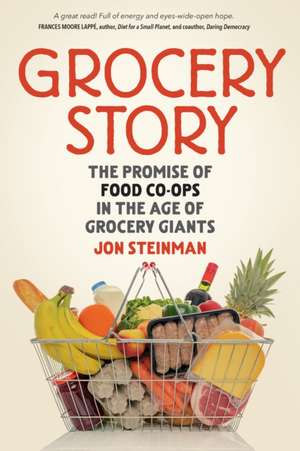
Grocery Story
Autor Jon Steinmanen Limba Engleză Paperback – 7 mai 2019
Reținem, încă din primele capitole dedicate ascensiunii giganților precum A&P, că magazinul alimentar nu este doar un punct de tranzit, ci epicentrul ritualului nostru de aprovizionare, exercitând o putere imensă asupra întregului lanț valoric. Grocery Story propune o analiză pătrunzătoare a modului în care marile corporații de retail au modelat sistemul alimentar contemporan, transformând supermarketul într-un centru de control care dictează nu doar prețurile, ci și estetica sau varietatea produselor de la raft. Autorul Jon Steinman deconstruiește mecanismele economice din spatele prețurilor la alimente, evidențiind discrepanța dintre valoarea la poarta fermei și prețul de retail. Structura cărții este una progresivă: pornește de la contextul istoric al monopolurilor, trece prin analiza puterii de piață și ajunge la soluția practică a cooperativelor alimentare. Această abordare completează perspectiva oferită de Food Co–ops in America – Communities, Consumption, and Economic Democracy, adăugând o critică economică aplicată a modelului de business corporatist și o foaie de parcurs pentru activarea comunităților locale. Spre deosebire de lucrările pur teoretice, textul beneficiază de experiența directă a autorului în administrarea celei mai mari cooperative de retail din Canada. Volumul include 40 de ilustrații alb-negru care susțin argumentația despre modul în care cooperativele pot spori accesul la alimente de calitate în zonele defavorizate. Tonul este precis și informativ, evitând retorica alarmistă în favoarea datelor concrete despre sistemele alimentare locale și economiile bazate pe comunitate.
Preț: 140.30 lei
Carte disponibilă
Livrare economică 16-30 noiembrie
Livrare express 31 octombrie-06 noiembrie pentru 32.28 lei
Specificații
ISBN-10: 0865719071
Pagini: 304
Ilustrații: 40 Halftones, black and white
Dimensiuni: 151 x 225 x 19 mm
Greutate: 0.48 kg
Editura: New Society Publishers
V-ar putea interesa
-
 Hunger Inc.: Building Solidarity Beyond the Food BankKayleigh GarthwaitePreț: 122.91 lei
-
 Your Shopping SuperpowerDiane Osgood-21%Preț: 74.25 lei93.99 lei
-
 Growing Local: Case Studies on Local Food Supply ChainsRobert P. KingPreț: 450.37 lei
-
 Everything I Want to Do Is IllegalJoel Salatin-17%Preț: 115.56 lei139.31 lei
-
 Concentration and Power in the Food System: Who Controls What We Eat?, Revised EditionProfessor Philip H. Howard-19%Preț: 176.20 lei218.54 lei
-
 The Meat RacketChristopher LeonardPreț: 110.59 lei
-
 Food 3eJennifer ClappPreț: 157.31 lei
-
 Land Rich, Cash PoorBrian ReisingerPreț: 73.91 lei
-
 -30%Preț: 134.59 lei192.19 lei
-
 A Foodie's Guide to CapitalismEric Holt-GiménezPreț: 145.72 lei
-
 Food Margins: Lessons from an Unlikely GrocerCathy StantonPreț: 170.94 lei
-
 Preț: 141.97 lei
-
 Reaping What She SowsNancy Matsumoto-17%Preț: 132.00 lei159.44 lei
-
 Food FightStuart GillespiePreț: 146.22 lei
-
 The Future of AgricultureSarah BearchellPreț: 71.26 lei
-
 How We Eat: The Brave New World of Food and DrinkPaco Underhill-18%Preț: 65.39 lei79.50 lei
-
 -18%Preț: 59.19 lei72.04 lei
-
 The Road to a Hunger-Free AmericaMark Winne-15%Preț: 163.54 lei193.28 lei
De ce să citești această carte
Această carte este esențială pentru oricine dorește să înțeleagă forțele invizibile care determină ce găsim pe rafturile magazinelor. Cititorul câștigă o perspectivă clară asupra modului în care cooperativele alimentare pot funcționa ca motoare de dezvoltare locală, oferind o alternativă democratică la monopolul marilor lanțuri de supermarketuri. Este un ghid practic pentru consumatorul conștient care vrea să investească direct în sustenabilitatea comunității sale.
Despre autor
Jon Steinman este un expert recunoscut în sistemele alimentare, fiind producătorul și gazda emisiunii „Deconstructing Dinner”, un proiect multimedia care include radio, podcast și un festival de film. Experiența sa teoretică este dublată de o vastă expertiză practică, servind timp de zece ani (2006-2016) în consiliul de administrație al Kootenay Co-op, cea mai mare cooperativă alimentară independentă de retail din Canada, unde a deținut și funcția de președinte. Locuiește în Nelson, British Columbia, fiind un militant activ pentru economiile locale durabile.
Cuprins
Preface
Note from the Author: Big Food
Introduction
[1] Rise of the Grocery Giants
A&P ¿ The First of the Giants
Other Giants Emerge
Self-Service
Regulating the Rise of Big Business
Expanding the War on Chain Grocers
Enter the Supermarket
[2] Retailer Market Power
Taming the Chains
The Giants Break Loose
The Accelerating of Supermarket Dominance
Regulating Market Power Today
The Generational Effect and Self-Reinforcing Apathy
[3] Food Prices and the People Who Grow Our Food
The Farm Crisis of the 1980s
The "Farm Share" and "Marketing Share" of Our Food Dollars
Squeezing Food Dollars Through Bottlenecks
Farm Value vs. Retail Price
Eaters Pay the Price for Concentrated Markets
Mergers Decrease Prices Paid to Farmers
The Most Extreme Expression of the Farm Income Crisis
[4] Grocery Stores ¿ The Food System's Control Center
Shaping Food ¿ Literally
Losses in Flavor
Cosmetic Requirements and Food Safety
Genetic Diversity
Food Standards as Buyer Leverage
Standards and Food Waste
Marching Orders for Suppliers
Suppliers Finance Their Own Servitude
Category Management
Pay to Play, Pay to Stay
Is It Bribery?
Private Labels (Deliberately Anonymous)
Barriers to Entry
Setting Food Policy
Eaters at the Controls
INTERLUDE
Welcome to What's Possible, North America
Welcome to Resisterville (Nelson, British Columbia)
Grocery Giants in Nelson
The Regional Food Movement
Viroqua, Wisconsin
[5] Enter the Co-op
What Is a Co-op?
Mission-Driven and Transparent
Resilience
History of the Cooperative Movement
The First Consumer Co-ops in Canada and the United States
The Empowered Consumer
[6] The Food Co-op Waves
The Consumer Wave
The New Wave
The New Wave Grows Up
The Newest Wave
Beyond Natural Foods ¿ Co-ops for Low-Income Communities
[7] Consumer Food Co-ops Today
There's Nothing Cookie-Cutter About Food Co-ops
Food Co-ops as Community Centers
Education
Kitchen Skills Training
Children's Programming
Co-ops in Schools
Food Access
Inexpensive Meals for Community Building
Community Giving
Nonprofit Arms
Positive Workplace
Working Members
Cooperation with Local Businesses
The Co-op Footprint
Community-Owned Good Food Media
College Town Co-ops
Governance and Ownership
Profiles of Board Directors at Food Co-ops
Engaging Members in Their Co-op
Diversity
Social Cohesion
Activism
On Prices
Unleashing Potential
[8] Co-ops as Food Desert Remediation
Greensboro, North Carolina
Cincinnati, Ohio
Other Stories of "What's Possible"
Starting a Co-op Isn't a Shoo-In for Success
[9] Food Co-ops and the Local Economy
Easier Access to Eaters
True Local
The Language of "Economic Development"
Food Co-ops as Economic Development
Local Food System Stimulation
Anchors for Main Street
Retention and Rearing of Community Leaders
A Different Kind of Profit
[10] Local Foodmakers ¿ The People Behind the Products
Co-ops as Small Business Incubators
The People Behind the Products
Where Does Your Food Dollar Go?
Planning the Co-op Shelves with Local Producers
[11] Threats to Food Co-ops
Fierce Competition
The Co-opting of "Local"
The "Whole Foods Effect"
The Demise of Co-op Atlantic
Closed
Relevance
Ideology
Institutional Isomorphism
Member Engagement
[12] Growing Food Co-ops, Growing the Movement
Start-ups
Financing Food Co-ops
Co-ops Supporting Co-ops
Epilogue: Where Do We Go from Here?
Acknowledgments
Grocery Story's Supporters
Endnotes
Index
About the Author
A Note about the Publisher
Descriere scurtă
"If you eat, you should give this book a read."
TOM WEBB, author, From Corporate Globalization to Global Co-operation
"Required reading for anyone helping to organize a new food co-op and everyone who cares at all about their food."
STUART REID, Executive Director, Food Co-op Initiative
FOOD HAS BECOME ground-zero in our efforts to increase awareness of how our choices impact the world. Yet while we have begun to transform our communities and dinner plates, the most authoritative strand of the food web has received surprisingly little attention: the grocery store¿the epicenter of our food-gathering ritual.
Through penetrating analysis and inspiring stories and examples of American and Canadian food co-ops, Grocery Story makes a compelling case for the transformation of the grocery store aisles as the emerging frontier in the local and good food movements.Author Jon Steinman:
- Deconstructs the food retail sector and the shadows cast by corporate giants
- Makes the case for food co-ops as an alternative
- Shows how co-ops spur the creation of local food-based economies and enhance low-income food access.
"A "must-implement" to pave the way toward a sustainable and just food system for us all."
ROB GREENFIELD, author, Dude Making a Difference
"Steinman shows us we can confront the power of food retailers and create an inclusive, health promoting, and sustainable food system."
ROD MacRAE, Associate Professor, York University
JON STEINMAN is the producer and host of Deconstructing Dinner, the internationally syndicated radio show, podcast, streaming television series, and annual film festival. He was an elected director, from 2006-2016, of the Kootenay Co-op, Canada's largest independent retail consumer food co-op, serving as Board President from 2014-2016. He lives in Nelson, BC.
Made possible with support from Horizon Distributors, Vancity, Nelson Kootenay Lake Tourism, and Marilyn Takefman