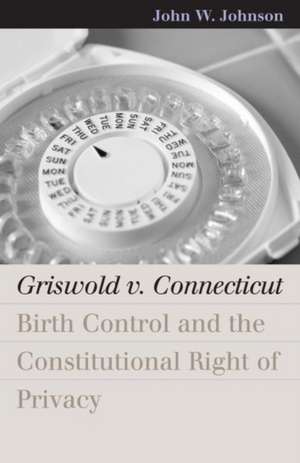
Griswold V. Connecticut: Landmark Law Cases & American Society
Autor John W. Johnsonen Limba Engleză Paperback – 28 feb 2005
Vezi toate premiile Carte premiată
Adresăm această lucrare studenților în drept, cercetătorilor din sfera științelor politice și practicienilor interesați de evoluția libertăților civile, oferindu-le o perspectivă riguroasă asupra modului în care un drept nemenționat explicit în Constituție a devenit fundamentul autonomiei individuale. Notăm cu interes cum John W. Johnson reușește să demistifice natura radicală a deciziei din 1965, demonstrând că aceasta nu a fost o noutate doctrinară absolută, ci rezultatul unei lupte prelungite împotriva legislației puritane din Connecticut.
În cadrul volumului Griswold V. Connecticut, autorul detaliază parcursul juridic de la clinica Planned Parenthood din New Haven până la Curtea Supremă, oferind o analiză critică a argumentelor lui William O. Douglas. Găsim aici o explicație clară a modului în care „dreptul de a fi lăsat în pace” a fost construit judiciar, influențând ulterior decizii monumentale precum Roe v. Wade. Această monografie extinde cadrul propus de The Right to Privacy de Richard A. Glenn prin integrarea unor date specifice despre contextul local din Connecticut și despre eșecul anterior din cazul Poe v. Ullman.
Poziționată în contextul operei sale, cartea rafinează preocupările autorului pentru drepturile civile și mecanismele judiciare, teme explorate anterior în Historic U.S. Court Cases sau Affirmative Action. Spre deosebire de abordarea tematică vastă din lucrările sale de referință, aici Johnson recurge la o micro-istorie juridică densă, reușind să explice de ce, după decenii, acest caz rămâne ancora dezbaterilor despre intimitate, sexualitate și viața de familie în societatea americană modernă.
Din seria Landmark Law Cases & American Society
-
 Preț: 235.32 lei
 -
 Preț: 243.52 lei
 -
 Preț: 245.50 lei
 -
 Preț: 222.95 lei
 -
 Preț: 231.75 lei
 -
 Preț: 239.63 lei
 -
 Preț: 285.74 lei
 -
 Preț: 241.10 lei
 -
 Preț: 233.48 lei
 -
 Preț: 225.56 lei
 -
 Preț: 225.16 lei
 -
 Preț: 237.13 lei
 -
 Preț: 224.79 lei
 -
 Preț: 225.56 lei
 -
 Preț: 239.12 lei
 -
 Preț: 225.16 lei
 -
 Preț: 241.71 lei
 -
 Preț: 241.26 lei
 -
 Preț: 240.32 lei
 -
 Preț: 241.49 lei
 -
 Preț: 231.55 lei
 -
 Preț: 269.63 lei
 -
 Preț: 222.60 lei
 -
 Preț: 242.69 lei
 -
 Preț: 223.69 lei
 -
 Preț: 225.16 lei
 -
 Preț: 221.84 lei
 - 23%
 Preț: 562.33 lei
 -
 Preț: 222.75 lei
 -
 Preț: 221.49 lei
 -
 Preț: 225.56 lei
 -
 Preț: 221.64 lei
 -
 Preț: 225.56 lei
 -
 Preț: 225.56 lei
 -
 Preț: 223.69 lei
 -
 Preț: 224.43 lei
 -
 Preț: 263.01 lei
 -
 Preț: 225.56 lei
 -
 Preț: 224.79 lei
Preț: 243.62 lei
Carte disponibilă
Livrare economică 18 noiembrie-02 decembrie
Specificații
ISBN-10: 0700613781
Pagini: 280
Dimensiuni: 140 x 218 x 21 mm
Greutate: 0.35 kg
Ediția:New.
Editura: University Press of Kansas
Seria Landmark Law Cases & American Society
V-ar putea interesa
-
 Reagan and ThatcherRichard AldousPreț: 114.62 lei
 -
 Final SolutionDavid Cesarani-30%Preț: 104.44 lei148.66 lei
 -
 1946: The Making of the Modern WorldVictor Sebestyen-33%Preț: 72.69 lei108.62 lei
 -
 The Decisive Duel: Spitfire vs 109David Isby-24%Preț: 83.01 lei109.40 lei
 -
 -33%Preț: 81.30 lei121.96 lei
 -
 -27%Preț: 68.35 lei93.14 lei
 -
 -26%Preț: 69.01 lei93.50 lei
 -
 -20%Preț: 209.96 lei261.65 lei
 -
 I am SpainDavid Boyd HaycockPreț: 73.20 lei
 -
 -9%Preț: 1044.24 lei1147.52 lei
De ce să citești această carte
Această lucrare este esențială pentru a înțelege geneza dreptului la viață privată în SUA. Cititorul câștigă o perspectivă istorică detaliată asupra modului în care jurisprudența poate transforma societatea, pornind de la accesul la metode contraceptive. Este o recomandare certă pentru cei care doresc să descifreze argumentele constituționale din spatele celor mai mari controverse juridice actuale, totul sub semnătura unui autor premiat pentru rigoarea sa istorică.
Descriere scurtă
Johnson explores Griswold's origins in a challenge to Connecticut's 1879 anti-contraception law, provides a detailed narrative of its progress, examines the unfolding of the newly secured right of privacy up to recent controversies over same-sex relations, and grounds the story in two key contexts: the struggle within one state to establish the right to birth control and the national debate over the right of privacy. He also provides important insights into the Supreme Court decision in "Poe v. Ullman" (1961), which rejected challenges to the Connecticut's law and was itself immediately challenged. In response to Poe, Planned Parenthood opened a clinic in New Haven to dispense birth control advice and devices to married women. Ten days later, a local prosecutor shut the clinic down and indicted executive director Estelle Griswold and her medical director, C. Lee Buxton.
Tracing the progress of Griswold's case, Johnson clarifies how privacy or "the right to be let alone" became a judicially constructed right. In one of the most idiosyncratic opinions in the Court's history, Justice William O. Douglas ruled that "emanations" from five constitutional amendments afforded protection to the right of privacy, while several other justices proposed competing rationales in support. As he unravels this fascinating tale, Johnson reveals a multifaceted decision that was not in fact the doctrinal novelty that many scholars have argued.
For two generations, Griswold has functioned as the legal basis for judicial rulings involving issues of sexual intimacy, reproductive rights, and family life. Even today, it continues to set the agenda for debates about privacy in American life and about how the Constitution itself should be interpreted. Johnson's deft and incisive analysis of the case will interest anyone concerned about the nature, scope, and future of privacy in America."
Premii
- Langum Prize for Historical Literature Honor Book, 2005