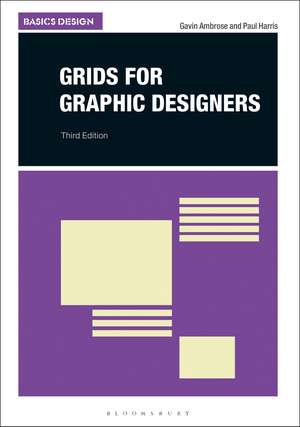
Grids for Graphic Designers: Basics Design
Autor Gavin Ambrose, Paul Harrisen Limba Engleză Paperback – 28 ian 2021
Deschiderea capitolului dedicat grilelor modulare exemplifică perfect rigoarea și claritatea acestui volum: o analiză vizuală a modului în care unitățile repetitive pot genera ordine în cele mai complexe structuri de informații. Recomandăm Grids for Graphic Designers ca pe un instrument tactil și vizual esențial, unde cele 200 de ilustrații color nu sunt doar decorativ-demonstrative, ci servesc drept studii de caz pentru echilibrul dintre formă și funcție. Ne-a atras atenția în mod deosebit modul în care Gavin Ambrose și Paul Harris reușesc să traducă principii clasice de design în realitatea digitală contemporană.
Pe raftul de artă, alături de Layout Essentials Revised and Updated, acest album se distinge prin dimensiunea sa pedagogică pronunțată, oferind nu doar exemple, ci și exerciții aplicate care invită la experimentare directă. Structura este una progresivă, pornind de la necesitatea organizării informației și anatomia de bază a paginii, trecând prin tipologii variate — de la grile simetrice la cele diagonale — și culminând cu adaptarea acestora pentru ecrane și platforme online. Interviurile cu studiouri de renume, precum Brody Associates, aduc o perspectivă pragmatică asupra modului în care teoria se transformă în identitate vizuală.
Această a treia ediție rafinează abordările din lucrările anterioare ale lui Gavin Ambrose, precum The Fundamentals of Typography sau Layout for Graphic Designers. Dacă în volumele precedente accentul cădea pe elemente individuale, aici Grids for Graphic Designers sintetizează totul într-un sistem coerent, demonstrând că grila nu este o constrângere, ci un limbaj al expresivității. Calitatea producției editoriale de la Bloomsbury Visual Arts facilitează o experiență de lectură fluidă, unde textul explicativ și imaginea coexistă într-o ierarhie impecabilă.

Preț: 181.84 lei
Preț vechi: 210.82 lei
-14%
Carte disponibilă
Livrare economică 30 octombrie-13 noiembrie
Livrare express 16-22 octombrie pentru 65.52 lei
Specificații
ISBN-10: 1474254772
Pagini: 216
Ilustrații: 200 colour illus
Dimensiuni: 160 x 228 x 14 mm
Greutate: 0.54 kg
Ediția:3
Editura: Bloomsbury Publishing
Colecția Bloomsbury Visual Arts
Seria Basics Design
Locul publicării:London, United Kingdom
V-ar putea interesa
-
 MotherhoodSheila Heti-20%Preț: 62.80 lei78.02 lei
 -
 A Sand BookAriana Reines-29%Preț: 77.32 lei108.32 lei
 -
 Uncreative WritingKenneth GoldsmithPreț: 128.82 lei
 -
 EssaysLydia Davis-16%Preț: 122.39 lei146.23 lei
 -
 The Collected Stories of Lydia DavisLydia Davis-27%Preț: 70.93 lei96.93 lei
 -
 Third World Women and the Politics of FeminismChandra Talpade MohantyPreț: 188.31 lei
 -
 this bridge we call home: radical visions for transformationGloria Anzaldúa-15%Preț: 470.21 lei553.18 lei
 -
 Furious Flower: Seeding the Future of African American PoetryDr. Joanne V. GabbinPreț: 234.75 lei
 -
 DeviationsGayle S RubinPreț: 212.17 lei
 -
 Essays TwoLydia DavisPreț: 137.38 lei
 -
 Vibrant Death: A Posthuman Phenomenology of MourningProfessor Nina Lykke-32%Preț: 584.81 lei864.97 lei
 -
 -24%Preț: 185.09 lei244.04 lei
 -
 -15%Preț: 158.73 lei187.41 lei
 -
 -43%Preț: 141.20 lei248.17 lei
 -
 More Posthuman GlossaryProfessor Rosi Braidotti-14%Preț: 162.03 lei189.28 lei
 -
 Materialist Phenomenology: A Philosophy of PerceptionProfessor Manuel DeLanda-20%Preț: 168.45 lei210.27 lei
 -
 This Bridge Called My BackCherríe MoragaPreț: 251.67 lei
 -
 Post-Digital: Dialogues and Debates from electronic book reviewProfessor Joseph Tabbi-59%Preț: 1373.91 lei3389.35 lei
 -
 Electronic Literature as Digital Humanities: Contexts, Forms, and PracticesProfessor Dene Grigar-25%Preț: 217.50 lei290.18 lei
 -
 This Wound Is a WorldBilly-Ray BelcourtPreț: 83.79 lei
 -
 The Right to Sex: Shortlisted for the Orwell Prize 2022Amia Srinivasan-33%Preț: 53.08 lei78.99 lei
 -
 Crying in H MartMichelle Zauner-40%Preț: 46.34 lei77.67 lei
 -
 The Pain JournalBob FlanaganPreț: 109.37 lei
 -
 The Violence of Financial Capitalism, New EditionChristian MarazziPreț: 71.99 lei
 -
 Last Days at Hot SlitAndrea Dworkin-14%Preț: 102.53 lei119.25 lei
 -
 The Cybernetic HypothesisTiqqun-17%Preț: 73.74 lei88.41 lei
 -
 Preț: 114.26 lei
 -
 -30%Preț: 68.89 lei98.67 lei
 -
 Fetishism and Curiosity: Cinema and the Mind's EyeLaura Mulvey-25%Preț: 174.01 lei233.20 lei
De ce să citești această carte
Recomandăm acest volum studenților și designerilor la început de drum care doresc să stăpânească structura invizibilă a oricărui proiect vizual reușit. Cititorul câștigă o înțelegere profundă a ierarhiei și proporției, primind instrumente concrete pentru a organiza informația pe print sau ecran. Este un ghid practic ce transformă teoria riguroasă în creativitate disciplinată, oferind acces la fluxul de lucru al unor profesioniști de talie internațională.
Despre autor
Gavin Ambrose este un autor prolific, educator și designer grafic practicant, a cărui expertiză acoperă sectoare diverse, de la galerii de artă și edituri până la agenții de publicitate. În prezent, acesta predă în cadrul programului de licență în Design Grafic la Universitatea din Brighton. A scris și conceput numeroase lucrări de referință în domeniu, concentrându-se pe branding, ambalaj și tipografie. Colaboratorul său constant, Paul Harris, este un scriitor și editor independent cu o vastă experiență în publicații din SUA și Europa, specializat în transformarea conceptelor complexe de design în resurse educaționale accesibile.
Descriere
Written and designed by best-selling authors Gavin Ambrose and Paul Harris, this clear and concise introduction to the use of grids in design covers all the basics and the expanded section of activities and exercises allows students to implement what they have learned.
Cuprins
1. The need for grids
Organising information
How we read a page
How we view a screen
Form and function
Industry view: Boy Bastaiens
2. Grid basics
Anatomy of a page
Measurements
Shapes on a page
Proportion
Hierarchy
Drawing on a grid
The rule of thirds
The rule of odds
Industry view: Second Story
3. Grid types
Symmetrical
Asymmetrical
Modules
Combinations
The horizontal
The vertical
Broadside
Diagonal and angular grids
Industry view: Peter Dawson
4. Grid elements
Type
The baseline
Images
Horizontal and vertical alignment
Columns
Type and column widths
Folios
Industry view: Brody Associates
5. Grid usage
Visible grids
Scale
The perimeter
Axis
Juxtaposition
White space
Environmental grids
Caption-oriented grids
Quantitative information grids
The grid as expression
The grid as identity
Industry view: Nicholas Felton
6. Online grids
The online grid
Formality versus informality
Web basics- fixed or flexible?
Translating the grid to the screen
Orientation
Industry view: 3 Deep
Exercises
Glossary
Index and credits
Recenzii
The 3rd edition of the Grid for Graphic Designers continues exploring ways in which contemporary graphic designers renew traditional approaches to 'grid making' practices, by emphasising both the imaginative and the practical. Examples of inventive designs are accompanied by meaningful annotations focusing both on what, and how it is represented. This exploration of relationships between content and grid format demonstrates the plurality of the approaches and the passage from fixed to fluidity as a modern way of representation. There are two generalisations about the grids: first, that they are inexhaustible and second, that they are selective. From this double perspective, the book demonstrates 'grid making' as a form of knowledge and provides a renewed context for the debate about the meaning and role of grids.
An essential and authoritative toolkit for constructors of the humble grid that will both inform and inspire content delivery, whether for print or screen. Historic and contemporary examples brilliantly illustrate the ongoing fascination and challenge of how graphic designers confront the blank page; creating work that unites content and form to deliver purposeful and appropriate visual communication.