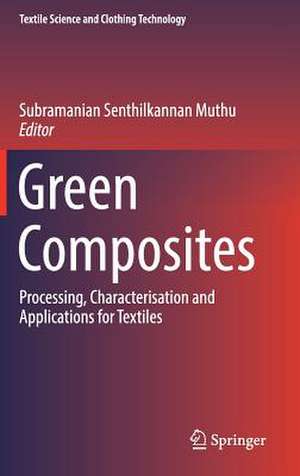
Green Composites: Textile Science and Clothing Technology
Editat de Subramanian Senthilkannan Muthuen Limba Engleză Hardback – 5 sep 2018
Din seria Textile Science and Clothing Technology
- 24%
 Preț: 1057.21 lei
 - 18%
 Preț: 990.61 lei
 - 15%
 Preț: 531.61 lei
 -
 Preț: 365.06 lei
 - 15%
 Preț: 445.19 lei
 -
 Preț: 364.08 lei
 - 15%
 Preț: 723.53 lei
 - 15%
 Preț: 599.43 lei
 - 15%
 Preț: 656.90 lei
 -
 Preț: 378.40 lei
 - 18%
 Preț: 1160.23 lei
 - 15%
 Preț: 519.89 lei
 - 15%
 Preț: 503.88 lei
 - 18%
 Preț: 926.05 lei
 - 18%
 Preț: 814.78 lei
 - 15%
 Preț: 554.46 lei
 - 15%
 Preț: 554.28 lei
 - 15%
 Preț: 661.90 lei
 -
 Preț: 396.28 lei
 - 18%
 Preț: 711.55 lei
 - 19%
 Preț: 525.72 lei
 - 15%
 Preț: 664.79 lei
 -
 Preț: 365.06 lei
 - 18%
 Preț: 759.34 lei
 - 18%
 Preț: 819.66 lei
 -
 Preț: 363.87 lei
 - 15%
 Preț: 600.52 lei
Preț: 397.08 lei
Puncte Express: 596
Carte tipărită la comandă
Livrare economică 01-15 decembrie
Livrare prin curier în România Termenul estimat este afișat lângă disponibilitate.
Transport gratuit de la 400.00 lei Plată online sau ramburs, în funcție de opțiunile comenzii.
Retur gratuit în 14 zile Comandă securizată și suport în română.
Specificații
ISBN-13: 9789811319716
ISBN-10: 9811319715
Pagini: 112
Ilustrații: VIII, 102 p. 32 illus., 24 illus. in color.
Dimensiuni: 160 x 241 x 12 mm
Greutate: 0.29 kg
Ediția:1st ed. 2019
Editura: Springer
Colecția Textile Science and Clothing Technology
Seria Textile Science and Clothing Technology
Locul publicării:Singapore, Singapore
ISBN-10: 9811319715
Pagini: 112
Ilustrații: VIII, 102 p. 32 illus., 24 illus. in color.
Dimensiuni: 160 x 241 x 12 mm
Greutate: 0.29 kg
Ediția:1st ed. 2019
Editura: Springer
Colecția Textile Science and Clothing Technology
Seria Textile Science and Clothing Technology
Locul publicării:Singapore, Singapore
Cuprins
Natural Fiber Based Hybrid Bio-Composites: Processing, Characterization and Applications.- Processing of Green Composites.- Sisal Fibers Reinforced Epoxidized Non-edible Oils Based Epoxy Green Composites and its Potential Applications.
Notă biografică
Dr Subramanian Senthilkannan Muthu holds a PhD in Textiles Sustainability and has over 60 books to his credit, along with 80 research publications. He is well known in the field of Textiles Sustainability due to his notable contributions in both academic and industrial contexts. He is currently working as Head of Sustainability for SgT Group & API, based in Hong Kong.
Textul de pe ultima copertă
This book highlights the processing, characterization and applications of various green composites. Composites are known for their unique properties, which are derived by combining two or more components. This yields properties such as greater strength and rigidity than that of the individual components, as well as reduced weight. To help achieve such outcomes, the book discusses the potential applications of hybrid bio-composites and sisal-fiber-reinforced epoxidized non-edible oil-based epoxy green composites.