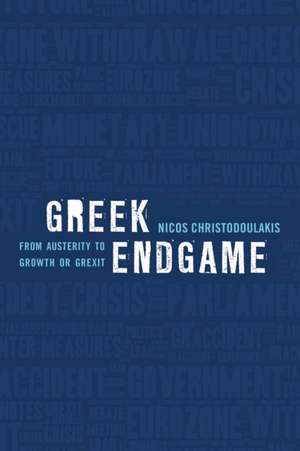
Greek Endgame: From Austerity to Growth or Grexit
Autor Nicos Christodoulakisen Limba Engleză Paperback – 20 oct 2015
However, the stringencies of the adjustment program led to more recession and unemployment, while social tension and political polarization became entrenched. In 2015, a radical Left party, Syriza, ascended to power on a ticket to end austerity and renegotiate Greece's debt agreements, but a long-lasting growth and reform agenda is still to be settled upon. This book lays out some key reforms that would allow Greece to return to growth and, at the same time, keep the Euro, an option that still remains a cornerstone for the country's economic and geopolitical stability.
,
Preț: 258.39 lei
Preț vechi: 351.48 lei
-26%
Puncte Express: 388
Carte tipărită la comandă
Livrare economică 07-21 decembrie
Livrare prin curier în România Termenul estimat este afișat lângă disponibilitate.
Transport gratuit de la 400.00 lei Plată online sau ramburs, în funcție de opțiunile comenzii.
Retur gratuit în 14 zile Comandă securizată și suport în română.
Specificații
ISBN-13: 9781783485246
ISBN-10: 1783485248
Pagini: 202
Ilustrații: 24 b/w illustrations; 6 tables
Dimensiuni: 150 x 231 x 15 mm
Greutate: 0.43 kg
Editura: Bloomsbury Publishing
Colecția Rowman & Littlefield
Locul publicării:New York, United States
ISBN-10: 1783485248
Pagini: 202
Ilustrații: 24 b/w illustrations; 6 tables
Dimensiuni: 150 x 231 x 15 mm
Greutate: 0.43 kg
Editura: Bloomsbury Publishing
Colecția Rowman & Littlefield
Locul publicării:New York, United States
V-ar putea interesa
-
 -19%Preț: 394.92 lei487.11 lei
 -
 Terrorism: A Critical IntroductionRichard Jackson-24%Preț: 253.69 lei333.89 lei
 -
 Contemporary Security and StrategyCraig A. Snyder-18%Preț: 327.21 lei401.24 lei
 -
 Preț: 285.57 lei
 -
 Preț: 278.93 lei
 -
 Dead AidDambisa MoyoPreț: 102.95 lei
 -
 Understanding Foreign Policy Decision MakingAlex MintzPreț: 347.63 lei
 -
 Preț: 242.68 lei
 -
 Global GovernanceTimothy SinclairPreț: 191.15 lei
 -
 State in AfricaJean-Francois BayartPreț: 238.92 lei
 -
 -10%Preț: 84.98 lei94.17 lei
 -
 Detente, Democracy and DictatorshipAleksandr SolzhenitsynPreț: 453.68 lei
 -
 Afghanistan: The Mirage of PeaceChris Johnson-27%Preț: 213.66 lei293.12 lei
 -
 Qatar: Rise to Power and InfluenceAllen J. FromherzPreț: 390.14 lei
Cuprins
Prologue / Introduction: The spectre of Grexit / PART I: THE RUN-UP TO THE CRISIS / 1. Origins: How Greece was engulfed in the crisis / 2. Complacency: Was the 2010 bail-out really inevitable? / 3. Reinventing the past: Should Greece have joined the Euro? / PART II: THE BAILOUT YEARS / 4. Getting it wrong: An appraisal of the austerity program / 5. The vicious circle: Snowballs, haircuts and hazards / PART III: THE ILLUSIONS / 6. Change currency? Illusions and miscalculations / 7. History lessons: The collapse in interwar Greece / 8. Modern lessons: Default and collapse in Argentina / PART IV: THE ESCAPE / 9. Getting it right: End recession and stabilize public debt / 10. A road map for growth: Some key fiscal reforms / 11. The feasible prosperity: A new contract for Greece / 12. The political economy of drachma: Lower wages, more inequalities / Epilogue: After the Left's victory in Greece
Recenzii
The author traces the origins of Greece's current economic crisis, incorporating his own opinions on the failures of the Greek government and the European Union. He presents several reform policies that he believes will relieve the Greek economy, and allow the country to continue to use the euro.
This is an impressive account of how Greece entered the crisis and the obstacles it faces in exiting it. It shows expertise, skill in clear expression, and well-balanced judgement. It is neither narrow nor shallow: it contextualises the crisis, appropriately, in its European, international, and historical settings. In a period of fast-moving events, its account will endure. I recommend it to all.
This is a fascinating read. As a former Cabinet Minister and one of Greece's most respected economists, Christodoulakis delivers an analysis that is both insightful and accessible. His account of the history and pre-history of Greece's bailout drama, is an invaluable resource to all those interested in the reform of the Eurozone and the future of European integration.
Greece is pursuing a high-risk strategy in getting bail-outs from Germany and the rest of Europe. But the costs of a Grexit in terms of inflation and decline in living standards will be enormous. This brilliant analysis of Greece's dilemmas are wonderfully described by a former Minister of Finance of Greece, who is also a very sensible and knowledgeable macroeconomics professor. Let us hope that the politicians of Greece take heed and keep Greece afloat and in the Eurozone. The book will appeal to both academic and policy audiences and is a must-read for anyone interested in a voice of reason in these turbulent times.
This is an impressive account of how Greece entered the crisis and the obstacles it faces in exiting it. It shows expertise, skill in clear expression, and well-balanced judgement. It is neither narrow nor shallow: it contextualises the crisis, appropriately, in its European, international, and historical settings. In a period of fast-moving events, its account will endure. I recommend it to all.
This is a fascinating read. As a former Cabinet Minister and one of Greece's most respected economists, Christodoulakis delivers an analysis that is both insightful and accessible. His account of the history and pre-history of Greece's bailout drama, is an invaluable resource to all those interested in the reform of the Eurozone and the future of European integration.
Greece is pursuing a high-risk strategy in getting bail-outs from Germany and the rest of Europe. But the costs of a Grexit in terms of inflation and decline in living standards will be enormous. This brilliant analysis of Greece's dilemmas are wonderfully described by a former Minister of Finance of Greece, who is also a very sensible and knowledgeable macroeconomics professor. Let us hope that the politicians of Greece take heed and keep Greece afloat and in the Eurozone. The book will appeal to both academic and policy audiences and is a must-read for anyone interested in a voice of reason in these turbulent times.