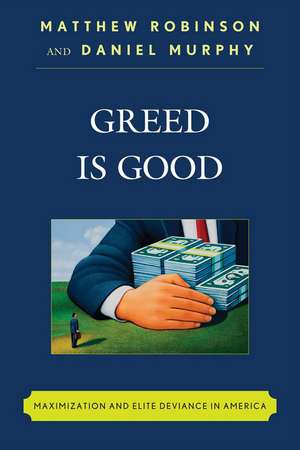
Greed is Good: Maximization and Elite Deviance in America
Autor Matthew Robinson, Daniel Murphyen Limba Engleză Hardback – 16 dec 2008
Preț: 567.48 lei
Preț vechi: 822.13 lei
-31%
Puncte Express: 851
Carte tipărită la comandă
Livrare economică 23 noiembrie-07 decembrie
Livrare prin curier în România Termenul estimat este afișat lângă disponibilitate.
Transport gratuit pentru acest produs Plată online sau ramburs, în funcție de opțiunile comenzii.
Retur gratuit în 14 zile Comandă securizată și suport în română.
Specificații
ISBN-13: 9780742560703
ISBN-10: 0742560708
Pagini: 150
Dimensiuni: 152 x 230 x 14 mm
Greutate: 0.36 kg
Ediția:New.
Editura: Bloomsbury Publishing
Colecția Rowman & Littlefield
Locul publicării:New York, United States
ISBN-10: 0742560708
Pagini: 150
Dimensiuni: 152 x 230 x 14 mm
Greutate: 0.36 kg
Ediția:New.
Editura: Bloomsbury Publishing
Colecția Rowman & Littlefield
Locul publicării:New York, United States
Descriere
Centered on the concept of "Maximization," Matthew B. Robinson and Dr. Daniel S. Murphy offer a new theory of elite deviance and corporate crime called contextual anomie/strain theory. Exploring how simultaneous use of legitimate (i.e., legal) and illegitimate (i.e., deviant or illegal) means of opportunity in pursuit of one's goals, Greed is Good explains various forms of elite deviance and corporate crime. Contextual anomie/strain theory posits that although everyone in American society experiences stress and frustration association with American Dream, there are certain contexts in American society that produce even greater stress, frustration, and pressures toward crime. One such context is the corporate workplace. This book affirms how deviance and criminality have become normal in big business due to pressure to produce massive profits at the expense of all other considerations.
Cuprins
Chapter 1 Introduction to Greed, Maximization, and Crime
Chapter 2 Theoretical Background: Strain and Anomie Theories
Chapter 3 Contextual Anomie/Strain Theory
Chapter 4 Maximization and Elite Property Crime
Chapter 5 Maximization and Elite Violent Crime
Chapter 6 Conclusions and Policy Implications
Chapter 2 Theoretical Background: Strain and Anomie Theories
Chapter 3 Contextual Anomie/Strain Theory
Chapter 4 Maximization and Elite Property Crime
Chapter 5 Maximization and Elite Violent Crime
Chapter 6 Conclusions and Policy Implications
Recenzii
In the midst of the present huge financial crisis, this book could hardly be more timely. The authors offer a novel theoretical framework for enriching our understanding of crimes of the rich and powerful. Matthew Robinson's previous books have been noteworthy additions to the criminological literature. In collaboration with Daniel Murphy, he has once again made a thought-provoking contribution to the field, from which the current generation of students has much to learn.
This book is a well-written introduction to crime in America. Undergraduates would generally have no problems reading this work as the material is organized well and presented very clearly. The theory is both simple and clearly presented as minor extension of Anomie theory. The major strength of this book is that it is well-written and presents both the concept of coperate crime and the authors' theory in a clear and concise manner.
This book is a well-written introduction to crime in America. Undergraduates would generally have no problems reading this work as the material is organized well and presented very clearly. The theory is both simple and clearly presented as minor extension of Anomie theory. The major strength of this book is that it is well-written and presents both the concept of coperate crime and the authors' theory in a clear and concise manner.