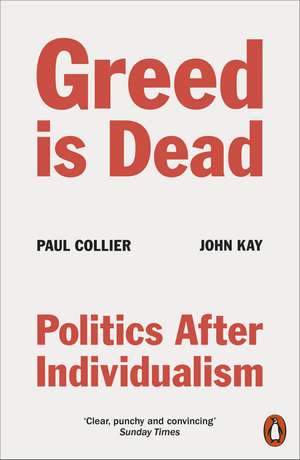
Greed Is Dead
Autor John Kay, Paul Collieren Limba Engleză Paperback – 29 iul 2021
Considerăm că prosperitatea unei națiuni nu este rezultatul direct al egoismului individual, ci, dimpotrivă, este produsul unei capacități colective de a tempera acest instinct. În Greed Is Dead, economiștii John Kay și Paul Collier demontează mitul conform căruia lăcomia este motorul inerent al progresului, arătând cum individualismul extrem a ajuns să paralizeze sistemele noastre politice și economice. Notăm cu interes teza autorilor: societățile care prosperă sunt cele care reușesc să creeze instituții capabile să canalizeze atât competiția, cât și cooperarea către obiective de beneficiu general. Complementar volumului Collective Action de Bill Jordan, care analizează transformările coercitive ale colectivității, lucrarea de față acoperă zona soluțiilor practice de reformă a culturii corporative și a politicilor locale, oferind un model de „pluralism disciplinat”. Această abordare continuă viziunea pragmatică începută de Paul Collier în The Future of Capitalism, unde acesta diagnostica eșecurile sistemului actual, și se aliniază cu rigoarea analitică din The Corporation in the Twenty-First Century de John Kay. Putem afirma că volumul nu este doar o critică socială, ci un manual de reconstrucție instituțională. Într-un stil riguros, dar accesibil, autorii explică de ce centralizarea excesivă și tribalismul politic sunt simptome ale aceleiași boli: pierderea sentimentului de apartenență și a responsabilității reciproce. Lectura relevă mecanismele prin care afacerile pot depăși stadiul de simple entități orientate spre profitul imediat pentru a redeveni piloni ai comunității.
Preț: 60.67 lei
Preț vechi: 72.86 lei
-17%
Carte disponibilă
Livrare economică 13-24 noiembrie
Livrare express 28 octombrie-03 noiembrie pentru 39.06 lei
Specificații
ISBN-10: 0141994169
Pagini: 224
Dimensiuni: 125 x 195 x 16 mm
Greutate: 0.37 kg
Editura: Penguin Books
Locul publicării:London, United Kingdom
V-ar putea interesa
-
 RefugePaul CollierPreț: 129.61 lei
 -
 Kenya: Policies for ProsperityChristopher Adam-31%Preț: 788.47 lei1146.00 lei
 -
 Zambia: Building Prosperity from Resource WealthChristopher Adam-31%Preț: 937.21 lei1358.40 lei
 -
 Plundered Nations?Paul Collier-15%Preț: 490.16 lei576.67 lei
 -
 Trade and Fiscal Adjustment in AfricaPaul Collier-15%Preț: 668.35 lei786.30 lei
 -
 Preț: 407.58 lei
 -
 Preț: 404.42 lei
 -
 Preț: 433.12 lei
 -
 Governmentality, Biopower, and Everyday LifeMajia Holmer Nadesan-18%Preț: 1249.78 lei1524.13 lei
 -
 Europeanization of British Defence PolicyRobert Dover-18%Preț: 1342.49 lei1637.18 lei
 -
 Preț: 352.52 lei
 -
 Preț: 487.01 lei
 -
 -15%Preț: 467.48 lei549.97 lei
 -
 Preț: 275.65 lei
 -
 Preț: 406.44 lei
 -
 Preț: 424.32 lei
 -
 Preț: 447.52 lei
 -
 The Politics of Peacebuilding in AfricaThomas Kwasi TiekuPreț: 427.09 lei
 -
 The Routledge Handbook of the Crimean WarCandan BademPreț: 433.27 lei
 -
 Research Ethics in Human GeographySebastian HennPreț: 422.92 lei
 -
 -18%Preț: 987.74 lei1204.57 lei
 -
 Preț: 79.03 lei
De ce să citești această carte
Recomandăm această carte liderilor din business și decidenților politici care caută o alternativă viabilă la polarizarea actuală. Veți învăța cum să recalibrați echilibrul dintre competiție și cooperare în interiorul organizațiilor și cum să reconstruiți încrederea în instituțiile economice. Este o lectură esențială pentru a înțelege de ce succesul pe termen lung necesită o revenire la valorile mutualității și la un capitalism cu față umană.
Despre autor
John Kay este profesor invitat la London School of Economics și membru al St. John's College, Oxford, fiind recunoscut pentru coloana sa săptămânală din Financial Times. Expertiza sa în analiza sistemelor financiare complexe este dublată de o înțelegere profundă a luării deciziilor în condiții de incertitudine, temă explorată în lucrări precum Radical Uncertainty. Paul Collier, profesor la Oxford și autor al celebrului volum The Future of Capitalism, completează această colaborare cu o perspectivă pragmatică asupra dezvoltării economice și a eticii sociale. Împreună, cei doi autori reprezintă voci autoritare în critica și reformarea capitalismului contemporan.
Notă biografică
Paul Collier is the Professor of Economics and Public Policy at the Oxford Blavatnik School of Government. He is the author of The Future of Capitalism, which won the 2019 Handelsblatt Prize; The Bottom Billion, which won the Lionel Gelber Prize and Arthur Ross Prize of the Council on Foreign Relations; The Plundered Planet, Exodus and Refuge (with Alexander Betts). Collier has served as Director of the Research Department of the World Bank, and works with governments around the world.
John Kay (Author)
John Kay is one of Britain's leading economists and a fellow of St John's College Oxford. His career has spanned academia, business, finance and public policy. He was the founding head of the Oxford Said Business School and the Institute for Fiscal Studies - Britain's most respected think tank. He is the author of The Truth About Markets, Obliquity, Other People's Money and other books and for twenty years contributed a regular column to the Financial Times.
Recenzii
Two of the most thoughtful economists writing today ... Collier and Kay are interesting on almost every subject they alight upon.
Written by two of the UK's best economists, the book attacks the solipsistic individualism that permeates modern economics and far too much of modern society. The book's animating idea is that humans are first and foremost social animals. Our successes always depend on co-operation. The authors apply this concept to our economic, social and political institutions, which can, they argue, only be revived by being seen as self-sustaining communities.
Their analysis is pitiless and compelling. This is a fine, incisive polemic.
In a provocative but thought-provoking and nuanced argument, Collier and Kay argue that our culture of hyper-centralisation is choking us.
Descriere scurtă
'provocative but thought-provoking and nuanced' Telegraph
Throughout history, successful societies have created institutions which channel both competition and co-operation to achieve complex goals of general benefit. These institutions make the difference between societies that thrive and those paralyzed by discord, the difference between prosperous and poor economies. Such societies are pluralist but their pluralism is disciplined.
Successful societies are also rare and fragile. We could not have built modernity without the exceptional competitive and co-operative instincts of humans, but in recent decades the balance between these instincts has become dangerously skewed: mutuality has been undermined by an extreme individualism which has weakened co-operation and polarized our politics.
Collier and Kay show how a reaffirmation of the values of mutuality could refresh and restore politics, business and the environments in which people live. Politics could reverse the moves to extremism and tribalism; businesses could replace the greed that has degraded corporate culture; the communities and decaying places that are home to many could overcome despondency and again be prosperous and purposeful. As the world emerges from an unprecedented crisis we have the chance to examine society afresh and build a politics beyond individualism.