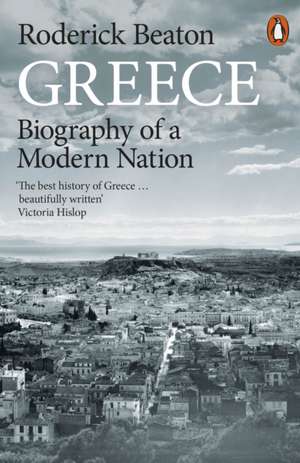
Greece: Biography of a Modern Nation
Autor Roderick Beatonen Limba Engleză Paperback – 4 mar 2020
Evoluția istoriografiei balcanice a trecut, în ultimele decenii, de la o cronologie a conflictelor teritoriale la o analiză profundă a modului în care se construiesc identitățile naționale în raport cu un trecut mitologizat. În Greece, Roderick Beaton propune o abordare inovatoare, tratând statul elen nu ca pe o succesiune de date arheologice, ci ca pe o biografie a unei entități vii, moderne, care a trebuit să își negocieze existența între moștenirea bizantină, stăpânirea otomană și idealurile iluministe occidentale. Descoperim aici un parcurs sinuos, care începe în secolul al XVIII-lea și ajunge până la tensiunile economice contemporane din interiorul Uniunii Europene.
Considerăm că forța acestui volum rezidă în capacitatea de a explica modul în care o civilizație dispărută a fost utilizată ca fundament pentru un stat național modern. Cititorii familiarizați cu The Making of Modern Greece de David Ricks vor aprecia modul în care Beaton extinde analiza dincolo de momentul 1821, oferind o perspectivă mai largă asupra culturii și artelor ca piloni ai identității naționale. Față de abordările strict politice, această „biografie” integrează organic transformările sociale și ideologice.
Structura cărții urmărește o progresie organică, de la „însămânțarea” ideii de națiune (1797-1821), trecând prin perioadele de „maturizare militară” și „auto-divizare” (1913-1923), până la ceea ce autorul numește metaforic „criza vârstei de mijloc” de după 2004. Această organizare permite cititorului să înțeleagă Grecia nu doar ca pe o destinație istorică, ci ca pe un actor dinamic în contextul geopolitic actual al Europei și al Orientului Apropiat.
Preț: 85.81 lei
Preț vechi: 106.96 lei
-20%
Carte disponibilă
Livrare economică 31 iulie-12 august
Livrare express 16-22 iulie pentru 47.59 lei
Specificații
ISBN-10: 0141986522
Pagini: 496
Dimensiuni: 129 x 198 x 22 mm
Greutate: 0.36 kg
Editura: Penguin Books
Colecția Penguin
Locul publicării:London, United Kingdom
V-ar putea interesa
-
 -31%Preț: 99.41 lei143.08 lei
 -
 The Penguin History of EuropeJ. Roberts-19%Preț: 110.00 lei136.29 lei
 -
 AfricaJohn Reader-19%Preț: 109.40 lei135.90 lei
 -
 Russia's WarRichard OveryPreț: 120.41 lei
 -
 GermanyNeil MacGregor-27%Preț: 99.38 lei135.82 lei
 -
 Lord Chesterfield's LettersLord Chesterfield-19%Preț: 69.32 lei85.98 lei
 -
 The World According to Karl: The Wit and Wisdom of Karl LagerfeldSandrine Gulbenkian-20%Preț: 80.59 lei100.12 lei
 -
 France: A History: from Gaul to de GaulleJohn Julius Norwich-28%Preț: 76.35 lei105.97 lei
 -
 History of the Caucasus: Volume 1: At the Crossroads of EmpiresChristoph Baumer-23%Preț: 204.83 lei267.28 lei
 -
 500 Beautiful Words You Should KnowCaroline Taggart-26%Preț: 52.98 lei71.89 lei
 -
 Preț: 38.08 lei
De ce să citești această carte
Această lucrare este esențială pentru cei care doresc să înțeleagă cum s-a format Grecia modernă dincolo de clișeele antichității clasice. Cititorul câștigă o perspectivă clară asupra modului în care cultura, politica și identitatea se împletesc pentru a crea o națiune europeană modernă. Este o recomandare excelentă pentru studenții la istorie, dar și pentru publicul larg interesat de evoluția geopolitică a Balcanilor și a Uniunii Europene.
Despre autor
Roderick Beaton este profesor emerit (Koraes Professor) de istorie, limbă și literatură modernă greacă și bizantină la King's College London. Cu o carieră dedicată studiului elenismului, el a explorat în lucrările sale anterioare, precum The Greeks, continuitatea și transformările ideilor grecești de la Epoca Bronzului până astăzi. În The Greek Revolution of 1821, s-a aplecat asupra contextului internațional al independenței, expertiza sa fiind recunoscută la nivel mondial prin numeroase distincții academice, consolidându-i poziția de autoritate în studiile neoeline.
Notă biografică
Recenzii
His new book - judicious, well-researched and commendably up-to-date - deserves to be the standard general history of modern Greece in English for years to come.
This book explores the history, not of a Greece of romantic or philhellenic imagination, but the reality of the country as it has become today. The empathy it evokes for the survival of modern Greek statehood against a recurring pattern of often existential crisis is all the more compelling, subtle and above all human in its many-sidedness. Beaton's account instantly becomes the single most outstanding treatment of its subject and shows us why - as Lord Palmerston expressed it succinctly for his own times - 'Greece' is an emotional word that still matters to contemporary society.
A wonderfully engaging narrative ... It is a superb achievement and to be recommended to anyone with even the most rudimentary interest
A perceptive analysis of Greece's financial crisis, the embers of which continue to threaten to derail the single currency project of the EU
Praise forByron's War: Indispensable
Descriere scurtă
AFINANCIAL TIMESBOOK OF THE YEAR
'The best history of Greece around... Beautifully written and packed with insights about the culture and the people. I will be dipping into this book for the rest of my life' Victoria Hislop
We think we know ancient Greece, the civilisation that shares the same name and gave us just about everything that defines 'western' culture today, in the arts, sciences, social sciences and politics. Yet, as Greece has been brought under repeated scrutiny during the financial crises that have convulsed the country since 2010, worldwide coverage has revealed just how poorly we grasp the modern nation. This book sets out to understand the modern Greeks on their own terms.
How did Greece come to be so powerfully attached to the legacy of the ancients in the first place, and then define an identity for themselves that is at once Greek and modern? This book reveals the remarkable achievement, during the last 300 years, of building a modern nation on, sometimes literally, the ruins of a vanished civilisation. This is the story of the Greek nation-state but also, and perhaps more fundamentally, of the collective identity that goes with it. It is not only a history of events and high politics, it is also a history of culture, of the arts, of people and of ideas.
Cuprins
List of Maps
Names, Dates and Titles
To the Reader
Introduction: The Nation and its Ancestors
1. East Meets West? (1718–1797)
2. A Seed is Sown (1797–1821)
3. Born in Blood (1821–1833)
4. First Steps (1833–1862)
5. Ideals and Sorrows of Youth (1862–1897)
6. Military Service (1897–1913)
7. The Self Divided (1913–1923)
8. Starting Over (1923–1940)
9. Meltdown (1940–1949)
10. Uncle Sam’s Protégé (1949–1974)
11. Coming of Age in Europe (1974–2004)
12. Midlife Crisis? (2004–)
Notes
Sources and Further Reading
Acknowledgements
Index