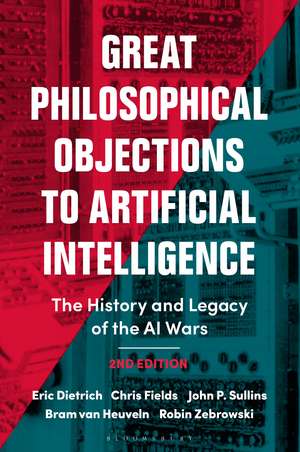
Great Philosophical Objections to Artificial Intelligence: The History and Legacy of the AI Wars
Autor Eric Dietrich, Chris Fields, John P. Sullins, Bram Van Heuveln, Robin Zebrowskien Limba Engleză Hardback – 8 ian 2026
Now updated to include the latest developments in AI, this is an exploration of the most famous philosophical arguments against building a machine with human-level intelligence. The arguments are organized into four central AI wars, showing how the debate that played out between the philosophers, AI scientists and engineers building AI systems.
Here is your guide to the major philosophical questions and attacks AI has received throughout its history. Packed with fresh insights and supporting material, this second edition features new content on:
- Language Learning Models (LLMs) and the existence of generative AI
- Sustainable AI and its ability to regulate our climate
- The theoretical, ethical and legislative issues around 'computational creativity'
- The uncanny valley effect and its potential consequences for AI
Are we on the brink of a new AI War? This introduction is for anyone looking to understand the debates that have shaped the philosophy of AI and the arguments that will define its future. It shows us what AI has been doing since its invention in the 1950s - pointing us back, repeatedly, to the philosophical questions humans have always faced: questions about knowledge, meaning, and how we should behave toward each other and toward the rest of the world.
| Toate formatele și edițiile | Preț | Express |
|---|---|---|
| Paperback (1) | 174.69 lei 3-5 săpt. | +0.00 lei 7-13 zile |
| Bloomsbury Publishing – 8 ian 2026 | 174.69 lei 3-5 săpt. | +0.00 lei 7-13 zile |
| Paperback (1) | 233.61 lei 3-5 săpt. | +0.00 lei 7-13 zile |
| Bloomsbury Publishing – 14 ian 2021 | 233.61 lei 3-5 săpt. | +0.00 lei 7-13 zile |
| Hardback (1) | 677.74 lei 6-8 săpt. | |
| Bloomsbury Publishing – 14 ian 2021 | 677.74 lei 6-8 săpt. |
Preț: 486.49 lei
Preț vechi: 670.95 lei
-27% Precomandă
Puncte Express: 730
Preț estimativ în valută:
86.10€ • 100.62$ • 74.75£
86.10€ • 100.62$ • 74.75£
Carte nepublicată încă
Doresc să fiu notificat când acest titlu va fi disponibil:
Se trimite...
Preluare comenzi: 021 569.72.76
Specificații
ISBN-13: 9781350499409
ISBN-10: 1350499404
Pagini: 376
Dimensiuni: 156 x 234 mm
Ediția:2. Auflage
Editura: Bloomsbury Publishing
Colecția Bloomsbury Academic
Locul publicării:London, United Kingdom
ISBN-10: 1350499404
Pagini: 376
Dimensiuni: 156 x 234 mm
Ediția:2. Auflage
Editura: Bloomsbury Publishing
Colecția Bloomsbury Academic
Locul publicării:London, United Kingdom
Cuprins
List of Figures
Prologue to the Second Edition
Prologue: The AI Wars and Beyond
Part I The AI Wars, 1950 to 2000
Introduction
The First War: Is AI Even Possible?
1. Gödel and a Foundational Objection to AI
2. How (not) to think about the Turing Test
The Second War: Architectures for Intelligence
3. How Computer Science Saved the Mind
4. Implementing an Intelligence
The Third War: Mental Semantics and Mental Symbols
5. The Strange Case of the Missing Meaning: Can Computers Think About Things?
The Fourth War: Rationality, Relevance, and Creativity
6. What is Relevant to What? The Frame Problem
Part II Beyond the AI Wars: New Issues Arise
Introduction
7. What about Consciousness?
8. Ethical Issues Surrounding AI Applications
9. Could Embodied AIs be Ethical Agents?
Part III The "New AI": Generative Models Reignite Old Controversies
Introduction: Why is the "new AI" surprising?
10. Representation and semantics in Large Language Models
11. Have LLMs changed the debate about consciousness?
12. Sustainability: the new ethical issue raised by generative AI
Conclusion: Whither the AI Wars?
Notes
Bibliography
Index
Prologue to the Second Edition
Prologue: The AI Wars and Beyond
Part I The AI Wars, 1950 to 2000
Introduction
The First War: Is AI Even Possible?
1. Gödel and a Foundational Objection to AI
2. How (not) to think about the Turing Test
The Second War: Architectures for Intelligence
3. How Computer Science Saved the Mind
4. Implementing an Intelligence
The Third War: Mental Semantics and Mental Symbols
5. The Strange Case of the Missing Meaning: Can Computers Think About Things?
The Fourth War: Rationality, Relevance, and Creativity
6. What is Relevant to What? The Frame Problem
Part II Beyond the AI Wars: New Issues Arise
Introduction
7. What about Consciousness?
8. Ethical Issues Surrounding AI Applications
9. Could Embodied AIs be Ethical Agents?
Part III The "New AI": Generative Models Reignite Old Controversies
Introduction: Why is the "new AI" surprising?
10. Representation and semantics in Large Language Models
11. Have LLMs changed the debate about consciousness?
12. Sustainability: the new ethical issue raised by generative AI
Conclusion: Whither the AI Wars?
Notes
Bibliography
Index
Recenzii
The book resembles a buffet meal offering many appealing individual pieces ... [and] makes philosophical arguments on AI accessible to non-philosophers-itself an important accomplishment.
An extraordinary book that does what scientists all too often don't do: highlight what is still unknown and lay the foundations for future development of a discipline. A must-read for both students and the experts of AI.
The promise and threat of artificial intelligence has sharpened debate on the nature of mind, morality, selfhood, intelligence and consciousness. Great Philosophical Objections to Artificial Intelligence deftly presents the recent history of this debate, from Turing to today, with engaging explanations of the technical issues, key insights, current stalemates, and the impact of advances in cognitive neuroscience.
This book cuts an accessible and engaging trail through the past 70 years of philosophical contention over the very possibility of artificial intelligence (AI) and some of its implications. It hits the sweet spot of providing a wonderful resource for the student and practitioner of the philosophy of AI and its recent history, while also giving a general audience a window into how philosophy works. The AI wars have evolved; we may have moved on from some battle lines, but understanding how they were fought enriches our mental repertoire and arms us with tools that will help us tackle new fronts in our struggle to come to terms with AI.
The book certainly is very informative and useful to students in the combined area of AI science, philosophy and ethics, with over 200 citations and bibliography of key readings in the field.
An extraordinary book that does what scientists all too often don't do: highlight what is still unknown and lay the foundations for future development of a discipline. A must-read for both students and the experts of AI.
The promise and threat of artificial intelligence has sharpened debate on the nature of mind, morality, selfhood, intelligence and consciousness. Great Philosophical Objections to Artificial Intelligence deftly presents the recent history of this debate, from Turing to today, with engaging explanations of the technical issues, key insights, current stalemates, and the impact of advances in cognitive neuroscience.
This book cuts an accessible and engaging trail through the past 70 years of philosophical contention over the very possibility of artificial intelligence (AI) and some of its implications. It hits the sweet spot of providing a wonderful resource for the student and practitioner of the philosophy of AI and its recent history, while also giving a general audience a window into how philosophy works. The AI wars have evolved; we may have moved on from some battle lines, but understanding how they were fought enriches our mental repertoire and arms us with tools that will help us tackle new fronts in our struggle to come to terms with AI.
The book certainly is very informative and useful to students in the combined area of AI science, philosophy and ethics, with over 200 citations and bibliography of key readings in the field.