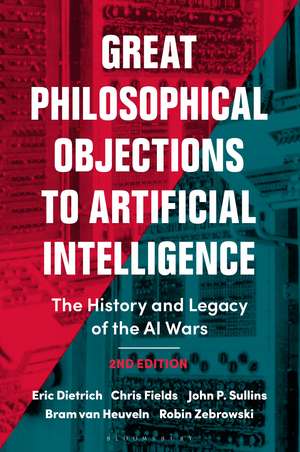
Great Philosophical Objections to Artificial Intelligence: The History and Legacy of the AI Wars
Autor Eric Dietrich, Chris Fields, John P. Sullins, Bram Van Heuveln, Robin Zebrowskien Limba Engleză Paperback – 8 ian 2026
Destinată studenților din mediul universitar, cercetătorilor în științe cognitive și practicienilor din domeniul tehnologiei, lucrarea Great Philosophical Objections to Artificial Intelligence oferă un cadru riguros pentru înțelegerea fundamentelor teoretice care preced actualul avânt al inteligenței artificiale. Considerăm că valoarea centrală a acestei a doua ediții rezidă în capacitatea autorilor de a contextualiza progresele tehnice recente, precum ChatGPT, într-o istorie lungă de 70 de ani de dispute intelectuale.
Structura volumului este organizată cronologic și tematic, debutând cu „Războaiele AI-ului” (1950-2000). Găsim în prima parte o analiză a obiecțiilor matematice ale lui Gödel și a limitărilor Testului Turing, urmată de dezbaterile privind simbolismul mental și arhitecturile inteligenței. Partea a doua și a treia extind analiza către problemele actuale: etica aplicațiilor AI, creativitatea computațională și sustenabilitatea. Această progresie reflectă evoluția autorului Eric Dietrich, care în lucrări precum Cognitive Dynamics a explorat deja limitele reprezentărilor computaționale în explicarea proceselor cognitive.
Comparativ cu volumul Machine Intelligence de Andy Clark, care se concentrează pe o colecție de lucrări fundamentale din neuroștiințe și filozofie, textul de față adoptă o abordare mai narativă și istorică, facilitând înțelegerea modului în care eșecurile teoretice din trecut au modelat arhitecturile de astăzi. De asemenea, dacă Artificial Intelligence de Margaret A. Boden oferă o introducere succintă în impactul social al tehnologiei, lucrarea coordonată de Dietrich plonjează mai adânc în mecanica semantică a modelelor de limbaj mari (LLMs), oferind instrumente critice pentru a evalua dacă „noua AI” chiar rezolvă vechile dileme despre sens și conștiință.
Preț: 188.47 lei
Preț vechi: 237.18 lei
-21%
Carte disponibilă
Livrare economică 16-30 noiembrie
Livrare express 31 octombrie-06 noiembrie pentru 87.02 lei
Specificații
ISBN-10: 1350499412
Pagini: 376
Dimensiuni: 156 x 232 x 24 mm
Greutate: 0.57 kg
Ediția:2. Auflage
Editura: Bloomsbury Publishing
Colecția Bloomsbury Academic
Locul publicării:London, United Kingdom
De ce să citești această carte
Această ediție actualizată este esențială pentru oricine dorește să treacă dincolo de entuziasmul momentului în domeniul AI. Cititorul câștigă o perspectivă istorică asupra eșecurilor și succeselor care au definit disciplina, învățând să identifice argumentele filozofice din spatele tehnologiilor generative actuale. Este o resursă academică solidă care transformă concepte abstracte în instrumente de analiză pentru viitorul eticii și legislației în tehnologie.
Descriere
Now updated to include the latest developments in AI, this is an exploration of the most famous philosophical arguments against building a machine with human-level intelligence. The arguments are organized into four central AI wars, showing how the debate that played out between the philosophers, AI scientists and engineers building AI systems.
Here is your guide to the major philosophical questions and attacks AI has received throughout its history. Packed with fresh insights and supporting material, this second edition features new content on:
- Language Learning Models (LLMs) and the existence of generative AI
- Sustainable AI and its ability to regulate our climate
- The theoretical, ethical and legislative issues around 'computational creativity'
- The uncanny valley effect and its potential consequences for AI
Are we on the brink of a new AI War? This introduction is for anyone looking to understand the debates that have shaped the philosophy of AI and the arguments that will define its future. It shows us what AI has been doing since its invention in the 1950s - pointing us back, repeatedly, to the philosophical questions humans have always faced: questions about knowledge, meaning, and how we should behave toward each other and toward the rest of the world.
Cuprins
Prologue: The AI Wars and Beyond
Part I. The AI Wars
Introduction
The First War: Is AI Even Possible?
1. Gödel and Foundational Objections to AI
2. How Would We Know If a Computer Was Intelligent? The Turing Test is Not the Answer
The Second War: Architectures of the Mind
3. How Computer Science Saved the Mind
4. Implementing an Intelligence
The Third War: Mental Semantics and Mental Symbols
5. The Strange Case of the Missing Meaning: Can Computers Think About Things?
The Fourth War: The Frame Problem: Rationality and Creativity
6. What is Relevant to What?: The Frame Problem
Part II. Beyond the AI Wars: Issues for Today
Introduction
7. What about Consciousness?
8. Ethical Issues Surrounding AI Applications
9. Could Embodied AIs be Ethical Agents
Part III The "New AI": Generative Models Reignite Old Controversies
Introduction: Why is the "New AI" Surprising?
10 . Representation and Semantics in Large Language Models
11 . Have LLMs Changed the Debate about Consciousness?
12 Sustainability: the New Ethical Issue Raised by Generative AI
Conclusion: Whither the AI Wars?
Notes
Bibliography
Index
Recenzii
An extraordinary book that does what scientists all too often don't do: highlight what is still unknown and lay the foundations for future development of a discipline. A must-read for both students and the experts of AI.
The promise and threat of artificial intelligence has sharpened debate on the nature of mind, morality, selfhood, intelligence and consciousness. Great Philosophical Objections to Artificial Intelligence deftly presents the recent history of this debate, from Turing to today, with engaging explanations of the technical issues, key insights, current stalemates, and the impact of advances in cognitive neuroscience.
This book cuts an accessible and engaging trail through the past 70 years of philosophical contention over the very possibility of artificial intelligence (AI) and some of its implications. It hits the sweet spot of providing a wonderful resource for the student and practitioner of the philosophy of AI and its recent history, while also giving a general audience a window into how philosophy works. The AI wars have evolved; we may have moved on from some battle lines, but understanding how they were fought enriches our mental repertoire and arms us with tools that will help us tackle new fronts in our struggle to come to terms with AI.
The book certainly is very informative and useful to students in the combined area of AI science, philosophy and ethics, with over 200 citations and bibliography of key readings in the field.