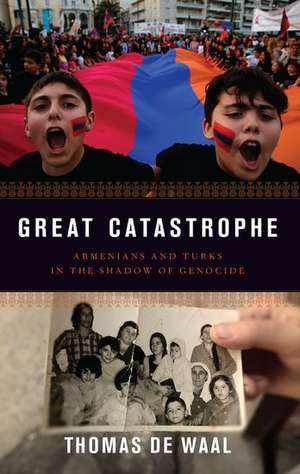
Great Catastrophe: Armenians and Turks in the Shadow of Genocide
Autor Thomas de Waalen Limba Engleză Paperback – 10 ian 2019
Preț: 162.88 lei
Preț vechi: 192.77 lei
-16%
Puncte Express: 244
Carte tipărită la comandă
Livrare economică 26 noiembrie-01 decembrie
Livrare prin curier în România Termenul estimat este afișat lângă disponibilitate.
Transport gratuit de la 400.00 lei Plată online sau ramburs, în funcție de opțiunile comenzii.
Retur gratuit în 14 zile Comandă securizată și suport în română.
Specificații
ISBN-13: 9780190904784
ISBN-10: 019090478X
Pagini: 328
Ilustrații: 2 maps; 22 photographs
Dimensiuni: 229 x 147 x 20 mm
Greutate: 0.36 kg
Editura: Oxford University Press
Colecția OUP USA
Locul publicării:New York, United States
ISBN-10: 019090478X
Pagini: 328
Ilustrații: 2 maps; 22 photographs
Dimensiuni: 229 x 147 x 20 mm
Greutate: 0.36 kg
Editura: Oxford University Press
Colecția OUP USA
Locul publicării:New York, United States
V-ar putea interesa
-
 Pity the Nation Lebanon at WarRobert Fisk-18%Preț: 136.46 lei166.60 lei
 -
 What Went Wrong?Bernard LewisPreț: 366.12 lei
 -
 From Babel to DragomansBernard LewisPreț: 220.99 lei
 -
 -28%Preț: 418.40 lei577.98 lei
 -
 -28%Preț: 418.08 lei584.33 lei
 -
 -19%Preț: 105.07 lei129.56 lei
 -
 Introduction to Middle Eastern LawChibli Mallat-22%Preț: 471.26 lei604.66 lei
 -
 Preț: 295.65 lei
 -
 Preț: 209.81 lei
 -
 Preț: 79.58 lei
 -
 -22%Preț: 184.67 lei235.68 lei
 -
 Letters to PalestineVijay PrashadPreț: 171.75 lei
 -
 Me and the Middle East: Firsthand Reporting on Israel's Most Dramatic DaysRichard OestermannPreț: 92.49 lei
Recenzii
This magnificent book is the ideal introduction to a difficult subject. Historically rigorous but also full of compassion, it will educate the expert as well as the curious beginner. Highly recommended for Turks, Armenians, and everyone else.
Finely researched and elegantly written, Tom de Waal's historical travelogue is an empathetic guide to how Armenians and Turks can ease the century of pain and conflict that succeeded the genocidal Ottoman destruction of the Armenian presence in Anatolia in 1915.
Great Catastrophe is a frank, honest, humane effort to understand the events surrounding the Armenian Genocide and its aftermath. Thomas de Waal writes with empathy and respect for the various contending narratives while avoiding an equivocating 'balance' that dishonors the events and the victims themselves. Meticulously researched and scrupulously fair, it attempts to comprehend and recount for a broad audience the complexity and pain of the MedZ Yeghern in the hope that average Turks and Armenians might continue the process of recognition, repentance and reconciliation that will allow them both to heal and be redeemed.
Finely researched and elegantly written, Tom de Waal's historical travelogue is an empathetic guide to how Armenians and Turks can ease the century of pain and conflict that succeeded the genocidal Ottoman destruction of the Armenian presence in Anatolia in 1915.
Great Catastrophe is a frank, honest, humane effort to understand the events surrounding the Armenian Genocide and its aftermath. Thomas de Waal writes with empathy and respect for the various contending narratives while avoiding an equivocating 'balance' that dishonors the events and the victims themselves. Meticulously researched and scrupulously fair, it attempts to comprehend and recount for a broad audience the complexity and pain of the MedZ Yeghern in the hope that average Turks and Armenians might continue the process of recognition, repentance and reconciliation that will allow them both to heal and be redeemed.
Notă biografică
Thomas de Waal is a writer and scholar on the Caucasus and Black Sea region and currently Senior Associate at the Carnegie Endowment for International Peace. He is the author of three books, including The Caucasus: An Introduction. Previously, de Waal worked as a newspaper and radio journalist in London and Moscow.