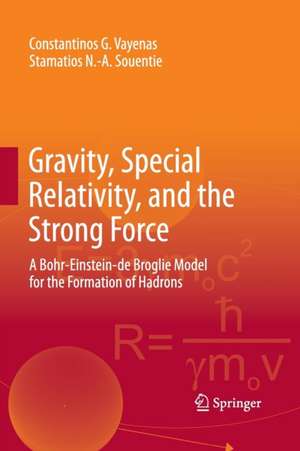
Gravity, Special Relativity, and the Strong Force
Autor Constantinos G. Vayenas, Stamatios N.-A. Souentieen Limba Engleză Paperback – 23 aug 2016
The results agree with experiments on the masses, binding energies, radii, angular moments and magnetic moments of hadrons. The model provides the means to rationalize all the main experimental features of the strong force. Some of the implications for the unification of forces and the nature of our micro-cosmos and macro-cosmos are also discussed. The creation of mass itself, in other words, of hadrons from particlesas light as neutrinos, can now be modeled in a straightforward manner.
Preț: 636.71 lei
Preț vechi: 749.06 lei
-15%
Puncte Express: 955
Carte tipărită la comandă
Livrare economică 17 noiembrie-01 decembrie
Livrare prin curier în România Termenul estimat este afișat lângă disponibilitate.
Transport gratuit pentru acest produs Plată online sau ramburs, în funcție de opțiunile comenzii.
Retur gratuit în 14 zile Comandă securizată și suport în română.
Specificații
ISBN-13: 9781489978202
ISBN-10: 1489978208
Pagini: 164
Ilustrații: XVIII, 144 p.
Dimensiuni: 155 x 235 x 10 mm
Greutate: 0.26 kg
Ediția:Softcover reprint of the original 1st ed. 2012
Editura: Springer
Locul publicării:New York, NY, United States
ISBN-10: 1489978208
Pagini: 164
Ilustrații: XVIII, 144 p.
Dimensiuni: 155 x 235 x 10 mm
Greutate: 0.26 kg
Ediția:Softcover reprint of the original 1st ed. 2012
Editura: Springer
Locul publicării:New York, NY, United States
V-ar putea interesa
-
 Fusion: The Energy of the UniverseGarry McCracken-19%Preț: 314.47 lei386.29 lei
 -
 Gas and Oil Reliability Engineering: Modeling and AnalysisEduardo Calixto-29%Preț: 451.33 lei638.16 lei
 -
 -20%Preț: 406.55 lei507.23 lei
 -
 Gravity: A Very Short IntroductionTimothy Clifton-20%Preț: 56.25 lei70.42 lei
 -
 The Universal Force: Gravity - Creator of WorldsLouis Girifalco-11%Preț: 376.87 lei424.01 lei
 -
 The Universal Force: Gravity - Creator of WorldsLouis Girifalco-16%Preț: 200.77 lei240.14 lei
 -
 Philosophy and the Foundations of DynamicsLawrence SklarPreț: 223.92 lei
 -
 GravityBrian Clegg-17%Preț: 59.61 lei72.15 lei
 -
 Einstein and the Changing Worldviews of PhysicsChristoph Lehner-15%Preț: 653.67 lei769.02 lei
 -
 Gravitation and SpacetimeHans C. Ohanian-11%Preț: 625.52 lei702.83 lei
 -
 The Foundations of Einstein's Theory of GravitationErwin FreundlichPreț: 229.65 lei
 -
 Preț: 93.85 lei
 -
 Spacetime, Geometry and GravitationPankaj SharanPreț: 385.87 lei
Cuprins
1905-1930: The golden age of physics.- Mass, special relativity and the equivalence principle.- The strong force: From quarks to hadrons and nuclei.- The world of particles and the standard model.- The equivalence principle, special relativity and Newton's gravitational law.- The three and two rotating neutrino models: Particle confinement by gravity.- Energy and other properties of the rotational states.- Gravitational hadronization: How mass can be produced from gravity.- Model comparison with the main experimental features of the strong interaction force.- The Bohr-de Broglie approach in physics: The dual nature of matter.- Gravity at relativistic velocities and dark matter.- Force unification: Is the strong force simply gravity?.
Textul de pe ultima copertă
This book shows that the strong interaction forces, which keep hadrons and nuclei together, are relativistic gravitational forces exerted between very small particles in the mass range of neutrinos. First, this book considers the motion of two or three charged particles under the influence of electrostatic and gravitational forces only, which shows that bound states are formed by following the same semi-classical methodology used by Bohr to describe the H atom. This approach is also coupled with Newton’s gravitational law and with Einstein’s special relativity.
The results agree with experiments on the masses, binding energies, radii, angular momenta and magnetic moments of hadrons. The model provides the means to rationalize all the main experimental features of the strong force. Some of the implications for the unification of forces and the nature of our micro-cosmos and macro-cosmos are also discussed. The creation of mass itself, in other words, of hadrons from particlesas light as neutrinos, can now be modeled in a straightforward manner.
The results agree with experiments on the masses, binding energies, radii, angular momenta and magnetic moments of hadrons. The model provides the means to rationalize all the main experimental features of the strong force. Some of the implications for the unification of forces and the nature of our micro-cosmos and macro-cosmos are also discussed. The creation of mass itself, in other words, of hadrons from particlesas light as neutrinos, can now be modeled in a straightforward manner.
Caracteristici
First book to present the Bohr-Einstein-de Broglie approach to the formation of hadrons and nuclei Demonstrates that strong forces are relativistic graviational forces Explains confinement and asymptotic freedom
Notă biografică
Professor Constantinos (Costas) Vayenas was born in Athens on September 22, 1950, studied Chemical Engineering at the National Technical University of Athens (NTU, 1968-1973) and got his PhD in 1976 from the University of Rochester in the USA. He then taught as an Assistant Professor in the Department of Engineering and Applied Science at Yale University (1976-77) and as an Associate Professor at MIT (1977-82), getting twice the Outstanding Teacher Award. He then moved for family reasons to the Department of Chemical Engineering at the University of Patras in Greece. He is an International member of the National Academy of Engineering (NAE) of the USA and a member of the Academy of Athens. Since 2001 he serves as Editor of Modern Aspects of Electrochemistry. He has authored two books and more than 250 papers in Catalysis and Electrochemistry and, after 2008, a Springer book and 50 papers in Particle Physics which is currently his main research interest and where, together with his coworkers, he has developed the Rotating Lepton Model (RLM) of the Elementary particles.
Dionysios Tsousis was born in Patras in 1998. He holds the highest average so far achieved in the Department of Chemical Engineering of the University of Patras, from which he graduated in 2021. He is currently doing his PhD on the "Unification of Gravitational, Strong and Weak Forces" under the supervision of Prof. Constantinos Vayenas, with whom he has seven joint publications so far. Prior to committing to the University of Patras for his PhD, he had been admitted to every single PhD program in the States he had applied to. He has also given several presentations on Physics and Chemical Engineering at International and Greek conferences. His research interests include Mathematical Modeling of Physical Systems, Quantum Mechanics, Relativity, Statistical Mechanics, and Particle Physics.
Dr. Eftychia Martino is a research Chemical Engineer at the University of Patras with interests in catalysis and electrocatalysis. She leads research on fuel cells and currently lectures at the Chemical Engineering Department of the University of Patras in Greece. Dr. Martino obtained her Ph.D. in electrochemistry from the University of Patras in 2019 and has authored several publications in her field.