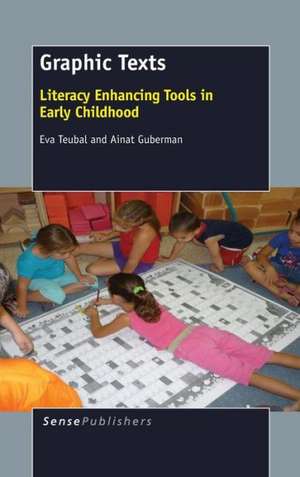
Graphic Texts
Autor Eva Teubal, Ainat Gubermanen Limba Engleză Hardback – 2014
Preț: 665.91 lei
Preț vechi: 822.11 lei
-19%
Puncte Express: 999
Carte disponibilă
Livrare economică 05-19 noiembrie
Livrare prin curier în România Termenul estimat este afișat lângă disponibilitate.
Transport gratuit pentru acest produs Plată online sau ramburs, în funcție de opțiunile comenzii.
Retur gratuit în 14 zile Comandă securizată și suport în română.
Specificații
ISBN-13: 9789462097094
ISBN-10: 9462097097
Pagini: 170
Dimensiuni: 160 x 240 x 15 mm
Greutate: 0.45 kg
Editura: Brill
ISBN-10: 9462097097
Pagini: 170
Dimensiuni: 160 x 240 x 15 mm
Greutate: 0.45 kg
Editura: Brill
V-ar putea interesa
-
 Language Knowledge for Primary TeachersAngela WilsonPreț: 374.17 lei
 -
 Preț: 372.04 lei
 -
 Storytelling and Imagination: Beyond Basic Literacy 8-14Rob ParkinsonPreț: 342.57 lei
 -
 -15%Preț: 483.64 lei568.99 lei
 -
 Preț: 447.00 lei
 -
 Preț: 321.29 lei
 -
 Teaching Children 3-11Anne Cockburn-19%Preț: 539.59 lei666.17 lei
 -
 Preț: 375.88 lei
 -
 Outdoor Play (Carrying on in Key Stage 1)Lynn Broadbent-19%Preț: 152.49 lei187.83 lei
Descriere
Descriere de la o altă ediție sau format:
The message of the book is straightforward and easy to apply: it derives from the interweaving of long years of field work with a solid theoretical background. The practice advocated presents children with the opportunity to confront contents and situations which are only too often considered inaccessible for them. The abundant examples presented show that when provided with an adequate toolkit composed of graphic texts, children are inherently motivated by the challenges surrounding them and can make the most out of them as valuable learning opportunities. Drawings, icons, photographs, maps and calendars are incorporated into the tool-kit while they are being used in circumstances in which they are required: children appropriate them while exposed to their use and experience their affordances. Children realize how the graphic texts empower their performance.
The fact that this toolkit is multimodal (involves several sensory modalities) implies that those for whom language is not the most readily available means of communication and processing are not discriminated against: on the one hand, it facilitates conceptualization and its expression by alternative means, and on the other it supports both the comprehension and production of verbal language.
The message of the book is straightforward and easy to apply: it derives from the interweaving of long years of field work with a solid theoretical background. The practice advocated presents children with the opportunity to confront contents and situations which are only too often considered inaccessible for them. The abundant examples presented show that when provided with an adequate toolkit composed of graphic texts, children are inherently motivated by the challenges surrounding them and can make the most out of them as valuable learning opportunities. Drawings, icons, photographs, maps and calendars are incorporated into the tool-kit while they are being used in circumstances in which they are required: children appropriate them while exposed to their use and experience their affordances. Children realize how the graphic texts empower their performance.
The fact that this toolkit is multimodal (involves several sensory modalities) implies that those for whom language is not the most readily available means of communication and processing are not discriminated against: on the one hand, it facilitates conceptualization and its expression by alternative means, and on the other it supports both the comprehension and production of verbal language.