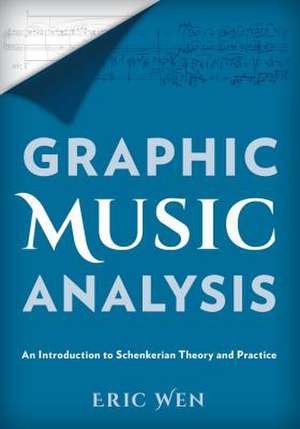
Graphic Music Analysis: An Introduction to Schenkerian Theory and Practice
Autor Eric Wenen Limba Engleză Paperback – 14 feb 2019
| Toate formatele și edițiile | Preț | Express |
|---|---|---|
| Paperback (1) | 521.00 lei 6-8 săpt. | |
| Bloomsbury Publishing – 14 feb 2019 | 521.00 lei 6-8 săpt. | |
| Hardback (1) | 823.63 lei 6-8 săpt. | |
| Bloomsbury Publishing – 14 feb 2019 | 823.63 lei 6-8 săpt. |
Preț: 521.00 lei
Preț vechi: 717.63 lei
-27%
Puncte Express: 782
Preț estimativ în valută:
92.20€ • 107.76$ • 80.05£
92.20€ • 107.76$ • 80.05£
Carte tipărită la comandă
Livrare economică 20 februarie-06 martie
Preluare comenzi: 021 569.72.76
Specificații
ISBN-13: 9781538104668
ISBN-10: 1538104660
Pagini: 478
Ilustrații: 666 b/w illustrations; 2 textboxes
Dimensiuni: 216 x 281 x 24 mm
Greutate: 1.03 kg
Editura: Bloomsbury Publishing
Colecția Rowman & Littlefield Publishers
Locul publicării:New York, United States
ISBN-10: 1538104660
Pagini: 478
Ilustrații: 666 b/w illustrations; 2 textboxes
Dimensiuni: 216 x 281 x 24 mm
Greutate: 1.03 kg
Editura: Bloomsbury Publishing
Colecția Rowman & Littlefield Publishers
Locul publicării:New York, United States
V-ar putea interesa
-
 -28%Preț: 329.25 lei456.30 lei
 -
 -31%Preț: 548.04 lei789.60 lei
 -
 Sight Singing Through Melodic AnalysisLeland D. Bland-15%Preț: 451.24 lei530.87 lei
 -
 Preț: 174.59 lei
 -
 Accidentals Happen! a Compilation of Scales for Violin in Three OctavesSomach, William H.Preț: 129.50 lei
 -
 Accidentals Happen! a Compilation of Scales for Cello in Three OctavesSomach, William H.Preț: 128.73 lei
 -
 Preț: 123.96 lei
 -
 5-String Banjo Hot and Wild!MR Dick ClaassenPreț: 136.23 lei
 -
 Ukulele FingerpickingMR Dick ClaassenPreț: 135.61 lei
 -
 Ella y YoRenesito AvichPreț: 75.97 lei
 -
 Lightning Piano Book 1Sally HopkinsPreț: 87.82 lei
 -
 21 More Easy Ukulele SongsRebecca BogartPreț: 111.85 lei
 -
 How to Play Classical GuitarJohn D. QuattromaniPreț: 192.81 lei
 -
 Preț: 166.72 lei
 -
 Kloze-Lazarus Method for ClarinetKlose-LazarusPreț: 74.05 lei
 -
 Multicultural Perspectives in Music Education: Volume IIIWilliam M. Anderson-34%Preț: 805.98 lei1216.53 lei
Cuprins
Section 1 - Graphic Music Analysis
Chapter 1: Highlighting Notes and Making Connections between Them
Chapter 2: Figuration
Chapter 3: The Linear Progression
Chapter 4: The 5-6 succession
Chapter 5: Structural Levels
Chapter 6: The Introduction to Mozart's "Dissonance" Quartet
Section 2 - Semper idem, sed non eodem modo
Chapter 7: The Fundamental Structure (Ursatz)
Chapter 8: Urlinie Descents from 3
Chapter 9: Urlinie Descents from 5
Section 3 - Techniques of Elaborating the Ursatz
Chapter 10: Substitution
Chapter 11: Delaying the Initial Tone of the Urlinie
Chapter 12: Boundary Play and the Obligatory Register
Chapter 13: Sequences
Chapter 14: Non-Structural Harmonies
Chapter 15: Implied Tones
Chapter 16: Mixture
Chapter 17: Relocating the Urlinie
Chapter 18: The Phrygian 2
Chapter 19: The Auxiliary Cadence
Chapter 20: Non-Tonic Expansions
Section 4 - Tonal Structure and Musical Form
Chapter 21: The Parallel Period (A A´)
Chapter 22: Variants of the Parallel Period
Chapter 23: A B A Form
Chapter 24: A B A' Form (with simple A)
Chapter 25: A B A' Form (with compound A)
Chapter 26: Sonata Form in the Major Mode
Chapter 27: Sonata Form in the Minor Mode
Epilogue
Chapter 1: Highlighting Notes and Making Connections between Them
Chapter 2: Figuration
Chapter 3: The Linear Progression
Chapter 4: The 5-6 succession
Chapter 5: Structural Levels
Chapter 6: The Introduction to Mozart's "Dissonance" Quartet
Section 2 - Semper idem, sed non eodem modo
Chapter 7: The Fundamental Structure (Ursatz)
Chapter 8: Urlinie Descents from 3
Chapter 9: Urlinie Descents from 5
Section 3 - Techniques of Elaborating the Ursatz
Chapter 10: Substitution
Chapter 11: Delaying the Initial Tone of the Urlinie
Chapter 12: Boundary Play and the Obligatory Register
Chapter 13: Sequences
Chapter 14: Non-Structural Harmonies
Chapter 15: Implied Tones
Chapter 16: Mixture
Chapter 17: Relocating the Urlinie
Chapter 18: The Phrygian 2
Chapter 19: The Auxiliary Cadence
Chapter 20: Non-Tonic Expansions
Section 4 - Tonal Structure and Musical Form
Chapter 21: The Parallel Period (A A´)
Chapter 22: Variants of the Parallel Period
Chapter 23: A B A Form
Chapter 24: A B A' Form (with simple A)
Chapter 25: A B A' Form (with compound A)
Chapter 26: Sonata Form in the Major Mode
Chapter 27: Sonata Form in the Minor Mode
Epilogue
Recenzii
Wen is to be commended and congratulated on having offered the music analysis community so many penetrating musical insights. A valuable resource for scholars, pedagogues, students and musicians alike. Having published a textbook, a workbook, an extensive instructor's manual, a supplementary commentary on the C major Prelude (which requires a separate study of its own) and a stand-alone analytical monograph, all within the space of just a few years, Wen has brought together years of teaching experience and graphic-analytical work of exceptional quantity and quality.
Eric Wen's Graphic Music Analysis: An Introduction to Schenkerian Theory and Practice offers a level of depth unusual for an introductory textbook and presents analyses that will be stimulating to anyone involved in Schenkerian studies. . . . the rigor of Wen's demonstrations is remarkable, and students will benefit by returning to already-read sections of GMA after some time has passed, and periodically. . . .The star quality of GMA is without a doubt the rare analytical discernment Wen demonstrates, which. . . should be evident to anyone who explores his graphs deeply.
Eric Wen has long been known as a leading Schenkerian scholar and a dynamic, inspirational teacher of tonal analysis. Both of these traits are fully on display in this wonderful book-an engrossing and welcoming introduction to the deeper meanings of the great works of the classical, tonal tradition.
Wen underlines the close connection between analysis and writing. He explains analytical terms on the basis of their graphic representation and from the beginning applies them to fine examples from well-known and remarkable works of Western tonal music. The book presents a rich variety of compositional possibilities in a balanced mixture of simple and rather complex examples, explained clearly and in detail. Further, Wen offers short and instructive historical information on the pieces and repeatedly highlights the contrapuntal fundamentals of tonal music
The synthesis of artistic intuition and intellectual rigor in Heinrich Schenker's theory of structural levels has always presented conundrums for any pedagogy; the transmission of his method has usually depended on an oral tradition in which students develop their analytical insights in dialogue with recognized experts. Although no textbook will ever replace this process of apprenticeship, Eric Wen's imaginative new book comes closer than any text I have seen. Professor Wen, who is one of our most creative analysts, manages to explain the technical complexities of the theory in lucid detail while showing students how analysis can respond to the unique sound world of each musical composition. I would use this book in my classes in Schenkerian analysis and encourage others to do so as well.
Richly illustrated, comprehensive in scope, and scrupulous in its attention to musical detail, Graphic Music Analysis lays out paths to understanding the hierarchic nature of common-practice music. Drawing on years of expert teaching, Eric Wen provides students with tools for performing linear analyses of tonal music. The book sets new standards in the domestication of Schenker's thought for the twenty-first century American classroom.
In Graphic Music Analysis Eric Wen draws upon decades of experience to elucidate the layered patterns and underlying linear structures of common-practice period tonal music, all engagingly explained through the analytic system of reduction developed by Heinrich Schenker early in the twentieth century. Clearly written and generously appointed with elegantly executed examples, Graphic Music Analysis offers not just a powerful method of analyzing tonal music, but also a rewarding way of hearing that music, which should be of compelling interest to theorists and practitioners alike.
Eric Wen's Graphic Music Analysis leads gently, but authoritatively, from very simple analytical decisions to nuanced readings of complete pieces. The repertoire, which emphasizes chamber and symphonic works, is a joy. The method is Schenkerian, but the humane approach of Donald Francis Tovey helped to inspire this remarkable text.
Drawing upon his extensive experiences teaching the concepts to students, Eric Wen presents a view of Schenkerian analytical techniques in clear and engaging language, with attention to the irreducible significance of the performer's role in expressing these concepts in performance. The book will be beneficial to students new to Schenkerian analysis, seasoned scholars, and performers alike.
Eric Wen's Graphic Music Analysis: An Introduction to Schenkerian Theory and Practice offers a level of depth unusual for an introductory textbook and presents analyses that will be stimulating to anyone involved in Schenkerian studies. . . . the rigor of Wen's demonstrations is remarkable, and students will benefit by returning to already-read sections of GMA after some time has passed, and periodically. . . .The star quality of GMA is without a doubt the rare analytical discernment Wen demonstrates, which. . . should be evident to anyone who explores his graphs deeply.
Eric Wen has long been known as a leading Schenkerian scholar and a dynamic, inspirational teacher of tonal analysis. Both of these traits are fully on display in this wonderful book-an engrossing and welcoming introduction to the deeper meanings of the great works of the classical, tonal tradition.
Wen underlines the close connection between analysis and writing. He explains analytical terms on the basis of their graphic representation and from the beginning applies them to fine examples from well-known and remarkable works of Western tonal music. The book presents a rich variety of compositional possibilities in a balanced mixture of simple and rather complex examples, explained clearly and in detail. Further, Wen offers short and instructive historical information on the pieces and repeatedly highlights the contrapuntal fundamentals of tonal music
The synthesis of artistic intuition and intellectual rigor in Heinrich Schenker's theory of structural levels has always presented conundrums for any pedagogy; the transmission of his method has usually depended on an oral tradition in which students develop their analytical insights in dialogue with recognized experts. Although no textbook will ever replace this process of apprenticeship, Eric Wen's imaginative new book comes closer than any text I have seen. Professor Wen, who is one of our most creative analysts, manages to explain the technical complexities of the theory in lucid detail while showing students how analysis can respond to the unique sound world of each musical composition. I would use this book in my classes in Schenkerian analysis and encourage others to do so as well.
Richly illustrated, comprehensive in scope, and scrupulous in its attention to musical detail, Graphic Music Analysis lays out paths to understanding the hierarchic nature of common-practice music. Drawing on years of expert teaching, Eric Wen provides students with tools for performing linear analyses of tonal music. The book sets new standards in the domestication of Schenker's thought for the twenty-first century American classroom.
In Graphic Music Analysis Eric Wen draws upon decades of experience to elucidate the layered patterns and underlying linear structures of common-practice period tonal music, all engagingly explained through the analytic system of reduction developed by Heinrich Schenker early in the twentieth century. Clearly written and generously appointed with elegantly executed examples, Graphic Music Analysis offers not just a powerful method of analyzing tonal music, but also a rewarding way of hearing that music, which should be of compelling interest to theorists and practitioners alike.
Eric Wen's Graphic Music Analysis leads gently, but authoritatively, from very simple analytical decisions to nuanced readings of complete pieces. The repertoire, which emphasizes chamber and symphonic works, is a joy. The method is Schenkerian, but the humane approach of Donald Francis Tovey helped to inspire this remarkable text.
Drawing upon his extensive experiences teaching the concepts to students, Eric Wen presents a view of Schenkerian analytical techniques in clear and engaging language, with attention to the irreducible significance of the performer's role in expressing these concepts in performance. The book will be beneficial to students new to Schenkerian analysis, seasoned scholars, and performers alike.