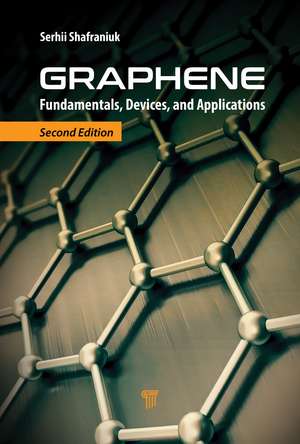
Graphene: Fundamentals, Devices, and Applications
Autor Serhii Shafraniuken Limba Engleză Hardback – 10 aug 2026
Preț: 1420.49 lei
Preț vechi: 1732.30 lei
-18% Nou
Puncte Express: 2131
Carte tipărită la comandă
Livrare economică 28 noiembrie-12 decembrie
Livrare prin curier în România Termenul estimat este afișat lângă disponibilitate.
Transport gratuit pentru acest produs Plată online sau ramburs, în funcție de opțiunile comenzii.
Retur gratuit în 14 zile Comandă securizată și suport în română.
Specificații
ISBN-13: 9789815352115
ISBN-10: 9815352113
Pagini: 752
Ilustrații: 372
Dimensiuni: 152 x 229 mm
Greutate: 1.17 kg
Ediția:2
Editura: Jenny Stanford Publishing
Colecția Jenny Stanford Publishing
ISBN-10: 9815352113
Pagini: 752
Ilustrații: 372
Dimensiuni: 152 x 229 mm
Greutate: 1.17 kg
Ediția:2
Editura: Jenny Stanford Publishing
Colecția Jenny Stanford Publishing
V-ar putea interesa
-
 -27%Preț: 610.47 lei841.69 lei
 -
 -21%Preț: 506.50 lei643.99 lei
 -
 Quantum Field Theory for the Gifted AmateurTom Lancaster-10%Preț: 325.53 lei360.98 lei
 -
 -25%Preț: 829.03 lei1103.42 lei
 -
 -8%Preț: 491.19 lei533.90 lei
 -
 -18%Preț: 1419.93 lei1731.62 lei
 -
 Combustion for Material SynthesisAlexander S. Rogachev-18%Preț: 1477.71 lei1802.09 lei
 -
 -18%Preț: 901.13 lei1098.94 lei
 -
 Advances in Solid State TheoryThomas PruschkePreț: 382.58 lei
 -
 CLEAN ELEC FROM PHOTOVOLTAICS, 2 EDArcher Mary D-18%Preț: 1453.82 lei1772.96 lei
 -
 Databook of Green SolventsGeorge Wypych-23%Preț: 1547.00 lei2009.09 lei
 -
 -15%Preț: 658.62 lei774.85 lei
 -
 -18%Preț: 832.10 lei1014.75 lei
 -
 Basic Elements of CrystallographyNevill Gonzalez Szwacki-15%Preț: 498.21 lei586.14 lei
Public țintă
Academic and PostgraduateRecenzii
“This comprehensive textbook is primarily focused on graphene but also provides up-to-date information on carbon nanotubes and even an introduction to few-layered transition metal dichalcogenides. The book is pedagogic and is aimed at advanced graduate students with a strong condensed matter physics background, though the introduction should make the book also useful for a much larger audience. Each of the 11 chapters has many examples of device applications as well as a problem set and an extensive list of references at the end.”
Prof. Mildred Dresselhaus
Massachusetts Institute of Technology, USA
“This book is the most advanced introduction to the fascinating world of two-dimensional materials. Detailed and self-contained description of electric, thermal, and thermoelectric properties of graphene and graphene nanostructures serve as a valuable resource for researchers in physics, materials science, nanotechnologies, and sensing. Accessible presentation of the most complicated phenomena and interesting original problems will be appreciated by graduate students.”
Prof. Vladimir Mitin
The State University of New York, USA
“This is a long-awaited monograph that provides a direct link from unique energy spectra, including chiral properties, thermal and electric transport, as well as vibrational interface scattering and dissipation phenomena in both ideal and dirty graphene, to their remarkable possible applications. Graphene nanocoolers and co-generators of electricity are presented as splendid examples of such novel applications in thermoelectricity. The miraculous potential of graphene–quantum-dot-based structures as THz detectors are supported by numerous theoretical analyses and experimental observations. The other two-dimensional monolayers, such as transition metal dichalcogenides, are demonstrated to have outstanding prospects in nanoelectronics, optoelectronics, and photovoltaics—as transistors, photodetectors, and electroluminescent devices. I strongly recommend this book to all who are interested in the most recent advances in the fascinating field of monolayered nanostructures.”
Prof. Vladimir M. Fomin
Leibniz Institute for Solid State and Materials Research (IFW), Germany
Notă biografică
Serhii Shafraniuk has spent 45 years working in the areas of condensed matter physics, quantum electronics, and thermal and electric transport. Besides graphene, his research interests encompass other low-dimensional materials, superconductors, and heavy fermion systems with potential applications in quantum computing, thermal transport, and the detection and generation of terahertz and infrared waves.
Cuprins
1. Chiral Fermions in Graphene 2. Intrinsic Coherence of Graphene 3. Quantized States in Graphene Ribbons 4. Phonons and Raman Scattering in Graphene 5. Electron Scattering on Atomic Defects and Phonons in Graphene 6. Many Body Effects and Excitations in Graphene 7. Andreev Reflection at the Graphene/Metal Interface 8. Non-Equilibrium Effects in Graphene Devices 9. Graphene Thermoelectric Nanocoolers and Electricity Co-generators 10. Sensing of Electromagnetic Waves with Graphene and Carbon Nanotube Quantum Dots 11. Other Atomic Monolayers 12. Unconventional Properties of the THz-Irradiated Graphene Quantum Dots 13. Electromagnetic Properties of Graphene Qubit Circuits
Descriere
This book stems from the author’s research experience and collaborations with scientists at tertiary institutions. It emphasizes practical applications driven by graphene’s unique characteristics. Fundamental concepts are reinforced through end-of-chapter problems, supported by a separate solutions manual.