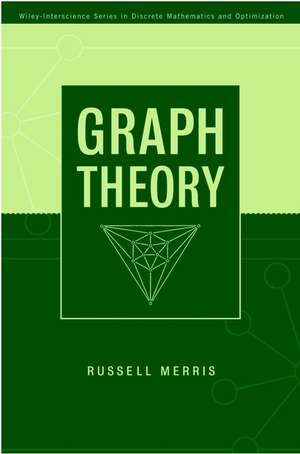
Graph Theory
Autor Russell Merrisen Limba Engleză Hardback – 6 noi 2000
Analizând resursele educaționale oferite de Wiley, observăm că Graph Theory, semnat de Russell Merris, se poziționează ca o invitație riguroasă, dar accesibilă, în universul matematicii discrete. Putem afirma că volumul evită natura enciclopedică a altor tratate, concentrându-se în schimb pe profunzimea tematică și pe puterea de vizualizare a conceptelor. Structura sa este una distinctiv modulară: după stabilirea fundamentelor în primele trei capitole, cititorul poate explora independent patru ramuri distincte: teoria potrivirilor (matching theory), grafurile planare, secvențele grafice și colorarea muchiilor, aceasta din urmă integrând teoria Ramsey și enumerarea Polya. Merită menționat că textul este conceput pentru a fi utilizat la nivel de licență și început de masterat, singura condiție prealabilă fiind parcurgerea unui curs de algebră liniară. Această abordare pragmatică facilitează accesul cercetătorilor care au nevoie de rezultate specifice fără a parcurge întregul volum. Stilul autorului, un pedagog premiat, echilibrează demonstrațiile matematice cu referințe istorice și exerciții atent selecționate, transformând abstractul în elemente ce pot fi manipulate și numărate. În contextul bibliografiei de specialitate, acest volum completează perspectiva oferită de A First Course in Graph Theory de Gary Chartrand, adăugând o structură modulară ce permite o specializare mai rapidă pe segmente precum grafurile cordale sau orientate, față de abordarea liniară tradițională. De asemenea, spre deosebire de Introduction to Graph Theory de Robin J. Wilson, care servește ca un manual introductiv generalist, lucrarea lui Merris pătrunde mai adânc în aplicațiile ce vizează structurile de permutări și factorizarea ciclurilor.
Preț: 1225.07 lei
Preț vechi: 1346.23 lei
-9%
Carte tipărită la comandă
Livrare economică 03-17 decembrie
Specificații
ISBN-10: 0471389250
Pagini: 256
Dimensiuni: 161 x 240 x 19 mm
Greutate: 0.56 kg
Ediția:New.
Editura: Wiley
Locul publicării:Hoboken, United States
V-ar putea interesa
-
 Proof and the Art of MathematicsJoel David Hamkins-13%Preț: 247.32 lei283.22 lei
 -
 Preț: 477.59 lei
 -
 CombinatoricsRussell Merris-9%Preț: 1193.27 lei1311.29 lei
 -
 Geometry of Time and SpaceAlfred A. Robb-19%Preț: 513.61 lei634.09 lei
 -
 Probability and Statistical InferenceMagdalena Niewiadomska-Bugaj-9%Preț: 864.67 lei950.18 lei
 -
 Algebraic Analysis of Social NetworksJ Antonio Rivero Ostoic-8%Preț: 469.03 lei509.81 lei
 -
 Advances in Longitudinal Survey MethodologyPeter Lynn-8%Preț: 683.52 lei742.96 lei
 -
 Direction Dependence in Statistical ModelingWolfgang Wiedermann-9%Preț: 815.66 lei896.33 lei
 -
 Applied Regression Modeling, Third EditionIain Pardoe-9%Preț: 778.91 lei855.94 lei
 -
 Linear AlgebraRichard C. Penney-27%Preț: 769.79 lei1054.50 lei
 -
 Linear and Convex OptimizationMichael H Veatch-9%Preț: 779.52 lei856.61 lei
 -
 Observations Regarding Non-Prime Odd NumbersJoe HilleyPreț: 95.06 lei
 -
 Learn Game TheoryAlbert RutherfordPreț: 176.12 lei
 -
 Monotone Bifunctions and Monotone OperatorsMohammad Hossein AlizadehPreț: 388.11 lei
 -
 The Crossing of Heaven: Memoirs of a MathematicianKarl GustafsonPreț: 197.59 lei
 -
 Preț: 350.96 lei
 -
 Preț: 117.14 lei
 -
 Matematica NumericaAlfio QuarteroniPreț: 288.62 lei
 -
 TopologiaMarco ManettiPreț: 275.70 lei
 -
 ALGEBRA FOR PARENTSRon AharoniPreț: 202.89 lei
 -
 P-ADIC ANALYTIC FUNCTIONSAlain Escassut-18%Preț: 729.92 lei890.15 lei
 -
 INTRODUCTION TO ANALYSIS WITH COMPLEX NUMBERSSwanson Irena-15%Preț: 485.71 lei571.43 lei
Public țintă
For Students of graph theory at the Upper Undergraduate–and Beginning Graduate–levels; for Research Mathematicians who need access to applied graph theory; for Practitioners who use graph theoretic notions; and for Academic Libraries.De ce să citești această carte
Această lucrare este esențială pentru studenții și cercetătorii care caută o introducere riguroasă, dar flexibilă, în teoria grafurilor. Câștigul principal al cititorului constă în structura modulară care permite studiul selectiv al unor teme avansate precum teoria Ramsey sau grafurile planare, fără a depinde de parcurgerea liniară a cărții. Este un instrument de lucru excelent pentru cei care apreciază rigoarea matematică susținută de exemple vizuale clare.