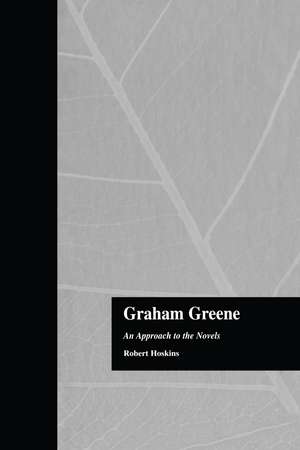
Graham Greene: An Approach to the Novels: Garland Reference Library of the Humanities
Autor Robert Hoskinsen Limba Engleză Hardback – iul 1999

Preț: 1124.23 lei
Preț vechi: 1371.02 lei
-18%
Puncte Express: 1686
Carte tipărită la comandă
Livrare economică 08-22 decembrie
Livrare prin curier în România Termenul estimat este afișat lângă disponibilitate.
Transport gratuit pentru acest produs Plată online sau ramburs, în funcție de opțiunile comenzii.
Retur gratuit în 14 zile Comandă securizată și suport în română.
Specificații
ISBN-13: 9780815312659
ISBN-10: 0815312652
Pagini: 340
Dimensiuni: 138 x 216 x 23 mm
Greutate: 0.79 kg
Ediția:1
Editura: Taylor & Francis
Colecția Routledge
Seria Garland Reference Library of the Humanities
Locul publicării:Oxford, United Kingdom
ISBN-10: 0815312652
Pagini: 340
Dimensiuni: 138 x 216 x 23 mm
Greutate: 0.79 kg
Ediția:1
Editura: Taylor & Francis
Colecția Routledge
Seria Garland Reference Library of the Humanities
Locul publicării:Oxford, United Kingdom
V-ar putea interesa
-
 -18%Preț: 1145.71 lei1397.20 lei
 -
 Preț: 212.32 lei
 -
 An Economic History of England 1870-1939William AshworthPreț: 318.84 lei
 -
 Preț: 480.79 lei
 -
 Preț: 302.43 lei
 -
 Preț: 464.56 lei
 -
 Travels in India, Ceylon and BorneoCaptain Basil HallPreț: 234.15 lei
 -
 -15%Preț: 433.06 lei509.48 lei
 -
 Five Letters 1519-1526Hernando CortésPreț: 483.01 lei
 -
 -15%Preț: 420.47 lei494.67 lei
 -
 Preț: 481.28 lei
 -
 Preț: 500.53 lei
Cuprins
Introduction * Protagonists of the First Phase * Letters and Diaries * A Gun for Sale * Brighton Rock * Protagonists of the Second Phase * The Ministry of Fear * Portraits of the Artists * Travels with My Aunt * The Honorary Consul * The Human Factor * Dr. Fischer of Geneva * Monsignor Quixote * The Captain and the Enemy * Editions Used * Notes * Bibliography * Index
Descriere
This study reveals Greene in a dual role as author, one who projects literary experience into his view of life and subsequently projects both his experience and its "literary" interpretation into his fiction.