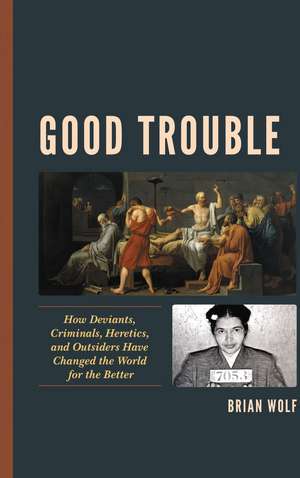
Good Trouble: How Deviants, Criminals, Heretics, and Outsiders Have Changed the World for the Better
Autor Brian Wolfen Limba Engleză Paperback – 25 iun 2021
Preț: 255.62 lei
Preț vechi: 349.99 lei
-27%
Puncte Express: 383
Carte tipărită la comandă
Livrare economică 24 noiembrie-08 decembrie
Livrare prin curier în România Termenul estimat este afișat lângă disponibilitate.
Transport gratuit de la 400.00 lei Plată online sau ramburs, în funcție de opțiunile comenzii.
Retur gratuit în 14 zile Comandă securizată și suport în română.
Specificații
ISBN-13: 9781498563468
ISBN-10: 1498563465
Pagini: 204
Dimensiuni: 153 x 219 x 15 mm
Greutate: 0.3 kg
Editura: Bloomsbury Publishing
Colecția Lexington Books
Locul publicării:New York, United States
ISBN-10: 1498563465
Pagini: 204
Dimensiuni: 153 x 219 x 15 mm
Greutate: 0.3 kg
Editura: Bloomsbury Publishing
Colecția Lexington Books
Locul publicării:New York, United States
Cuprins
Part I: Deviance and Good Trouble
Chapter 1: Deviant Heroism
Chapter 2: Good Trouble in the Sociological Tradition
Part II: Good Trouble against Inequality
Chapter 3: Creative Maladjustment: The Words and Actions of Martin Luther King Jr.
Chapter 4: Disciplined Nonconformists: The Struggle against Racism
Chapter 5: Heretics: Women in Good Trouble
Chapter 6: The Agitators: Labor Trouble
Chapter 7: Truth-Tellers
Chapter 8: Deviant Peacemakers, Lovers, and Dreamers
Part III: Good Trouble and the Individual
Chapter 9: Complicit Conformity
Chapter 10: Good Trouble in Everyday Life
Chapter 1: Deviant Heroism
Chapter 2: Good Trouble in the Sociological Tradition
Part II: Good Trouble against Inequality
Chapter 3: Creative Maladjustment: The Words and Actions of Martin Luther King Jr.
Chapter 4: Disciplined Nonconformists: The Struggle against Racism
Chapter 5: Heretics: Women in Good Trouble
Chapter 6: The Agitators: Labor Trouble
Chapter 7: Truth-Tellers
Chapter 8: Deviant Peacemakers, Lovers, and Dreamers
Part III: Good Trouble and the Individual
Chapter 9: Complicit Conformity
Chapter 10: Good Trouble in Everyday Life
Recenzii
In Good Trouble, Wolf (criminology, sociology, Univ. of Idaho) argues that there are times when deviant behavior results in positive social change. The initial chapters delve into this topic with a discussion of heroic deviance, in which norm breaches result in veneration of the deviant, as in the examples given of iconic individuals involved in the 1960s Civil Rights Movement. . . The strength of this volumeis two-fold pedagogically. It forces readers to think differently about the definition of "deviance," especially "positive deviance," which might yield positive norm change. It also offers ways of teaching deviance in a new light, with suggested class assignments.
Summing Up: Recommended. Graduate students and faculty.
Good Trouble expands the field of deviance to recognize the power and often heroic nature of ethical altruism, disciplined nonconformity, and those who resist norms and break laws in the name of truth, justice, and equality. The book, using case studies, provides a social accounting of history that recognizes the great debt owed to our deviant heroes, those willing to break the rules, risk arrest and often their lives, in the name of progressive social change and resistance to oppression. Good Trouble is timely, relevant, and accessible to students of all ages and backgrounds. A must read for deviance scholars.
A fascinating take on the 'creative side' of the sociology of deviance and crime, and very timely too! Wolf's book provides a breath of fresh air in a field dominated by stuffy, cop-shop criminology. One of the real strengths of this study is its use of detailed case studies to exemplify each of the main types of 'heroic deviance,' including civil rights leaders like Martin Luther King, and many others who have engaged in 'good trouble' to achieve progressive social change.
A thoughtful and productive sociological perspective on how those persons thought of as deviant or even criminal, but who are motivated by ethical altruism, can contribute to positive changes in society. Using the concepts of deviant heroism and a special kind of criminal, Brian Wolf focuses on numerous individuals and social movements that have created important social changes in this country. He discusses, for example, Martin Luther King, Jr., Rosa Parks, and John Lewis and the civil rights movement; Susan B. Anthony, Margaret Sanger and women's movements; and Joe Hill and Cesar Chavez and labor movements. These monumental people and events are seen here through a new lens, providing insights into modes of social activism which can help to overcome our current divisive political and cultural contexts, and continuing structural injustices.
Summing Up: Recommended. Graduate students and faculty.
Good Trouble expands the field of deviance to recognize the power and often heroic nature of ethical altruism, disciplined nonconformity, and those who resist norms and break laws in the name of truth, justice, and equality. The book, using case studies, provides a social accounting of history that recognizes the great debt owed to our deviant heroes, those willing to break the rules, risk arrest and often their lives, in the name of progressive social change and resistance to oppression. Good Trouble is timely, relevant, and accessible to students of all ages and backgrounds. A must read for deviance scholars.
A fascinating take on the 'creative side' of the sociology of deviance and crime, and very timely too! Wolf's book provides a breath of fresh air in a field dominated by stuffy, cop-shop criminology. One of the real strengths of this study is its use of detailed case studies to exemplify each of the main types of 'heroic deviance,' including civil rights leaders like Martin Luther King, and many others who have engaged in 'good trouble' to achieve progressive social change.
A thoughtful and productive sociological perspective on how those persons thought of as deviant or even criminal, but who are motivated by ethical altruism, can contribute to positive changes in society. Using the concepts of deviant heroism and a special kind of criminal, Brian Wolf focuses on numerous individuals and social movements that have created important social changes in this country. He discusses, for example, Martin Luther King, Jr., Rosa Parks, and John Lewis and the civil rights movement; Susan B. Anthony, Margaret Sanger and women's movements; and Joe Hill and Cesar Chavez and labor movements. These monumental people and events are seen here through a new lens, providing insights into modes of social activism which can help to overcome our current divisive political and cultural contexts, and continuing structural injustices.