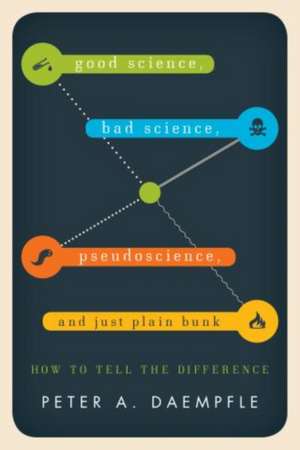
Good Science, Bad Science, Pseudoscience, and Just Plain Bunk: How to Tell the Difference: Rowman & Littlefield Publishers
Autor Peter A. Daempfleen Limba Engleză Paperback – 8 iul 2014
Din seria Rowman & Littlefield Publishers
-
 Preț: 113.82 lei
 - 13%
 Preț: 155.38 lei
 -
 Preț: 109.93 lei
 - 20%
 Preț: 370.93 lei
 - 19%
 Preț: 323.76 lei
 - 26%
 Preț: 223.03 lei
 - 19%
 Preț: 321.01 lei
 - 21%
 Preț: 307.35 lei
 - 21%
 Preț: 186.50 lei
 - 24%
 Preț: 255.02 lei
 - 16%
 Preț: 109.26 lei
 - 31%
 Preț: 351.69 lei
 - 15%
 Preț: 127.13 lei
 - 23%
 Preț: 320.61 lei
 - 19%
 Preț: 324.21 lei
 - 30%
 Preț: 355.24 lei
 - 23%
 Preț: 258.39 lei
 -
 Preț: 400.51 lei
 - 23%
 Preț: 275.97 lei
 - 24%
 Preț: 275.28 lei
 - 31%
 Preț: 351.50 lei
 - 22%
 Preț: 323.28 lei
 - 32%
 Preț: 373.39 lei
 - 34%
 Preț: 842.33 lei
 - 19%
 Preț: 314.30 lei
 - 23%
 Preț: 354.68 lei
 - 21%
 Preț: 128.84 lei
 - 30%
 Preț: 774.75 lei
 - 23%
 Preț: 278.65 lei
 - 23%
 Preț: 259.97 lei
 - 19%
 Preț: 344.02 lei
 - 32%
 Preț: 594.45 lei
 - 31%
 Preț: 566.85 lei
 - 22%
 Preț: 358.54 lei
 - 19%
 Preț: 322.03 lei
 - 16%
 Preț: 148.06 lei
 - 22%
 Preț: 360.79 lei
 - 19%
 Preț: 323.37 lei
 - 31%
 Preț: 414.61 lei
 - 25%
 Preț: 344.18 lei
 - 30%
 Preț: 703.64 lei
 - 14%
 Preț: 152.49 lei
 - 30%
 Preț: 827.47 lei
 - 19%
 Preț: 316.66 lei
 - 23%
 Preț: 276.77 lei
 - 29%
 Preț: 709.89 lei
 - 23%
 Preț: 262.16 lei
 - 19%
 Preț: 335.82 lei
Preț: 278.53 lei
Preț vechi: 362.28 lei
-23%
Puncte Express: 418
Carte tipărită la comandă
Livrare economică 20 noiembrie-04 decembrie
Livrare prin curier în România Termenul estimat este afișat lângă disponibilitate.
Transport gratuit de la 400.00 lei Plată online sau ramburs, în funcție de opțiunile comenzii.
Retur gratuit în 14 zile Comandă securizată și suport în română.
Specificații
ISBN-13: 9781442217270
ISBN-10: 1442217278
Pagini: 264
Ilustrații: 27 b/w illustrations
Dimensiuni: 153 x 229 x 16 mm
Greutate: 0.38 kg
Editura: Bloomsbury Publishing
Colecția Rowman & Littlefield
Seria Rowman & Littlefield Publishers
Locul publicării:New York, United States
ISBN-10: 1442217278
Pagini: 264
Ilustrații: 27 b/w illustrations
Dimensiuni: 153 x 229 x 16 mm
Greutate: 0.38 kg
Editura: Bloomsbury Publishing
Colecția Rowman & Littlefield
Seria Rowman & Littlefield Publishers
Locul publicării:New York, United States
V-ar putea interesa
-
 Birthright: People and Nature in the Modern WorldStephen R. KellertPreț: 349.15 lei
 -
 Intuition Pumps And Other Tools for ThinkingDaniel C. DennettPreț: 130.03 lei
 -
 ChemistryVincenzo BalzaniPreț: 142.11 lei
 -
 Étude Du MacrocosmeRobert FluddPreț: 169.73 lei
 -
 Excursions dans le cielCamille FlammarionPreț: 146.48 lei
 -
 L'astronomie et la météorologie récréativesH N HémannPreț: 162.89 lei
 -
 Petite astronomie descriptive (4e éd.)Camille FlammarionPreț: 131.80 lei
 -
 Histoire des astresJean RambossonPreț: 239.11 lei
 -
 Les ComètesAmédée GuilleminPreț: 231.62 lei
 -
 Comportement mécanique de mousses polymères à température cryogéniqueAnne-Gaëlle Denay-19%Preț: 461.08 lei569.24 lei
 -
 Preț: 315.08 lei
 -
 -19%Preț: 646.26 lei797.86 lei
 -
 -19%Preț: 553.62 lei683.48 lei
 -
 -19%Preț: 443.58 lei547.63 lei
 -
 -19%Preț: 495.34 lei611.53 lei
 -
 Vesto Melvin Slipher (1875-1969)Alain Brémond-23%Preț: 684.26 lei888.64 lei
Descriere
We are constantly bombarded with breaking scientific news in the media, but we are almost never provided with enough information to assess the truth of these claims. Does drinking coffee really cause cancer? Does bisphenol-A in our tin can linings really cause reproductive damage? Good Science, Bad Science, Pseudoscience, and Just Plain Bunk teaches readers how to think like a scientist to question claims like these more critically.
Peter A. Daempfle introduces readers to the basics of scientific inquiry, defining what science is and how it can be misused. Through provocative real-world examples, the book helps readers acquire the tools needed to distinguish scientific truth from myth. The book celebrates science and its role in society while building scientific literacy.
Peter A. Daempfle introduces readers to the basics of scientific inquiry, defining what science is and how it can be misused. Through provocative real-world examples, the book helps readers acquire the tools needed to distinguish scientific truth from myth. The book celebrates science and its role in society while building scientific literacy.
Cuprins
List of Figures
Preface
I. Science Tools
1: Introduction
2: Science is Arguing
3: Tools Scientists Use
4: Science for Every Person
5: The Role of Critical Thinking
II. Science in Everyday Life
6 : The Media
7: Pseudoscience
8: Debunking Science Myths: Separating Fact from Fluff
9: What are Scientists' Responsibilities?
III. Science: Threats or Compromises
10: Science Progress
11: Getting People to Love Science
12: Driving the Economy through Science
Acknowledgments
About the Author
Glossary
Index
Preface
I. Science Tools
1: Introduction
2: Science is Arguing
3: Tools Scientists Use
4: Science for Every Person
5: The Role of Critical Thinking
II. Science in Everyday Life
6 : The Media
7: Pseudoscience
8: Debunking Science Myths: Separating Fact from Fluff
9: What are Scientists' Responsibilities?
III. Science: Threats or Compromises
10: Science Progress
11: Getting People to Love Science
12: Driving the Economy through Science
Acknowledgments
About the Author
Glossary
Index
Recenzii
Daempfle describes the scientific method and critical thinking in Good Science, Bad Science, Pseudoscience, and Just Plain Bunk. . . . The author's goal is to show readers 'how to think like a scientist,' enhance science literacy, and illustrate the use and misuse of science. Case studies are included throughout the text. After the introduction, subsequent chapters describe arguing in the evaluation of science and science information; scientific tools; and championing science and scientific thinking for all people. Further discussions address critical thinking; media influence; pseudoscience; and science myths. Later chapters address the responsibilities of scientists in terms of ethics and in communication; challenges; raising the status of scientists and scientific careers; and science as an economic driver. . . . [It] will interest high school and college science students and their families and teachers. Summing Up: Recommended. All undergraduate students, high school students, general readers, and science educators.
Good Science, Bad Science, Psuedoscience, and Just Plain Bunk is a book that should be required reading for every science teacher, school administrator, and STEM instructor. Is should be used in all university teacher education courses regardless of subject and on-the-job-service training seminars. This book will serve as their paramount guide to lesson design, helping educators and trainers to formulate ideas to make science education interesting, to make the teaching and learning experience for students relevant; to draw the STEM prospect into the realm of dreams, of science fiction, and into their destiny of living in science fact.
Good Science, Bad Science, Pseudoscience, and Just Plain Bunk: How to Tell the Difference addresses the nature of the sciences within a multidisciplinary context through the use of intriguing examples and a provocative writing style that urges the reader into deeper inquiry-the essence of science itself.
I find this book to be fascinating, provocative, and stimulating at the same time. Not just a "must read" for everyone in the field of science and science education, but an excellent resource for cultivating and promoting science literacy for everyone.
Daempfle sets out to do something very important - to make scientific thinking more accessible to a broader segment of the future workforce. This is good for the student/future worker and good for society.
Getting new and non-scientists engaged in science. This book is an excellent example of what science books should bring to the conversation-how to think like a scientist and why it is important for every one of us to do so. Daempfle allows the reader to look behind the curtain and see science as a whole rather than an isolated field. This book is enjoyable especially as science myths are debunked--right up there with Mythbusters for educators!
Peter Daempfle's Good Science, Bad Science, Pseudoscience and Just Plain Bunk: How to Tell the Difference is a must read for any individual who wishes to evaluate competing arguments, develop informed opinions and make sound decisions on contemporary issues involving science. It is a well-written and timely work, which will serve equally well as a textbook for scientific literacy studies in higher education.
Good Science, Bad Science, Psuedoscience, and Just Plain Bunk is a book that should be required reading for every science teacher, school administrator, and STEM instructor. Is should be used in all university teacher education courses regardless of subject and on-the-job-service training seminars. This book will serve as their paramount guide to lesson design, helping educators and trainers to formulate ideas to make science education interesting, to make the teaching and learning experience for students relevant; to draw the STEM prospect into the realm of dreams, of science fiction, and into their destiny of living in science fact.
Good Science, Bad Science, Pseudoscience, and Just Plain Bunk: How to Tell the Difference addresses the nature of the sciences within a multidisciplinary context through the use of intriguing examples and a provocative writing style that urges the reader into deeper inquiry-the essence of science itself.
I find this book to be fascinating, provocative, and stimulating at the same time. Not just a "must read" for everyone in the field of science and science education, but an excellent resource for cultivating and promoting science literacy for everyone.
Daempfle sets out to do something very important - to make scientific thinking more accessible to a broader segment of the future workforce. This is good for the student/future worker and good for society.
Getting new and non-scientists engaged in science. This book is an excellent example of what science books should bring to the conversation-how to think like a scientist and why it is important for every one of us to do so. Daempfle allows the reader to look behind the curtain and see science as a whole rather than an isolated field. This book is enjoyable especially as science myths are debunked--right up there with Mythbusters for educators!
Peter Daempfle's Good Science, Bad Science, Pseudoscience and Just Plain Bunk: How to Tell the Difference is a must read for any individual who wishes to evaluate competing arguments, develop informed opinions and make sound decisions on contemporary issues involving science. It is a well-written and timely work, which will serve equally well as a textbook for scientific literacy studies in higher education.