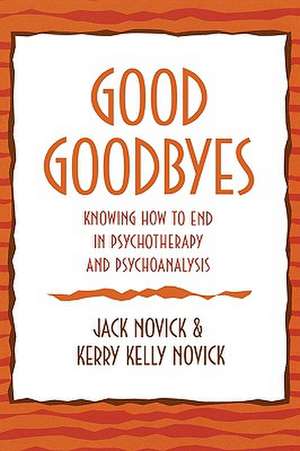
Good Goodbyes: Knowing How to End in Psychotherapy and Psychoanalysis
Autor Jack Novick, Kerry Kelly Novicken Limba Engleză Hardback – 7 mar 2006
With vivid clinical examples from all diagnostic groups and all stages of development, the Novicks demonstrate how to engage each patient in building the "emotional muscle" needed to master life's challenges, transform early losses, and integrate new experiences of joy and sadness into the personality.
Preț: 536.11 lei
Preț vechi: 745.83 lei
-28%
Puncte Express: 804
Carte tipărită la comandă
Livrare economică 05-19 decembrie
Livrare prin curier în România Termenul estimat este afișat lângă disponibilitate.
Transport gratuit pentru acest produs Plată online sau ramburs, în funcție de opțiunile comenzii.
Retur gratuit în 14 zile Comandă securizată și suport în română.
Specificații
ISBN-13: 9780765704122
ISBN-10: 0765704129
Pagini: 149
Dimensiuni: 165 x 239 x 16 mm
Greutate: 0.43 kg
Editura: Bloomsbury Publishing
Colecția Jason Aronson Inc
Locul publicării:New York, United States
ISBN-10: 0765704129
Pagini: 149
Dimensiuni: 165 x 239 x 16 mm
Greutate: 0.43 kg
Editura: Bloomsbury Publishing
Colecția Jason Aronson Inc
Locul publicării:New York, United States
V-ar putea interesa
-
 -27%Preț: 753.56 lei1031.43 lei
 -
 Everyday Mysteries: A Handbook of Existential PsychotherapyEmmy van Deurzen-5%Preț: 370.05 lei389.53 lei
 -
 -5%Preț: 361.70 lei380.74 lei
 -
 What Made Freud Laugh: An Attachment Perspective on LaughterJudith Kay Nelson-15%Preț: 418.00 lei491.77 lei
 -
 Acupuncture in Pregnancy and ChildbirthZita West-26%Preț: 386.32 lei521.73 lei
 -
 Irvin D. YalomRuthellen JosselsonPreț: 153.85 lei
 -
 Cognitive Behavior Therapy and Eating DisordersChristopher G. Fairburn-5%Preț: 436.97 lei459.97 lei
 -
 Cognitive Therapy of SchizophreniaDavid G. Kingdon-5%Preț: 278.13 lei292.77 lei
 -
 Preț: 333.09 lei
 -
 -5%Preț: 436.25 lei459.22 lei
Cuprins
Chapter 1 Overview
Chapter 2 Evaluation
Chapter 3 Beginning Phase
Chapter 4 Middle Phase
Chapter 5 Pretermination
Chapter 6 Termination
Chapter 7 Post-Termination
Chapter 8 Final Thoughts
Chapter 2 Evaluation
Chapter 3 Beginning Phase
Chapter 4 Middle Phase
Chapter 5 Pretermination
Chapter 6 Termination
Chapter 7 Post-Termination
Chapter 8 Final Thoughts
Recenzii
Good Goodbyes is a fitting culmination of the Novicks' esteemed contributions to the literatures on termination, child and adult psychotherapies, and the 'two systems' model of self-esteem regulation. This thorough, practical, and wise volume on how to productively approach the ending of psychotherapies will be a great resource for experienced therapists and an invaluable guide to clinicians in training.
With generously supplied illustrative clinical vignettes, Kerry Kelly and Jack Novick have assembled a most valuable presentation concerning treatment termination. They demonstrate how the prospect of termination shapes the work of the entire collaboration, from its very onset through and beyond the final day that patient and analyst meet. Their detailed exposition, organized along the lines of a reader's expectable questions, throws clarifying light on an aspect of the treatment enterprise hitherto accorded but meager attention.
The Novicks have produced an excellent and most original book on termination in psychoanalysis and psychotherapy.At last we have an approach that conceives termination so fully, that it includes the concerns, and reasonable preparations for the patient self care after termination.
Jack and Kerry Kelly Novick have written a very interesting book that grapples with the difficult issue of termination. I highly recommend this book to both beginning and advanced therapists and analysts. It will give them many ideas about many different ways to think about termination.
Deciding when to end clinical therapy and how to end it well can be a mystifying process. In Good Goodbyes: Knowing How to End in Psychotherapy and Psychoanalysis, Jack Novick and Kerry Kelly Novick share insights from their vast combined experienceto diminish the mystery of therapeutic closure. The book, which is firmly based in psychoanalytic theory, uses a question format to explore the many hows, whys, whats, and whens of termination. The authors outline treatment stages along the path to the therapeutic conclusion, all the while fine-tuning a constructive approach for supplying the good in goodbye. As psychoanalysts, teachers, and supervisors, the Novicks bring a refreshing perspective to ?endings, beginnings, and the work needed for a goodgoodbye? (p. xi), filling in gaps not previously addressed. The layout is especially helpful for locating information to apply in practice settings. Fortunately, each chapter includes illustrations that allow practitioners with little training in psychoanalysis to understand key concepts without a deep grounding in psychoanalytic theory. Some of the new insights into termination do generalize across theoretical orientations. Although it is comprehensively psychoanalytic, Good Goodbyes presen
Nearly every therapist has watched in helpless agony when the good work of a patient's therapy is spoiled by a bad ending. In Good Goodbyes, the Novicks help us to minimize the possibility of such painful occurrences. Through an easy-to-follow series of questions and answers they walk us through the phases of intensive analytic treatment: from evaluation to beginning; from middle to pre-termination; and finally, from the much neglected phases of termination to post-termination. Through vivid and compelling child and adult clinical vignettes, they illuminate the challenges and satisfactions inherent in such work. Moreover, they demonstrate that when a treatment culminates in a "good, goodbye", a patient's system of self regulation can be transformed from one that is joyless, constricted and closed to one that is healthy, alive and open.
With generously supplied illustrative clinical vignettes, Kerry Kelly and Jack Novick have assembled a most valuable presentation concerning treatment termination. They demonstrate how the prospect of termination shapes the work of the entire collaboration, from its very onset through and beyond the final day that patient and analyst meet. Their detailed exposition, organized along the lines of a reader's expectable questions, throws clarifying light on an aspect of the treatment enterprise hitherto accorded but meager attention.
The Novicks have produced an excellent and most original book on termination in psychoanalysis and psychotherapy.At last we have an approach that conceives termination so fully, that it includes the concerns, and reasonable preparations for the patient self care after termination.
Jack and Kerry Kelly Novick have written a very interesting book that grapples with the difficult issue of termination. I highly recommend this book to both beginning and advanced therapists and analysts. It will give them many ideas about many different ways to think about termination.
Deciding when to end clinical therapy and how to end it well can be a mystifying process. In Good Goodbyes: Knowing How to End in Psychotherapy and Psychoanalysis, Jack Novick and Kerry Kelly Novick share insights from their vast combined experienceto diminish the mystery of therapeutic closure. The book, which is firmly based in psychoanalytic theory, uses a question format to explore the many hows, whys, whats, and whens of termination. The authors outline treatment stages along the path to the therapeutic conclusion, all the while fine-tuning a constructive approach for supplying the good in goodbye. As psychoanalysts, teachers, and supervisors, the Novicks bring a refreshing perspective to ?endings, beginnings, and the work needed for a goodgoodbye? (p. xi), filling in gaps not previously addressed. The layout is especially helpful for locating information to apply in practice settings. Fortunately, each chapter includes illustrations that allow practitioners with little training in psychoanalysis to understand key concepts without a deep grounding in psychoanalytic theory. Some of the new insights into termination do generalize across theoretical orientations. Although it is comprehensively psychoanalytic, Good Goodbyes presen
Nearly every therapist has watched in helpless agony when the good work of a patient's therapy is spoiled by a bad ending. In Good Goodbyes, the Novicks help us to minimize the possibility of such painful occurrences. Through an easy-to-follow series of questions and answers they walk us through the phases of intensive analytic treatment: from evaluation to beginning; from middle to pre-termination; and finally, from the much neglected phases of termination to post-termination. Through vivid and compelling child and adult clinical vignettes, they illuminate the challenges and satisfactions inherent in such work. Moreover, they demonstrate that when a treatment culminates in a "good, goodbye", a patient's system of self regulation can be transformed from one that is joyless, constricted and closed to one that is healthy, alive and open.