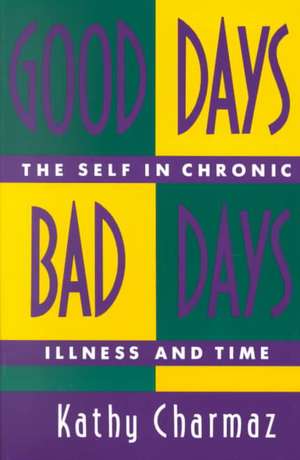
Good Days, Bad Days: The Self and Chronic Illness in Time
Autor Kathy Charmazen Limba Engleză Paperback – sep 1993
Kathy Charmaz has written a compelling book on chronic illness and the effect it has on the self-concepts of those who suffer. It will appeal to anyone facing a long-term problem that seems beyond control. Her work is based on interviews with people suffering from such diseases as cancer, multiple sclerosis, and arthritis, and with their caregivers. Charmaz looks at how these people disclose their illness, how they experience their emotions, and how they manage daily life.
Illness provides a mirror that allows sufferers to see themselves and to become more introspective. As they struggle for control over illness and control over time, they also struggle to control the central images of the self. For example, the chronically ill may situate their self-concepts in the past, present, or future. Charmaz examines under what conditions they situate their self-concepts in each of those timeframes. People may say they live one day at a time. They may bracket certain experiences, such as a heart attack, as timemarkers or turning points in the past. Or they may look ahead to recovering their health. Or ahead to death. Charmaz artfully combines near jargon-free analysis with moving stories about how people have experienced illness, usually told in the sufferers' own words. She enters the world of the chronically ill, and brings us into it.
Preț: 300.41 lei
Preț vechi: 316.22 lei
-5%
Puncte Express: 451
Carte tipărită la comandă
Livrare economică 23 noiembrie-07 decembrie
Livrare prin curier în România Termenul estimat este afișat lângă disponibilitate.
Transport gratuit de la 400.00 lei Plată online sau ramburs, în funcție de opțiunile comenzii.
Retur gratuit în 14 zile Comandă securizată și suport în română.
Specificații
ISBN-13: 9780813519678
ISBN-10: 0813519675
Pagini: 324
Dimensiuni: 152 x 229 x 23 mm
Greutate: 0.51 kg
Ediția:None
Editura: Rutgers University Press
Colecția Rutgers University Press
ISBN-10: 0813519675
Pagini: 324
Dimensiuni: 152 x 229 x 23 mm
Greutate: 0.51 kg
Ediția:None
Editura: Rutgers University Press
Colecția Rutgers University Press
V-ar putea interesa
-
 That's a Great Question, I'd Love to Tell YouElyse MyersPreț: 145.37 lei
 -
 Preț: 173.56 lei
 -
 Nowhere GirlCarla CicconePreț: 122.34 lei
 -
 Getting Well AgainO Carl SimontonPreț: 51.71 lei
 -
 Twenty-Four Hours a DayANONYMOUSPreț: 105.65 lei
 -
 -27%Preț: 87.21 lei119.13 lei
 -
 Savoring CareEmily MendenhallPreț: 168.70 lei
 -
 Identity Theft, Second Edition: Rediscovering Ourselves After StrokeDebra E. Meyerson-17%Preț: 98.85 lei118.48 leiRecomandat
 -
 Take CareLindsey BurrowPreț: 156.94 lei
 -
 When Someone You Love Has an IllnessTamara GreenbergPreț: 83.26 lei
 -
 How to Live Well with Chronic Pain and IllnessToni Bernhard-17%Preț: 108.35 lei131.29 lei
 -
 The uncharted selfTalal AlaliPreț: 99.33 lei
 -
 -26%Preț: 106.22 lei142.92 lei
 -
 Crafting a Path Through IllnessGermaine Hypher-5%Preț: 148.98 lei156.82 lei
 -
 Death of an Ordinary ManSarah PerryPreț: 123.62 lei
 -
 Being Ill: On Sickness, Care and AbandonmentNeil VickersPreț: 111.29 lei
 -
 -20%Preț: 110.53 lei138.12 lei
 -
 Preț: 108.35 lei
Notă biografică
KATHY CHARMAZ is professor and chair of the department of sociology at Sonoma State University. She is the author of The Social Reality of Death.
Cuprins
Preface
1. Introduction
Part I. Experiencing Chronic Illness
2. Chronic Illness as Interruption
3. Intrusive Illness
4. Immersion in Illness
Part II. Problems in Everyday Life
5. Disclosing Illness
6. Living with Chronic Illness
Part III. Illness, the Self, and Time
7. Time Perspectives and Time Structures
8. Timemarkers and Turning Points
9. The Self in Time
10. Lessons from the Experience of Illness
Epilogue
Methodological Appendix
Notes
Glossary
References
Index
1. Introduction
Part I. Experiencing Chronic Illness
2. Chronic Illness as Interruption
3. Intrusive Illness
4. Immersion in Illness
Part II. Problems in Everyday Life
5. Disclosing Illness
6. Living with Chronic Illness
Part III. Illness, the Self, and Time
7. Time Perspectives and Time Structures
8. Timemarkers and Turning Points
9. The Self in Time
10. Lessons from the Experience of Illness
Epilogue
Methodological Appendix
Notes
Glossary
References
Index
Recenzii
Charmaz transcends the basic issues involved in chronic illness to disclose linkages between one's sense of identity and one's construction of time, which have implications well beyond the realm of health and illness.
A very moving work. It does a marvelous job of allowing the reader to get 'inside' the experience of chronic illness.
This is an outstanding work. [It] brilliantly conveys an unsurpassable depth of understanding and feeling about the chronically ill.
Descriere
Millions of American suffer chronic illness, but what is life really like when you are chronically ill? Drawing on skillfully conducted in-depth interviews, Kathy Charmaz takes a fresh look at the experiences of people with serious chronic illnesses such as cardiovascular disease, cancer, lupus, emphysema, multiple sclerosis, and arthritis.