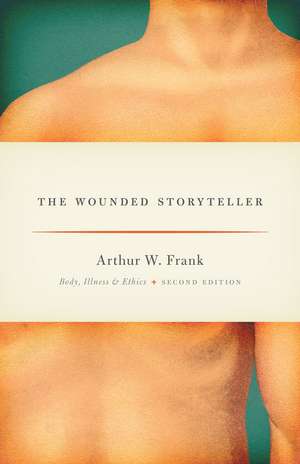
The Wounded Storyteller: Body, Illness, and Ethics, Second Edition
Autor Arthur W. Franken Limba Engleză Paperback – 28 aug 2013
Since it was first published in 1995, The Wounded Storyteller has occupied a unique place in the body of work on illness. Both the collective portrait of a so-called “remission society” of those who suffer from some type of illness or disability and a cogent analysis of their stories within a larger framework of narrative theory, Arthur W. Frank’s book has reached a large and diverse readership including the ill, medical professionals, and scholars of literary theory.
Drawing on the work of authors such as Oliver Sacks, Anatole Broyard, Norman Cousins, and Audre Lorde, as well as from people he met during the years he spent among different illness groups, Frank recounts a stirring collection of illness stories, ranging from the well-known—Gilda Radner's battle with ovarian cancer—to the private testimonials of people with cancer, chronic fatigue syndrome, and disabilities. Their stories are more than accounts of personal suffering: they abound with moral choices and point to a social ethic.
In this new edition Frank adds a preface describing the personal and cultural times when the first edition was written. His new afterword extends the book’s argument significantly, writing about storytelling and experience, other modes of illness narration, and a version of hope that is both realistic and aspirational. Reflecting on both his own life during the creation of the first edition and the conclusions of the book itself, Frank reminds us of the power of storytelling as way to understanding our own suffering.
Preț: 175.98 lei
Puncte Express: 264
Carte disponibilă
Livrare economică 12-26 noiembrie
Livrare express 29 octombrie-04 noiembrie pentru 26.85 lei
Livrare prin curier în România Termenul estimat este afișat lângă disponibilitate.
Transport gratuit de la 400.00 lei Plată online sau ramburs, în funcție de opțiunile comenzii.
Retur gratuit în 14 zile Comandă securizată și suport în română.
Specificații
ISBN-13: 9780226004976
ISBN-10: 022600497X
Pagini: 280
Dimensiuni: 140 x 216 x 20 mm
Greutate: 0.39 kg
Ediția:Second Edition
Editura: University of Chicago Press
Colecția University of Chicago Press
ISBN-10: 022600497X
Pagini: 280
Dimensiuni: 140 x 216 x 20 mm
Greutate: 0.39 kg
Ediția:Second Edition
Editura: University of Chicago Press
Colecția University of Chicago Press
V-ar putea interesa
-
 The Handmaid's TaleMargaret Atwood-18%Preț: 59.78 lei72.48 lei
 -
 The Oxford Handbook of Tense and AspectRobert I. Binnick-27%Preț: 420.55 lei576.22 lei
 -
 Oneself as AnotherPaul RicoeurPreț: 263.13 lei
 -
 Postmodern Narrative TheoryMark CurriePreț: 233.22 lei
 -
 -5%Preț: 397.61 lei418.54 lei
 -
 Preț: 438.36 lei
 -
 -27%Preț: 1938.71 lei2655.77 lei
 -
 The Autism MatrixGil EyalPreț: 229.08 lei
 -
 About TimeMark Currie-18%Preț: 171.25 lei207.75 lei
 -
 Growing Up with a Schizophrenic MotherMargaret J. BrownPreț: 162.63 lei
 -
 Narrative Discourse RevisitedGerard GenettePreț: 232.32 lei
 -
 You Bet Your LifeNeil D. Isaacs-5%Preț: 164.67 lei173.34 lei
 -
 Policing MethamphetamineWilliam GarriottPreț: 247.57 lei
 -
 Kafka: Toward a Minor LiteratureGilles DeleuzePreț: 157.16 lei
 -
 Listening to the LandLee SchweningerPreț: 207.89 lei
 -
 Alcohol Problems in Older Adults: Prevention and ManagementKristen Lawton Barry-11%Preț: 509.98 lei573.00 lei
 -
 The Cambridge Handbook of PragmaticsKeith AllanPreț: 395.58 lei
 -
 The Cambridge Handbook of Generative SyntaxMarcel Den DikkenPreț: 569.13 lei
 -
 Understanding Sentence StructureChristina TortoraPreț: 407.59 lei
 -
 Preț: 158.04 lei
 -
 -5%Preț: 397.99 lei418.94 lei
 -
 Preț: 399.60 lei
 -
 Thinking about AddictionCraig HansonPreț: 400.80 lei
Notă biografică
Arthur W. Frank is professor of sociology at the University of Calgary and the author of At the Will of the Body: Reflections on Illness; Letting Stories Breathe: A Socio-Narratology; and The Renewal of Generosity: Illness, Medicine, and How to Live, the latter two also published by the University of Chicago Press.
Cuprins
Preface, 2013
Preface
Acknowledgments
One When Bodies Need Voices
Two The Body’s Problem with Illness
Three Illness as a Call for Stories
Four The Restitution Narrative
Five The Chaos Narrative
Six The Quest Narrative
Seven Testimony
Eight The Wound as Half Opening
Afterword
Notes
Index
Recenzii
"Frank sees the value of illness narratives not so much in solving clinical conundrums as in addressing the question of how to live a good life."
"Arthur Frank's writings on illness and the body transcend the barriers of academic and professional disciplines, making them uniquely relevant to a wide variety of audiences: clinicians, ethicists, sociologists, scholars in the humanities and human sciences, those engaged in medical education, caregivers, and (always) the never-to-be-forgotten community of the ill."
“This is a bold and imaginative book which moves our thinking about narratives of illness in new directions.”
“Arthur W. Frank’s second edition of The Wounded Storyteller provides instructions for use of this now-classic text in the study of illness narratives. At the remove of twenty years, the author sees that he was trying for not only an analytic study of illness narratives but also ‘self-healing . . . to assure myself I wasn’t crazy.’ By recognizing that his own illness incorporated all three of his canonical narrative types and then by adding to his typology, Frank reveals the evolution of his frames of thought about illness. Perhaps health is a mirage and illness is a natural state of being. Perhaps getting old and sick is the blue book price for living mortal lives. Frank has helped us all not just to accept but to revere these givens of our human predicament.”
“Arthur W. Frank has changed the way we think about storytelling and health care. His work champions a point of view long neglected and too often thought to be medically irrelevant. His penetrating essays on the human need to make sense and meaning from illness have become ‘required reading’ for many of us. This new edition of The Wounded Storyteller is most welcome.”
“A classic book. Illness touches us all—patients, providers, family, friends—and Arthur W. Frank shows how illness extends beyond bodies to shape the stories (personal and cultural) that we almost inevitably construct to explain and to contain it. The stories in turn often reshape the experience of illness. The Wounded Storyteller is thus an indispensable guide to the oddly familiar but alien territory we inhabit when we enter what Susan Sontag called ‘the kingdom of the ill.’ Now, with an extended new preface and afterword, a classic-plus.”