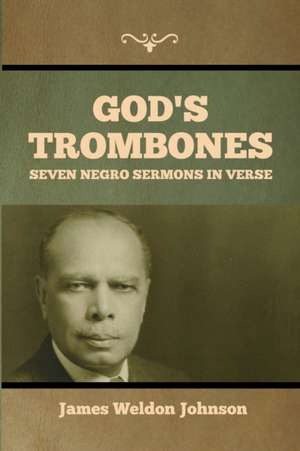
God's Trombones
Autor James Weldon Johnsonen Limba Engleză Paperback – 9 ian 2023
Preț: 109.55 lei
Carte tipărită la comandă
Livrare economică 24-30 octombrie
Specificații
Pagini: 68
Dimensiuni: 152 x 229 x 5 mm
Greutate: 0.1 kg
Editura: Bibliotech Press
V-ar putea interesa
-
 Sir Gawain and the Green KnightAnonymousPreț: 68.44 lei
 -
 The Quest of the Holy GrailAnonymousPreț: 95.56 lei
 -
 The Songs of the SouthQuyuanPreț: 93.01 lei
 -
 The Epic of GilgameshN K SandarsPreț: 59.55 lei
 -
 Complete PoemsJames Weldon JohnsonPreț: 108.31 lei
 -
 Lives of the AnimalsRobert WrigleyPreț: 123.83 lei
 -
 Selected PoemsPaul Laurence DunbarPreț: 145.47 lei
 -
 Good Poems for Hard TimesGarrison KeillorPreț: 115.21 lei
 -
 DoveglionJose Garcia VillaPreț: 111.89 lei
 -
 MixologyAdrian MatejkaPreț: 123.64 lei
 -
 Reading Black, Reading FeministHenry Louis GatesPreț: 148.81 lei
 -
 The Future of the RaceHenry Louis GatesPreț: 128.32 lei
 -
 At The River's Edge: Where Quantum Streams FlowYvonne L. JonesPreț: 32.88 lei
 -
 Confessions of a Porn AddictJay SizemorePreț: 87.99 lei
 -
 This Is PoetryEd Michele McDannoldPreț: 100.75 lei
 -
 Dual Impressions: Poetic Conversations About ArtJeffrey GraessleyPreț: 96.85 lei
 -
 Thoughts Of LoveJacqueline DodsonPreț: 65.60 lei
 -
 A One-Star NightSonja CiottiPreț: 94.98 lei
 -
 The Essence Of A Virtuous WomanBridgette N. ThorntonPreț: 103.96 lei
 -
 Chocolate and CigarettesArthur MarinelloPreț: 67.67 lei
 -
 Speaking of Race, Speaking of SexHenry Louis Gates, Jr.-23%Preț: 631.29 lei819.86 lei
 -
 -8%Preț: 482.02 lei523.93 lei
 -
 The Autobiography of an Ex Colored ManJames Weldon JohnsonPreț: 91.21 lei
 -
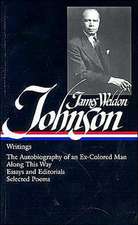 Johnson, J: LIAM JAMES WELDON JOHNSON WRITJames Weldon JohnsonPreț: 237.18 lei
Notă biografică
James Weldon Johnson (1871-1938) was an African American writer and civil rights activist. Born in Jacksonville, Florida, he obtained an education from a young age, first by his mother, a musician and teacher, and then at the Edwin M. Stanton School. In 1894, he graduated from Atlanta University, a historically black college known for its rigorous classical curriculum. With his brother Rosamond, he moved to New York City, where they excelled as songwriters for Broadway. His poem "Lift Ev'ry Voice and Sing" (1899), set to music by Rosamond, eventually became known as the "Negro National Anthem." Over the next several decades, he dedicated himself to education, activism, and diplomacy. From 1906 to 1913, he worked as a United States Consul, first in Puerto Cabello, Venezuela, and then in Nicaragua. He married Grace Nail, an activist and artist, in 1910, and would return to New York with her following the end of his diplomatic career. While in Nicaragua, he wrote and anonymously published The Autobiography of an Ex-Colored Man (1912), a novel exploring the phenomenon of racial passing. In 1917, Johnson began his work with the NAACP, eventually rising to the role of executive secretary. He became known as a towering figure of the Harlem Renaissance, writing poems and novels as well as compiling such anthologies as The Book of American Negro Poetry (1922). For his contributions to African American culture as an artist and patron, his activism against lynching, and his pioneering work as the first African American professor at New York University, Johnson is considered one of twentieth century America's leading cultural figures.