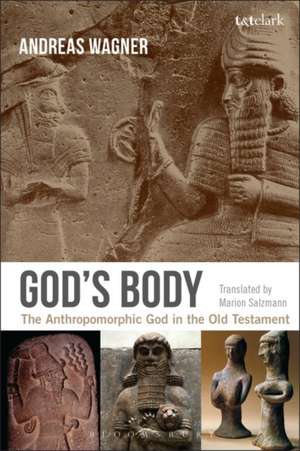
God's Body: The Anthropomorphic God in the Old Testament
Autor Professor Andreas Wagneren Limba Engleză Paperback – 21 feb 2019
Wagner begins by introducing readers to aspects of anthropomorphism, the study of body parts, and Israel's basic understanding of the human body. He then turns specifically to the body of God, analysing why and how certain body parts are emphasized or regularly employed in the biblical text when it tries to describe God. Wagner draws out the theological aspects of the ways in which God's body is described as well as considering the diverse range of ancient Near Eastern perspectives on God, and the ways in which ancient cultures constructed and understood deities. Wagner concludes by looking at how the depiction of God in the Old Testament fits with the concept of mankind made in God's image. Enhanced by over fifty illustrations, God's Body will lead the debate in biblical anthropomorphism for years to come.
Preț: 255.21 lei
Preț vechi: 310.00 lei
-18%
Puncte Express: 383
Carte disponibilă
Livrare economică 16-30 noiembrie
Livrare express 30 octombrie-05 noiembrie pentru 87.31 lei
Livrare prin curier în România Termenul estimat este afișat lângă disponibilitate.
Transport gratuit de la 400.00 lei Plată online sau ramburs, în funcție de opțiunile comenzii.
Retur gratuit în 14 zile Comandă securizată și suport în română.
Specificații
ISBN-13: 9780567655981
ISBN-10: 0567655989
Pagini: 208
Ilustrații: 55 bw illus
Dimensiuni: 156 x 232 x 16 mm
Greutate: 0.34 kg
Editura: Bloomsbury Publishing
Colecția T&T Clark
Locul publicării:London, United Kingdom
ISBN-10: 0567655989
Pagini: 208
Ilustrații: 55 bw illus
Dimensiuni: 156 x 232 x 16 mm
Greutate: 0.34 kg
Editura: Bloomsbury Publishing
Colecția T&T Clark
Locul publicării:London, United Kingdom
V-ar putea interesa
-
 Cosmology and Self in the Apostle Paul: The Material SpiritTroels Engberg-Pedersen-22%Preț: 414.06 lei533.85 lei
 -
 -31%Preț: 864.38 lei1259.94 lei
 -
 Discovering GenesisIain ProvanPreț: 151.54 lei
 -
 The Good ShepherdKenneth BaileyPreț: 118.80 lei
 -
 ActsEckhard J. Schnabel-8%Preț: 520.60 lei565.87 lei
 -
 The Philosophy of Hebrew ScriptureYoram HazonyPreț: 292.19 lei
 -
 The King James Only ControversyJames R WhitePreț: 109.67 lei
 -
 1 CorinthiansDavid E. GarlandPreț: 428.49 lei
 -
 The Gospel of MatthewEdward SriPreț: 159.42 lei
 -
 First and Second Peter, JudeDaniel KeatingPreț: 143.10 lei
 -
 LukeCraig A EvansPreț: 169.16 lei
 -
 MatthewRobert H MouncePreț: 128.78 lei
 -
 The Holy Spirit -- In Biblical Teaching, through the Centuries, and TodayAnthony C. ThiseltonPreț: 379.90 lei
 -
 The First Epistle to the Corinthians, Revised EditionGordon D. Fee-8%Preț: 435.51 lei473.38 lei
 -
 ActsJohn B PolhillPreț: 230.60 lei
 -
 Philippians, Colossians, PhilemonRichard MelickPreț: 220.58 lei
 -
 Isaac on Jewish and Christian AltarsDevorah SchoenfeldPreț: 499.11 lei
 -
 Galatians, EphesiansGerald L BrayPreț: 411.63 lei
 -
 Misreading Scripture with Western EyesE. Randolph RichardsPreț: 129.26 lei
 -
 Preaching: A Guidebook for BeginnersAllan ChapplePreț: 95.79 lei
Cuprins
Image Credits
Preface
1. Introduction - An Investigation Into The External Body Of God As It Can Be Portrayed Pictorially
2. The "Picture" Of God - Yhwh In The Corporeal Form Of Man
3. God In Human Form - Anthropomorphism As A Theological Problem
4. Deciphering The Language Of Images And Of Corporeal Depictions
5. God's Body (The External Figure) - Its Theological Message
6. The Picture Of God In The Old Testament And Of Mankind Made In The Image Of God
Bibliography
Preface
1. Introduction - An Investigation Into The External Body Of God As It Can Be Portrayed Pictorially
2. The "Picture" Of God - Yhwh In The Corporeal Form Of Man
3. God In Human Form - Anthropomorphism As A Theological Problem
4. Deciphering The Language Of Images And Of Corporeal Depictions
5. God's Body (The External Figure) - Its Theological Message
6. The Picture Of God In The Old Testament And Of Mankind Made In The Image Of God
Bibliography
Recenzii
God's Body presents an important introduction to the discussion of the body in the Bible and the ANE.
Praise for the German Edition of this Book:
In this eminently readable and engaging work, Wagner offers to a wide audience an informed overview of Israelite reflections on divine embodiment within the context of ancient Near Eastern religions.
Wagner presents an engaging and challenging description of YHWH's body and why it should be properly understood ... The multiple depictions of the art of Egypt, Syria-Palestine, Phoenicia, and Mesopotamia is a highlight of the book. He also mentions possible avenues for future research.
This study book on the metaphors and language imagery of the Hebrew Bible, in comparison with the pictorial representations of the Ancient Near East, is to be [...] appreciated. One finds in this book valuable explanations of how gods were portrayed in the Ancient Near East, differentiated between Egypt and Mesopotamia, and how, in comparison, the body of God is linguistically described in the Hebrew Bible.
Andreas Wagner advocates taking seriously the Old Testament ideas of the human form of God. But modern misunderstandings have to be dispelled. Ancient Oriental images are not visuals but visuals before the emergence of Greek pictorial tradition [...] This inspiring study concludes that, all in all, it is therefore a theologically most demanding achievement to maintain the (mental) image of the body of God, to think a prohibition of images in the sense of a cult image prohibition, and to carry out the whole in strict monotheism.
Praise for the German Edition of this Book:
In this eminently readable and engaging work, Wagner offers to a wide audience an informed overview of Israelite reflections on divine embodiment within the context of ancient Near Eastern religions.
Wagner presents an engaging and challenging description of YHWH's body and why it should be properly understood ... The multiple depictions of the art of Egypt, Syria-Palestine, Phoenicia, and Mesopotamia is a highlight of the book. He also mentions possible avenues for future research.
This study book on the metaphors and language imagery of the Hebrew Bible, in comparison with the pictorial representations of the Ancient Near East, is to be [...] appreciated. One finds in this book valuable explanations of how gods were portrayed in the Ancient Near East, differentiated between Egypt and Mesopotamia, and how, in comparison, the body of God is linguistically described in the Hebrew Bible.
Andreas Wagner advocates taking seriously the Old Testament ideas of the human form of God. But modern misunderstandings have to be dispelled. Ancient Oriental images are not visuals but visuals before the emergence of Greek pictorial tradition [...] This inspiring study concludes that, all in all, it is therefore a theologically most demanding achievement to maintain the (mental) image of the body of God, to think a prohibition of images in the sense of a cult image prohibition, and to carry out the whole in strict monotheism.