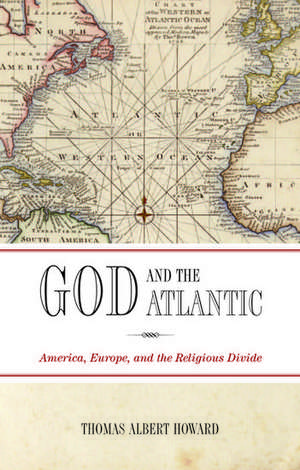
God and the Atlantic: America, Europe, and the Religious Divide
Autor Thomas Albert Howarden Limba Engleză Paperback – 17 ian 2013
Recomandăm God and the Atlantic istoricilor, teologilor și cercetătorilor în științe politice care doresc să înțeleagă rădăcinile profunde ale divergenței religioase dintre Lumea Nouă și continentul european. În timp ce sociologii și jurnaliștii s-au concentrat pe datele recente ale secularizării, Thomas Albert Howard propune o perspectivă istorică riguroasă, examinând modul în care intelectualii europeni din secolele al XIX-lea și al XX-lea au perceput vitalitatea religioasă americană.
Găsim în această lucrare o structură echilibrată: primele capitole analizează reticența 'Vechii Lumi' față de pluralismul religios american, în timp ce partea finală se concentrează pe evaluări constructive. Considerăm că elementul distinctiv al cărții este efortul autorului de a depăși 'umbra' lui Alexis de Tocqueville, aducând în prim-plan voci subestimate precum istoricul Philip Schaff și filozoful Jacques Maritain. Această abordare nuanțează înțelegerea modului în care religia a modelat identitățile transatlantice.
Această monografie completează perspectiva oferită de Religious America, Secular Europe? de Peter Berger, adăugând o profunzime istorică și intelectuală acolo unde lucrarea lui Berger se concentrează pe dimensiunile sociologice și instituționale. În contextul operei sale, God and the Atlantic continuă interesul lui Thomas Albert Howard pentru intersecția dintre religie și modernitate, temă centrală și în Broken Altars, unde a explorat violența secularismului extrem, sau în The Pope and the Professor, unde a analizat tensiunile doctrinare din secolul al XIX-lea. Ritmul narativ este cel al unei analize academice dense, dar accesibile, publicată sub egida prestigioasă a OUP Oxford.
Preț: 264.61 lei
Preț vechi: 304.12 lei
-13%
Carte tipărită la comandă
Livrare economică 27 noiembrie-02 decembrie
Specificații
ISBN-10: 0199671303
Pagini: 272
Dimensiuni: 144 x 215 x 14 mm
Greutate: 0.34 kg
Editura: OUP OXFORD
Colecția OUP Oxford
Locul publicării:Oxford, United Kingdom
V-ar putea interesa
-
 Christianity: A Global HistoryDavid ChidesterPreț: 135.52 lei
 -
 -19%Preț: 357.48 lei440.47 lei
 -
 The Ecclesiology of Karl RahnerRichard Lennan-21%Preț: 302.26 lei380.36 lei
 -
 -22%Preț: 506.94 lei653.46 lei
 -
 -28%Preț: 483.17 lei671.34 lei
 -
 -28%Preț: 398.43 lei556.52 lei
 -
 -24%Preț: 721.31 lei944.81 lei
 -
 -19%Preț: 673.00 lei830.87 lei
 -
 -29%Preț: 406.72 lei568.90 lei
 -
 The Johannine Corpus in the Early ChurchCharles E. Hill-24%Preț: 686.75 lei900.92 lei
 -
 Protestant Theology and the Making of the Modern German UniversityThomas Albert Howard-21%Preț: 451.49 lei570.07 lei
 -
 The Closing Of The Western MindCharles FreemanPreț: 145.50 lei
 -
 The Earliest Christian ArtifactsLarry W. HurtadoPreț: 179.28 lei
 -
 Preț: 122.03 lei
De ce să citești această carte
Studenții și practicienii din domeniul relațiilor internaționale sau al istoriei religiilor vor găsi aici un instrument esențial pentru a înțelege de ce Statele Unite au rămas o societate profund religioasă în comparație cu Europa secularizată. Cartea oferă un context istoric clar pentru tensiunile culturale actuale, demonstrând că 'decalajul religios' nu este un fenomen recent, ci unul cu rădăcini intelectuale complexe și bine documentate.
Despre autor
Thomas Albert Howard este profesor de istorie la Gordon College și director fondator al Jerusalem & Athens Forum. Cu un doctorat în istorie intelectuală europeană obținut la University of Virginia, Howard s-a specializat în evoluția gândirii religioase și a secularismului în modernitate. Expertiza sa este reflectată în lucrări de referință precum 'Religion and the Rise of Historicism', fiind recunoscut pentru capacitatea de a sintetiza curente filozofice și evoluții teologice în cadrul istoriei politice și culturale a Occidentului.
Descriere
Recenzii
Howard has written a remarkable essay in the history of ideas. ... an original contribution, with implications far beyond its original focus for the history and theory of secularization.
[an] immensely thoughtful and useful book ... engagingly written in a lucid and accessible style, for which the author should be congratulated. It valuably moves beyond many generations of thought that have eclipsed America from conventional religious history.
The author expertly demonstrates that Europeans assessment of American religion is not simply negative ... This book is valuable for scholars interested in the intellectual history of the embattled but remarkably resilient secularization thesis.
The causes of the religious divide between Europe and America are hotly disputed among social scientists and contemporary historians. By carefully examining European views of America since the late eighteenth century, Thomas Albert Howard is the first scholar to give historical depth to this debate. Everyone interested to find a way through the labyrinth of transatlantic comparisons and prejudice is well advised to read this book.
This is an excellent, thoughtful, and balanced book. As a historical study with contemporary relevance, it is tightly focused, but gracefully written, with a nice balance struck between theoretical analysis and expository narrative. Howard's ability to navigate the complex political-religious histories of both Europe and the United States gives this book a truly transatlantic perspective.
God and the Atlantic is not only a well-researched and wide-ranging study, it is also a timely book that holds out the promise of helping Americans and Europeans understand each other better. It is illuminating to discover how certain contemporary reactions to apparently new developments are actually based on assumptions with deep historical roots. This book deserves to be read well beyond the scholarly world.
For breadth of research, depth of historical insight, and timeliness of publication, God and the Atlantic is an unusually fine work. Its careful cataloguing of European responses to religion in the United States shows that perspectives from the conservative Right and radical Left share a common rigidity and even sometimes nearly identical judgments. By contrast, European savants who traveled extensively in the United States have sometimes seen things more clearly, and with more nuance, than even America's homegrown observers. The book is a pathbreaking exploration.
God and the Atlantic provides an overview with impressive sweep, and it gives a vivid account of a virulent, persistent and consistent strain of European anti-Americanism. It is worth reading.