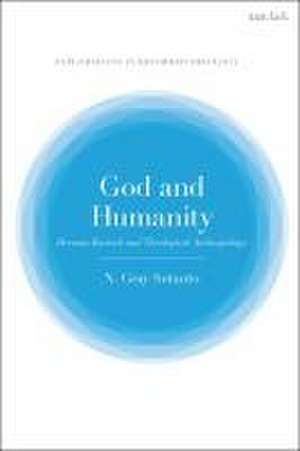
God and Humanity: Herman Bavinck and Theological Anthropology: T&T Clark Explorations in Reformed Theology
Autor Dr N. Gray Sutantoen Limba Engleză Hardback – 8 aug 2024






Preț: 552.03 lei
Preț vechi: 867.43 lei
-36%
Puncte Express: 828
Carte tipărită la comandă
Livrare economică 01-15 decembrie
Livrare prin curier în România Termenul estimat este afișat lângă disponibilitate.
Transport gratuit pentru acest produs Plată online sau ramburs, în funcție de opțiunile comenzii.
Retur gratuit în 14 zile Comandă securizată și suport în română.
Specificații
ISBN-13: 9780567709011
ISBN-10: 0567709019
Pagini: 240
Dimensiuni: 155 x 234 x 18 mm
Greutate: 0.54 kg
Editura: Bloomsbury Publishing
Colecția T&T Clark
Seria T&T Clark Explorations in Reformed Theology
Locul publicării:London, United Kingdom
ISBN-10: 0567709019
Pagini: 240
Dimensiuni: 155 x 234 x 18 mm
Greutate: 0.54 kg
Editura: Bloomsbury Publishing
Colecția T&T Clark
Seria T&T Clark Explorations in Reformed Theology
Locul publicării:London, United Kingdom
Cuprins
Acknowledgments
1. Bavinck and Theological Anthropology
2. Personality and the Unconscious: Charting Bavinck on the Unity of Body and Soul
3. Religious Creatures: Revelation, Affect Theory, and the Cognitive Science of Religion
4. Knowing God and Intransigent Sin
5. Organic Humanity and Sin
6. Race and History
7, Race and Religion
8. Consumation Anyway
9. Beatific Vision
10. Conclusion
Bibliography
1. Bavinck and Theological Anthropology
2. Personality and the Unconscious: Charting Bavinck on the Unity of Body and Soul
3. Religious Creatures: Revelation, Affect Theory, and the Cognitive Science of Religion
4. Knowing God and Intransigent Sin
5. Organic Humanity and Sin
6. Race and History
7, Race and Religion
8. Consumation Anyway
9. Beatific Vision
10. Conclusion
Bibliography
Recenzii
A helpful guide to those engaging these questions in theological anthropology, the work of Herman Bavinck, and the history of Reformed Dogmatics.
In his new release . Sutanto has not only added an important volume to his growing tour de force of Bavinck scholarship, but he has done so by advancing and refining critical questions emerging in contemporary theological anthropology.
While in presentation Sutanto's volume reaches only to the academic, its contents cannot be neglected by the professor or practitioner today. The work is demanding, but its fruits will be well worth the labour.
Herman Bavinck's theology was richly engaged in reappropriating the Catholic tradition for his own day, so it is not surprising, or beside the point, that he has been identified with a movement called 'Neo-Calvinism.' This latest book by N. Gray Sutanto not only traces the contours of Bavinck's thought, which is significant enough, but goes on likewise to ponder contemporary challenges with the benefit of historic resources from this great modern Reformed theologian.
Sutanto has masterfully demonstrated why Bavinck deserves a seat at the table. From cognitive science to the beatific vision, Sutanto shows why Bavinck's anthropology is relevant to contemporary philosophy and theology.
What Gray Sutanto does in this panoramic study is exactly what should be done at this stage of the surprising Anglophone Bavinck-renaissance: he not just offers a fine exposition of the Dutch neo-Calvinist's theological thoughts on the human being in its many contexts, but creatively dovetails Bavinck's theological anthropology with some of today's "big questions" in faith, science and society. Thus, he brings to bear Bavinck's organic thinking on contemporary conversations about the human self as an embodied, socially embedded being, about race and religion, about the meaning and goal of human existence. For example, in a fascinating engagement with the cognitive science of religion he interprets its results in the light of Bavinckian insights in the pre-theoretical, affective ways in which humans have become "born idolators" in their inner psyches. In such ways, Sutanto transcends standard historical reconstructions of Bavinck's thinking by engaging in constructive theology in line with and beyond Bavinck. Sutanto convincingly shows that this (rather than just repeating Bavinck) is actually the best way to take him with full seriousness.
This book is simultaneously predictable and surprising. It is predictable in offering more healthy fruit from Gray Sutanto's careful, expert scholarship on Herman Bavinck. But it may surprise us about how generative Bavinck's theological anthropology can be for addressing a range of important concerns. Without ignoring historical context or sanitizing ethical challenges, Sutanto brings Bavinck into a fruitful contemporary dialogue.
Gray Sutanto goes beyond Herman Bavinck and offers a challenging theological conversation with him and with contemporary theologians about neo-Calvinist views on the unity of the human race and the comprehensive meaning of man as God's image and its implications for theologizing today. Sutanto represents a new generation of neo-Calvinist theologians, and his reflections illustrate that this theology has entered a next and promising phase.
Sutanto provides an engaging and impressively lucid example of how historical theology can speak constructively into a wide-range of contemporary conversations, such as cognitive science of religion, affective psychology, and racial diversity.
Herman Bavinck enjoys a recent renaissance of new and invigorating studies, yet this one stands out from the rest in constructively engaging contemporary theology by learning from Bavinck.
Sutanto's God and Humanity is truly a noteworthy contribution . [it] is a commendable and vital addition to the church's resources. I anticipate this book will serve as an important secondary source for Bavinck's theological anthropology, yielding significant constructive theology.
Sutanto has also found in Bavinck interesting angles for current anthropological debates about gender and sexuality, ecotheology, and technology.
In his new release . Sutanto has not only added an important volume to his growing tour de force of Bavinck scholarship, but he has done so by advancing and refining critical questions emerging in contemporary theological anthropology.
While in presentation Sutanto's volume reaches only to the academic, its contents cannot be neglected by the professor or practitioner today. The work is demanding, but its fruits will be well worth the labour.
Herman Bavinck's theology was richly engaged in reappropriating the Catholic tradition for his own day, so it is not surprising, or beside the point, that he has been identified with a movement called 'Neo-Calvinism.' This latest book by N. Gray Sutanto not only traces the contours of Bavinck's thought, which is significant enough, but goes on likewise to ponder contemporary challenges with the benefit of historic resources from this great modern Reformed theologian.
Sutanto has masterfully demonstrated why Bavinck deserves a seat at the table. From cognitive science to the beatific vision, Sutanto shows why Bavinck's anthropology is relevant to contemporary philosophy and theology.
What Gray Sutanto does in this panoramic study is exactly what should be done at this stage of the surprising Anglophone Bavinck-renaissance: he not just offers a fine exposition of the Dutch neo-Calvinist's theological thoughts on the human being in its many contexts, but creatively dovetails Bavinck's theological anthropology with some of today's "big questions" in faith, science and society. Thus, he brings to bear Bavinck's organic thinking on contemporary conversations about the human self as an embodied, socially embedded being, about race and religion, about the meaning and goal of human existence. For example, in a fascinating engagement with the cognitive science of religion he interprets its results in the light of Bavinckian insights in the pre-theoretical, affective ways in which humans have become "born idolators" in their inner psyches. In such ways, Sutanto transcends standard historical reconstructions of Bavinck's thinking by engaging in constructive theology in line with and beyond Bavinck. Sutanto convincingly shows that this (rather than just repeating Bavinck) is actually the best way to take him with full seriousness.
This book is simultaneously predictable and surprising. It is predictable in offering more healthy fruit from Gray Sutanto's careful, expert scholarship on Herman Bavinck. But it may surprise us about how generative Bavinck's theological anthropology can be for addressing a range of important concerns. Without ignoring historical context or sanitizing ethical challenges, Sutanto brings Bavinck into a fruitful contemporary dialogue.
Gray Sutanto goes beyond Herman Bavinck and offers a challenging theological conversation with him and with contemporary theologians about neo-Calvinist views on the unity of the human race and the comprehensive meaning of man as God's image and its implications for theologizing today. Sutanto represents a new generation of neo-Calvinist theologians, and his reflections illustrate that this theology has entered a next and promising phase.
Sutanto provides an engaging and impressively lucid example of how historical theology can speak constructively into a wide-range of contemporary conversations, such as cognitive science of religion, affective psychology, and racial diversity.
Herman Bavinck enjoys a recent renaissance of new and invigorating studies, yet this one stands out from the rest in constructively engaging contemporary theology by learning from Bavinck.
Sutanto's God and Humanity is truly a noteworthy contribution . [it] is a commendable and vital addition to the church's resources. I anticipate this book will serve as an important secondary source for Bavinck's theological anthropology, yielding significant constructive theology.
Sutanto has also found in Bavinck interesting angles for current anthropological debates about gender and sexuality, ecotheology, and technology.