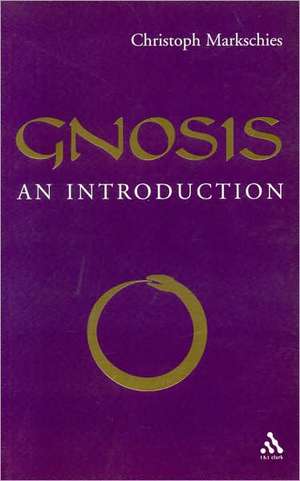
Gnosis: An Introduction
Autor Christoph Markschiesen Limba Engleză Paperback – iul 2003
Preț: 368.74 lei
Preț vechi: 513.18 lei
-28%
Puncte Express: 553
Carte tipărită la comandă
Livrare economică 27 noiembrie-11 decembrie
Livrare prin curier în România Termenul estimat este afișat lângă disponibilitate.
Transport gratuit de la 400.00 lei Plată online sau ramburs, în funcție de opțiunile comenzii.
Retur gratuit în 14 zile Comandă securizată și suport în română.
Specificații
ISBN-13: 9780567089458
ISBN-10: 0567089452
Pagini: 158
Ilustrații: chronology, bibliography, index
Dimensiuni: 140 x 216 x 9 mm
Greutate: 0.22 kg
Editura: Bloomsbury Publishing
Colecția T&T Clark
Locul publicării:London, United Kingdom
ISBN-10: 0567089452
Pagini: 158
Ilustrații: chronology, bibliography, index
Dimensiuni: 140 x 216 x 9 mm
Greutate: 0.22 kg
Editura: Bloomsbury Publishing
Colecția T&T Clark
Locul publicării:London, United Kingdom
V-ar putea interesa
-
 The Nag Hammadi ScripturesMarvin W. MeyerPreț: 195.69 lei
 -
 The Gnostic ReligionHans JonasPreț: 232.83 lei
 -
 Rabbi, Tell Me...Peter FerraroPreț: 75.18 lei
 -
 The Gnostic BibleMarvin Meyer-28%Preț: 254.37 lei355.74 lei
 -
 Preț: 129.10 lei
 -
 Invest Your HumanityDaniele C. StruppaPreț: 150.11 lei
 -
 Evagrius's Kephalaia GnostikaIlaria L. E. RamelliPreț: 477.74 lei
 -
 The Secret History of the GnosticsAndrew Philip SmithPreț: 93.74 lei
 -
 The Gnostic GospelsAlan JacobsPreț: 73.18 lei
 -
 The Esoteric Teachings of the GnosticsFrances SwineyPreț: 92.41 lei
 -
 Christ and the Virgin: The Forgotten Purpose of ChristianitySamael Aun WeorPreț: 52.53 lei
 -
 Preț: 165.60 lei
 -
 Alta Trinita BeataChristoph Markschies-19%Preț: 551.83 lei681.26 lei
 -
 Erinnerungsorte des ChristentumsChristoph MarkschiesPreț: 223.70 lei
Cuprins
Introduction: Definition of Gnosis, its relationship to 'Gnosticism'.
Chapter II: The sources, ancient authors (from Irenaeus to Epiphanius), heresologists (Justin and Tertullian), Gnostic original text (the Nag Hammadi material) and non-'Gnostic' texts (the Hermetic Writings and the Hekhalot literature).
Chapter III: Early forms of 'Gnosis' in antiquity: Jewish, New Testament, and early representatives (Simon Magus and Basilides).
Chapter IV: Marcion and the Marcionites, Valentinus and Valentinians and the 'Barbelo Gnostics'.
Chapter V: Manichaeism as the culmination and end-point of Gnosis.
Chapter VI: Ancient communities of 'Gnostics'.
Chapter VII: 'Gnosis' in antiquity and the present.Index
Chapter II: The sources, ancient authors (from Irenaeus to Epiphanius), heresologists (Justin and Tertullian), Gnostic original text (the Nag Hammadi material) and non-'Gnostic' texts (the Hermetic Writings and the Hekhalot literature).
Chapter III: Early forms of 'Gnosis' in antiquity: Jewish, New Testament, and early representatives (Simon Magus and Basilides).
Chapter IV: Marcion and the Marcionites, Valentinus and Valentinians and the 'Barbelo Gnostics'.
Chapter V: Manichaeism as the culmination and end-point of Gnosis.
Chapter VI: Ancient communities of 'Gnostics'.
Chapter VII: 'Gnosis' in antiquity and the present.Index
Recenzii
'Christoph Markschies, now professor at Heidelberg, is the scholar of the rising generation who looks most likely to become one of the internationally known figures in the scholarship of early Christianity. His Between Two Worlds, published by SCM Press, is a fascinating introduction to the social practices of early Christians. He combines great clarity of writing with immense learning. In 128 pages there is everything the reader needs to know, along with where to look for further information. If ever a book was worth translating this is: it would be ideal for schools, university and theological students and clergy in length, approach and everything else.' - John Bowden
"I agree with the blurbs on the back of this book. Maurice Wiles finds that the Gnostics presented here are neither bizarre eccentrics nor evil enemies of the Christianity, but rather credible participants in ancient dialogue about meaningful Christiantiy. Gerd Theissen lauds the book as an introduction to an ancient movement and a balanced summary of recent scholarship on that movement. I too recomment this book to anyone interested in early Christian history and ancient intellectual history."-Catholic Book Reviews Online, January 2004
"I agree with the blurbs on the back of this book. Maurice Wiles finds that the Gnostics presented here are neither bizarre eccentrics nor evil enemies of the Christianity, but rather credible participants in ancient dialogue about meaningful Christiantiy. Gerd Theissen lauds the book as an introduction to an ancient movement and a balanced summary of recent scholarship on that movement. I too recomment this book to anyone interested in early Christian history and ancient intellectual history."-Catholic Book Reviews Online, January 2004