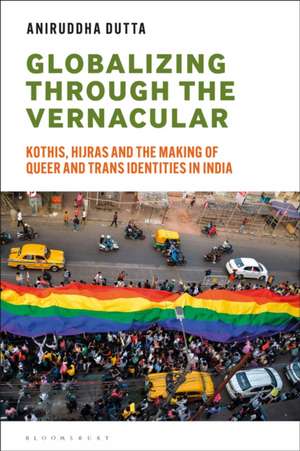
Globalizing through the Vernacular: Kothis, Hijras, and the Making of Queer and Trans Identities in India
Autor Aniruddha Duttaen Limba Engleză Hardback – 9 ian 2025
Based on long-term ethnographic fieldwork, the book demonstrates that non-elite groups facilitate the transregional expansion of organized queer politics and become more consolidated as gender/sexual identities in the process. Yet, they often remain irreducible to emerging identity categories and become subordinated through hierarchies of scale and language that serve to contain such communities and related discourses as local and vernacular. The book shows how this process, in effect, denies them an equal role in transnational LGBT politics; reinforces class/caste hierarchies within and beyond queer communities; and delegitimizes or erases articulations of gender/sexual difference that contravene dominant understandings of gender/sexual identity aligned with transnational capitalism, liberalism, or nationalism. Simultaneously, it reveals how non-elite communities rearticulate dominant identity categories in more equal, liberatory ways.
The ebook editions of this book are available open access under a CC BY-NC-ND 4.0 licence on bloomsburycollections.com. This book was made possible with generous support from the University of Iowa's Office of the Vice President for Research and College of Liberal Arts and Sciences.
Preț: 552.03 lei
Preț vechi: 818.36 lei
-33%
Puncte Express: 828
Carte tipărită la comandă
Livrare economică 08-22 decembrie
Livrare prin curier în România Termenul estimat este afișat lângă disponibilitate.
Transport gratuit pentru acest produs Plată online sau ramburs, în funcție de opțiunile comenzii.
Retur gratuit în 14 zile Comandă securizată și suport în română.
Specificații
ISBN-13: 9781350382770
ISBN-10: 1350382779
Pagini: 240
Dimensiuni: 155 x 234 x 20 mm
Greutate: 0.54 kg
Editura: Bloomsbury Publishing
Colecția Bloomsbury Academic
Locul publicării:London, United Kingdom
ISBN-10: 1350382779
Pagini: 240
Dimensiuni: 155 x 234 x 20 mm
Greutate: 0.54 kg
Editura: Bloomsbury Publishing
Colecția Bloomsbury Academic
Locul publicării:London, United Kingdom
Cuprins
List of Figures
List of Maps
List of Tables
Acknowledgements
List of Abbreviations
Introduction: Toward a Theory of Vernacularization
1. The Scalar Emergence of the Hijra
2. Kothi and the Cartography of MSM
3. Vernacularization and Non/Linear Gender Among Kothis
4. Rupantarkami Narratives and the Attempted Standardization of Trans Interiority
5. Refashioning Transgender: Pluralization and Re-Vernacularization
6. Cis/Trans Divides and the Partial Erasure of the Kothi
Afterword: Afterlives of the Vernacluarized
Notes
Glossary
References
Index
List of Maps
List of Tables
Acknowledgements
List of Abbreviations
Introduction: Toward a Theory of Vernacularization
1. The Scalar Emergence of the Hijra
2. Kothi and the Cartography of MSM
3. Vernacularization and Non/Linear Gender Among Kothis
4. Rupantarkami Narratives and the Attempted Standardization of Trans Interiority
5. Refashioning Transgender: Pluralization and Re-Vernacularization
6. Cis/Trans Divides and the Partial Erasure of the Kothi
Afterword: Afterlives of the Vernacluarized
Notes
Glossary
References
Index
Recenzii
A rich and theoretically nuanced ethnography of non-metropolitan "vernacular" queer/trans categories in relation to dominant LGBT representation in India, Dutta's long-awaited book pushes the envelope of queer/trans studies in India and beyond by highlighting and problematizing recursive hierarchies of language and scale, legibility and legitimacy produced in their wake.
Aniruddha Dutta's book based on several years of painstaking fieldwork is a theoretically strong and empirically rich work analysing non elite and non-metropolitan LGBT communities and identities in India. It excellently provides a critical counter narrative to the globalising discourse around queer identities and rights in neoliberal India.
A paradigm-shifting, timely, and long overdue study. Recasting the analytical purchase of vernacularization, Dutta issues a major intervention in debates around scalar, linguistic, and epistemic hierarchies. By bridging vertical and horizontal traffics of transness, Globalizing through the Vernacular refutes a romanticized idea of cultural authenticity as much as the unidirectional burden of globalization. This book, replete with compelling ethnographic insights, constitutes a major blow to (queer) theory's stubborn unwillingness to register the power of geopolitical fault lines.
Engaging linguistic, transnational feminist, and gender studies frames, Dutta realigns "vernacularization" and forces us to rethink the term as well as the hierarchies, linguistic and social, that the term signifies. This is the first time that a text has so thoroughly mapped the tensions between elite, dominant, class-based discourses onto the rawness of lived experiences of non-elite expressions of sexuality, identity, and sexual politics. Dutta's writing takes us on a journey of true understanding of the complexity of the way politics of sexuality works in India. Using the frame of venacularization, Dutta shows ways in which voices and discourses of non-dominant LGBTQIA communities are muffled and, in this process, also shows how these communities offer pushback. This is a truly thrilling text.
Globalizing through the Vernacular is a fascinating, deeply nuanced investigation of how gender minority communities across urban and rural India navigate the tensions between local experience, national political representation, and transnational funding streams as they fight for health, safety, and justice. Drawing on nearly 15 years of community-embedded fieldwork, Aniruddha Dutta offers an unprecedented view into quotidian life among hijras, kothis, and dhuranis, and a rich portrait of how the everyday has transformed since the global emergence of transgender rights. Globalizing through the Vernacular is a much-need contribution to the field of transgender studies that establishes Dutta as one of the field's most insightful thinkers.
Globalizing through the vernacular is essential reading for anyone seeking to re-understand gender and sexual variance beyond the urban LGBTQ identities in India today. Theoretically informed and empirically rich, this book is an indispensable addition to the growing body of critical scholarship on gender and sexual diversity in India and beyond.
Dutta's book challenges linear models of globalization and identity formations, instead underscoring a complex interplay of translation, hierarchy, and resistance. Globalizing through the Vernacular thus offers readers a major contribution to queer and trans studies, South Asian studies, class and caste studies, and language by giving us contemporary philology of trans/nonbinary bodies of India.
Aniruddha Dutta's book based on several years of painstaking fieldwork is a theoretically strong and empirically rich work analysing non elite and non-metropolitan LGBT communities and identities in India. It excellently provides a critical counter narrative to the globalising discourse around queer identities and rights in neoliberal India.
A paradigm-shifting, timely, and long overdue study. Recasting the analytical purchase of vernacularization, Dutta issues a major intervention in debates around scalar, linguistic, and epistemic hierarchies. By bridging vertical and horizontal traffics of transness, Globalizing through the Vernacular refutes a romanticized idea of cultural authenticity as much as the unidirectional burden of globalization. This book, replete with compelling ethnographic insights, constitutes a major blow to (queer) theory's stubborn unwillingness to register the power of geopolitical fault lines.
Engaging linguistic, transnational feminist, and gender studies frames, Dutta realigns "vernacularization" and forces us to rethink the term as well as the hierarchies, linguistic and social, that the term signifies. This is the first time that a text has so thoroughly mapped the tensions between elite, dominant, class-based discourses onto the rawness of lived experiences of non-elite expressions of sexuality, identity, and sexual politics. Dutta's writing takes us on a journey of true understanding of the complexity of the way politics of sexuality works in India. Using the frame of venacularization, Dutta shows ways in which voices and discourses of non-dominant LGBTQIA communities are muffled and, in this process, also shows how these communities offer pushback. This is a truly thrilling text.
Globalizing through the Vernacular is a fascinating, deeply nuanced investigation of how gender minority communities across urban and rural India navigate the tensions between local experience, national political representation, and transnational funding streams as they fight for health, safety, and justice. Drawing on nearly 15 years of community-embedded fieldwork, Aniruddha Dutta offers an unprecedented view into quotidian life among hijras, kothis, and dhuranis, and a rich portrait of how the everyday has transformed since the global emergence of transgender rights. Globalizing through the Vernacular is a much-need contribution to the field of transgender studies that establishes Dutta as one of the field's most insightful thinkers.
Globalizing through the vernacular is essential reading for anyone seeking to re-understand gender and sexual variance beyond the urban LGBTQ identities in India today. Theoretically informed and empirically rich, this book is an indispensable addition to the growing body of critical scholarship on gender and sexual diversity in India and beyond.
Dutta's book challenges linear models of globalization and identity formations, instead underscoring a complex interplay of translation, hierarchy, and resistance. Globalizing through the Vernacular thus offers readers a major contribution to queer and trans studies, South Asian studies, class and caste studies, and language by giving us contemporary philology of trans/nonbinary bodies of India.
Notă biografică
Aniruddha Dutta is Associate Professor at University of Iowa, USA.