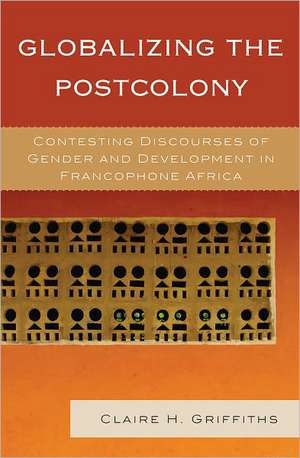
Globalizing the Postcolony: Contesting Discourses of Gender and Development in Francophone Africa: After the Empire: The Francophone World and Postcolonial France
Autor Claire H. Griffithsen Limba Engleză Hardback – 18 dec 2010
This study analyzes current thinking on the challenges facing gender and development in Africa, before moving on to examine the historical factors marking the gender and development profile of the francophone West African region. Through an analysis of gender politics in the region from pre-colonial to postcolonial times, the book examines the gradual incursion of exogenous gender policies into the region throughout the 20th century. The discussion concludes by arguing that despite the tendency of the international community, and their colonial administrative forebears, to pursue 'one-size-fits-all' solutions to what they identified as the main development challenges of the day, the impact of standardized solutions remains subject to the unique historical and cultural context in which they are implemented. Adapting formula-driven policies to unique cultural contexts constitutes a major challenge for gender and development politics in the second decade of the new century.
Meanwhile, the book coincides with the introduction of a new international development agenda in Africa articulated around issues of security and globalization. While civil unrest continues to destabilize vast regions of the continent making the prospe
Din seria After the Empire: The Francophone World and Postcolonial France
- 34%
 Preț: 563.78 lei
 - 22%
 Preț: 328.34 lei
 - 34%
 Preț: 767.93 lei
 - 34%
 Preț: 551.44 lei
 - 34%
 Preț: 565.02 lei
 - 23%
 Preț: 326.64 lei
 - 31%
 Preț: 480.20 lei
 - 22%
 Preț: 294.99 lei
 - 34%
 Preț: 564.61 lei
 - 23%
 Preț: 319.28 lei
 - 23%
 Preț: 326.05 lei
 - 34%
 Preț: 539.37 lei
 - 23%
 Preț: 304.83 lei
 - 14%
 Preț: 602.27 lei
 - 23%
 Preț: 304.94 lei
 - 18%
 Preț: 691.97 lei
 - 34%
 Preț: 563.86 lei
 - 32%
 Preț: 503.02 lei
 - 34%
 Preț: 564.36 lei
 - 34%
 Preț: 645.12 lei
 - 22%
 Preț: 329.07 lei
 - 23%
 Preț: 325.19 lei
 - 31%
 Preț: 533.22 lei
 - 34%
 Preț: 564.77 lei
 - 34%
 Preț: 565.41 lei
 - 22%
 Preț: 307.00 lei
 - 28%
 Preț: 562.94 lei
 - 22%
 Preț: 309.89 lei
 - 34%
 Preț: 565.02 lei
 - 23%
 Preț: 305.14 lei
 - 23%
 Preț: 326.64 lei
 - 23%
 Preț: 303.49 lei
 - 22%
 Preț: 310.87 lei
 - 23%
 Preț: 305.24 lei
 - 23%
 Preț: 327.21 lei
 - 23%
 Preț: 290.69 lei
 - 34%
 Preț: 540.20 lei
 - 23%
 Preț: 325.29 lei
 - 23%
 Preț: 318.88 lei
Preț: 706.73 lei
Preț vechi: 1067.76 lei
-34%
Puncte Express: 1060
Preț estimativ în valută:
125.07€ • 146.17$ • 108.59£
125.07€ • 146.17$ • 108.59£
Carte tipărită la comandă
Livrare economică 20 februarie-06 martie
Preluare comenzi: 021 569.72.76
Specificații
ISBN-13: 9780739143827
ISBN-10: 0739143824
Pagini: 323
Dimensiuni: 163 x 239 x 27 mm
Greutate: 0.67 kg
Editura: Bloomsbury Publishing
Colecția Lexington Books
Seria After the Empire: The Francophone World and Postcolonial France
Locul publicării:New York, United States
ISBN-10: 0739143824
Pagini: 323
Dimensiuni: 163 x 239 x 27 mm
Greutate: 0.67 kg
Editura: Bloomsbury Publishing
Colecția Lexington Books
Seria After the Empire: The Francophone World and Postcolonial France
Locul publicării:New York, United States
Cuprins
Part 1 Part One: Is There a Gender and Development Crisis in Francophone Africa?
Chapter 2 Chapter One: Gender and Development in Francophone Africa: The Making of a Crisis
Chapter 3 Chapter Two: Science, Statistics, & Stories: In Search of Methodology
Part 4 Part Two: When Gender and Development Went Global
Chapter 5 Chapter Three: The Origins of a Global Discourse, 1945 to1990
Chapter 6 Chapter Four: 'Good Governance' for Development, 1990-2000
Chapter 7 Chapter Five: The Millennium Summit and Beyond: Writing Women out of Development?
Part 8 Part Three: From the Global to the Postcolony: Data Profiling in Gabon and Senegal
Chapter 9 Chapter Six: Mapping Gender and Development: The Tools of the Trade
Chapter 10 Chapter Seven: Senegal: A Monitoring Model for Francophone Africa?
Chapter 11 Chapter Eight: Gabon: At the Limits of the Data Profile
Chapter 12 Chapter Nine: Measuring Gender and Development: Challenges for Francophone Africa
Part 13 Part Four: In Search of Context and Culture 1: Historicizing Gender
Chapter 14 Chapter Ten: Sex and Status in Pre-colonial Africa
Chapter 15 Chapter Eleven: Engendering the Colony: France in Africa
Part 16 Part Five: In Search of Context and Culture : Locating Gender
Chapter 17 Chapter Twelve: Speaking the Language of Gender and Development in Senegal
Chapter 18 Chapter Thirteen: International Agencies and the Agenda for Change in Senegal
Chapter 19 Chapter Fourteen: Theorizing Gender and Development in the Academy
Chapter 20 Chapter Fifteen: Voicing Dissent and Contesting Change in Civil Society
Part 21 Part Six: Writing Gender and Development: Culture, Context, and Change in Francophone Africa
Chapter 22 Chapter Sixteen: The Literary Politics of Gender and Development
Chapter 23 Chapter Seventeen: Writing Gender and Development: the Birth of a Literary Voice
Chapter 24 Chapter Eighteen: Modernization and Marginalization in the Francophone African Feminist Novel
Part 25 Conclusions
Chapter 26 Chapter Nineteen: Harnessing Culture for Gender and Development
Chapter 2 Chapter One: Gender and Development in Francophone Africa: The Making of a Crisis
Chapter 3 Chapter Two: Science, Statistics, & Stories: In Search of Methodology
Part 4 Part Two: When Gender and Development Went Global
Chapter 5 Chapter Three: The Origins of a Global Discourse, 1945 to1990
Chapter 6 Chapter Four: 'Good Governance' for Development, 1990-2000
Chapter 7 Chapter Five: The Millennium Summit and Beyond: Writing Women out of Development?
Part 8 Part Three: From the Global to the Postcolony: Data Profiling in Gabon and Senegal
Chapter 9 Chapter Six: Mapping Gender and Development: The Tools of the Trade
Chapter 10 Chapter Seven: Senegal: A Monitoring Model for Francophone Africa?
Chapter 11 Chapter Eight: Gabon: At the Limits of the Data Profile
Chapter 12 Chapter Nine: Measuring Gender and Development: Challenges for Francophone Africa
Part 13 Part Four: In Search of Context and Culture 1: Historicizing Gender
Chapter 14 Chapter Ten: Sex and Status in Pre-colonial Africa
Chapter 15 Chapter Eleven: Engendering the Colony: France in Africa
Part 16 Part Five: In Search of Context and Culture : Locating Gender
Chapter 17 Chapter Twelve: Speaking the Language of Gender and Development in Senegal
Chapter 18 Chapter Thirteen: International Agencies and the Agenda for Change in Senegal
Chapter 19 Chapter Fourteen: Theorizing Gender and Development in the Academy
Chapter 20 Chapter Fifteen: Voicing Dissent and Contesting Change in Civil Society
Part 21 Part Six: Writing Gender and Development: Culture, Context, and Change in Francophone Africa
Chapter 22 Chapter Sixteen: The Literary Politics of Gender and Development
Chapter 23 Chapter Seventeen: Writing Gender and Development: the Birth of a Literary Voice
Chapter 24 Chapter Eighteen: Modernization and Marginalization in the Francophone African Feminist Novel
Part 25 Conclusions
Chapter 26 Chapter Nineteen: Harnessing Culture for Gender and Development
Recenzii
A triumph of detailed and sound research, Claire H. Griffith's Globalizing the Postcolony. Contesting Discourses of Gender and Development in Francophone Africa is a wonderful resource for anyone interested in issues concerning the intersection of gender and development. Whether analyzing these issues in Senegal or Gabon, her two case studies, Griffith's book is an impeccably reasoned and convincing argument on how the discourses and policies of development evolved within Francophone Africa with the influx of globalizing interventions, and the impact they have on women's lives. Using a variety of sources contextualized in history, Globalizing the Postcolony is careful to take local cultures into account. One standout innovation is Griffith's ability to push critical theories to their limits by daring to make aesthetic/subjective analyses from creative narrative accounts of politically engaged women novelists. The quantitative aspects of the book are rendered through analyses, tables and graphs, but the qualitative considerations attained through literary texts hold an equally important place-thus providing a fully integrated critical approach that revitalizes the debate. With enlightening and original conclusions, Globalizing the Postco
This timely book provides a subtle discussion on gender and development in francophone sub-Saharan Africa from the end of the Second World War up to the present day. In this meticulously researched monograph Claire Griffiths explores the UN-driven agenda to develop conceptual models, which are, it is argued here, too monolingual and universalizing to bridge the gender gap between the Western rich center and its impoverished peripheries. The novelty of the author's approach and methodology lies in the fact that the traditional tools of sociological enquiries are not so much dismissed as challenged in their ability to produce reliable results and redress gender inequalities. With this challenging study, Professor Griffiths has provided an invaluable service to policymakers and students of Francophone Africa.
This timely book provides a subtle discussion on gender and development in francophone sub-Saharan Africa from the end of the Second World War up to the present day. In this meticulously researched monograph Claire Griffiths explores the UN-driven agenda to develop conceptual models, which are, it is argued here, too monolingual and universalizing to bridge the gender gap between the Western rich center and its impoverished peripheries. The novelty of the author's approach and methodology lies in the fact that the traditional tools of sociological enquiries are not so much dismissed as challenged in their ability to produce reliable results and redress gender inequalities. With this challenging study, Professor Griffiths has provided an invaluable service to policymakers and students of Francophone Africa.